· ReadyStack
Worked example
Real numbers from this tool, line by line.
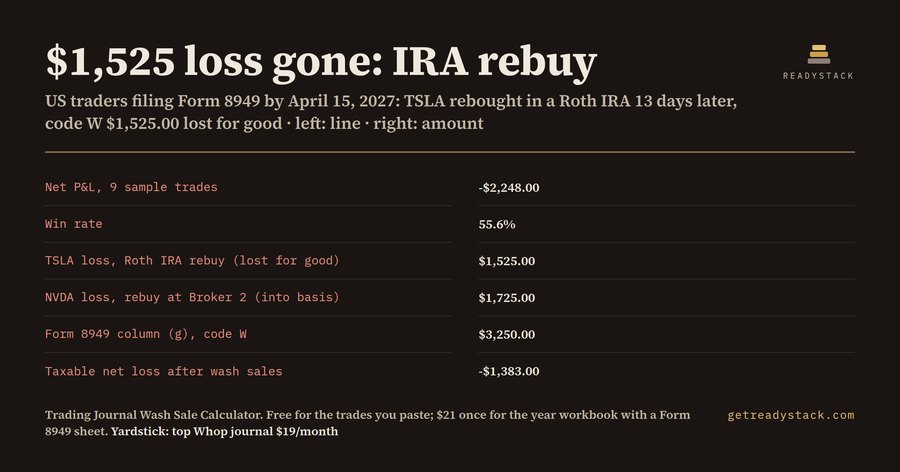
You sold TSLA at a loss in January, and thirteen days later you bought it back in your Roth IRA. Your broker's 1099-B will not show any problem. The IRS rules say that loss is gone, permanently.
This is the wash-sale rule, and most retail traders meet it through their own trades, not through tax law. IRC §1091(a) disallows a loss on stock or securities when you acquire substantially identical stock within a window that starts 30 days before the sale and ends 30 days after it. Usually the loss is only postponed: §1091(d) adds it to the basis of the new shares, and you get it back when you sell those. IRS Publication 550 lists the exception that hurts. If the rebuy happens in your IRA or Roth IRA, the disallowed loss is not added to any basis. It is simply lost.
Why doesn't the broker catch it? Treasury Regulation §1.6045-1(d)(6)(iii)(A) only requires a broker to apply the wash-sale rule when the sale and the purchase have the same CUSIP in the same account. A rebuy at a second broker, in your IRA, or in your spouse's account never reaches box 1g of the 1099-B. The Form 8949 instructions are clear about whose job the fix is: if the nondeductible wash-sale amount on your 1099-B is wrong, you enter the correct amount as a positive number in column (g) with code W.
Here is what that looks like with real numbers. Take nine sample trades from January to April 2026, the ones preloaded in our free journal page. The journal view first: net P&L across all accounts is -$2,248.00, the win rate is 55.6% (5 of 9), the average win is $585.00 and the average loss is -$1,293.25.
Now the tax view. Two loss sales had a rebuy of the same ticker within 30 days in another account. TSLA: 50 shares sold on 2026-01-21 for a $1,525.00 loss, then 50 shares bought in a Roth IRA on 2026-02-03. Code W amount: $1,525.00, lost for good. NVDA: 200 shares sold on 2026-02-10 for a $2,300.00 loss, then 150 shares bought at a second broker on 2026-02-20. Code W amount: $1,725.00, which moves into the basis of those 150 shares. Column (g) totals $3,250.00. With the replacement basis adjusted, the taxable result for the year is a net loss of -$1,383.00, and all of it is deductible under the §1211(b) cap of $3,000.
Change one fact and the answer changes. Drop the IRA trade, file married filing separately, and the cap falls to $1,500. The taxable loss becomes -$2,908.00, you deduct $1,500.00 this year, and $1,408.00 carries over.
Our free page does all of this in your browser. Paste your closed trades, one per line with a header row. You can use our columns (close date, ticker, account, side, quantity, open date, entry, exit, fees, risk) or a broker realized-gain export with Date Sold, Symbol, Quantity, Date Acquired, Proceeds and Cost Basis. Add open positions with an empty close date so their buys count as rebuys. You get net P&L, win rate, average win and loss, average R, a monthly table, every wash-sale match with the account it came from, the code W amount, what is lost to an IRA rebuy, and the cap and carryover. Nothing is uploaded.
The page has limits. It matches rebuys of the same ticker and does not judge whether two different securities are substantially identical. It is a calculation aid, not tax advice.
The 2026 Form 8949 is due with your return on April 15, 2027. Before then, paste your year, then compare the column (g) total with box 1g on each 1099-B. Where your number is higher, the gap is your cross-account and IRA rebuys, and it is yours to report.
15 seconds — what it actually does
Questions people ask
What does this trading journal do?
You paste your closed trades from a broker CSV. It shows net P&L, win rate, average win and loss, and P&L by month. It also flags every loss sale with a rebuy of the same ticker within 30 days before or after in any account. For each one it gives the Form 8949 code W amount for column (g).
Who is it for?
US day and swing traders who trade the same ticker in more than one account: a taxable account plus an IRA, two brokers, or a spouse's account. Your 1099-B only catches same-CUSIP rebuys in the same account. Rebuys in another account are yours to find and report on the 2026 Form 8949, due April 15, 2027.
Why not just trust the 1099-B or a free journal?
Under Treas. Reg. §1.6045-1(d)(6)(iii)(A), brokers apply the wash-sale rule only when the sale and the rebuy share the same CUSIP in the same account. A rebuy at another broker or in your IRA does not show in box 1g. Free journals track P&L but do not match trades across accounts for IRC §1091.
What is free and what is paid?
Free, in your browser: paste trades, then read P&L, win rate, monthly P&L, wash-sale flags with code W amounts, and the $3,000 loss cap with carryover. Nothing is uploaded. Paid is the Excel workbook that keeps the whole year: a 500-row log, a 12-month table, flags on every row, and a Form 8949-layout sheet. It is one payment.
How does the cost compare?
The top trading-journal seller on Whop charges $19 a month, which is $228 a year, and has no wash-sale or Form 8949 layer. BLS OEWS 2025 puts the median accountant wage at $40.23 an hour. This workbook is one $21 payment that you keep and reuse each tax year.
What does the worked example show?
Worked example, 9 sample trades: net P&L -$2,248.00, win rate 55.6% (5 of 9). TSLA sold at a loss on 2026-01-21 and rebought in a Roth IRA on 2026-02-03: $1,525.00 code W, lost for good. NVDA loss of $2,300.00 on 2026-02-10, 150 of 200 shares rebought at a second broker on 2026-02-20: $1,725.00 code W, added to the new basis. Column (g) total $3,250.00; taxable net loss after wash sales -$1,383.00.
Ask about this tool
One question, answered by the person who built it. Your email only if you want the answer sent.