· ReadyStack
Worked example
Real numbers from this tool, line by line.
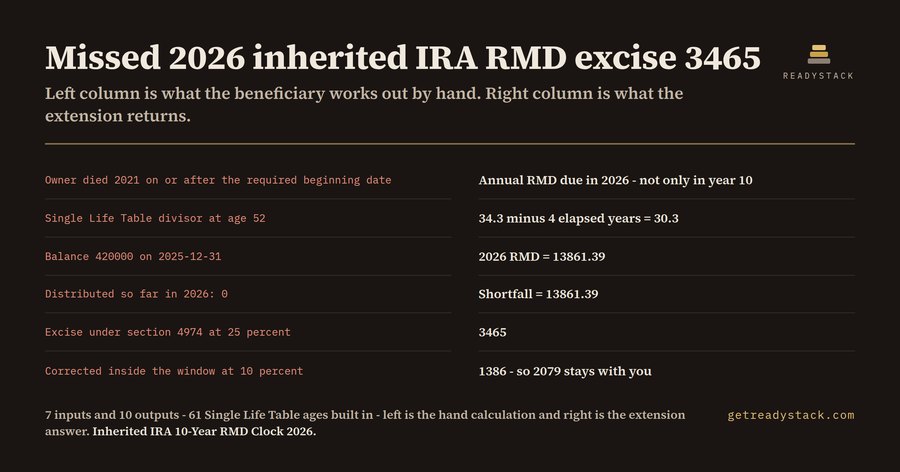
A 420000 inherited IRA left by an owner who died in 2021 owes 13861.39 before 2026-12-31, and a US non-spouse beneficiary who misses it pays a 3465 excise on top. That is the whole of the change most people have not noticed: the years when nobody had to take an annual distribution inside the 10-year window are over.
The IRS finalised the SECURE Act distribution regulations on 2024-07-19. They settled a question that had been open since 2020: when the original owner died on or after their required beginning date, a non-spouse designated beneficiary must take an annual required minimum distribution in years one through nine of the 10-year window, and still empty the account by the end of year ten. The IRS had waived the excise for the 2021 to 2024 tax years while the rules were being finalised. Those waivers are exhausted. 2025 was the first live year.
Run the default case in the extension and you can watch it assemble. The owner died in 2021, so the first distribution year is 2022 and the account must be empty by 2031-12-31. The beneficiary was 52 in 2022, which is a Single Life Table divisor of 34.3. The subtract-one method takes one off for each year that has passed, and four years have passed, so the 2026 divisor is 30.3. The balance on 2025-12-31 was 420000. Divide and the 2026 RMD is 13861.39.
Now the part that costs money. Section 4974 charges an excise on the shortfall. Nothing has been distributed in this case, so the shortfall is the whole 13861.39 and the excise at 25 percent is 3465. SECURE 2.0 added a correction window: fix the shortfall and file Form 5329 inside it and the rate drops to 10 percent, which is 1386. The difference, 2079, is the entire reason to know the number before 2026-12-31 rather than at filing time. For a shortfall that arises in 2026 the correction window runs to 2028-12-31.
Change one input and the answer changes completely. Tell the extension the owner died before their required beginning date and the annual RMD disappears: there is no yearly distribution at all, the shortfall is zero, the excise is zero, and the only date that matters is still 2031-12-31. This is the single fork that free calculators and general chatbots get wrong most often.
An owner who died in 2023 leaving 900000 to a beneficiary who was 38 in 2024 has a divisor of 45.7, a 2026 RMD of 19693.65, an excise of 4923, and an account that must be empty by 2033-12-31. Check it on 2026-12-01 and there are 30 days left.
Why not just ask a chatbot. Because the pre-2024 answer, that the 10-year rule requires no annual distributions, was correct for four tax years and is now wrong, and it is still the answer that comes back most often. A calculator that has not been updated since the final regulations returns a zero exactly where the excise is 25 percent of the shortfall.
The extension carries all 61 Single Life Table entries for ages 25 to 85, applies the subtract-one method, and returns ten outputs: whether a 2026 RMD is due, the divisor, the RMD, the shortfall, the excise at 25 percent, the excise at 10 percent, the amount kept by correcting in time, the empty-by date, the days left, and the correction deadline.
The free layer finishes the job for one beneficiary, with no key and no limit. The licence key adds a different axis: it exports every beneficiary you check, with inputs and all ten outputs, to a dated .csv you keep, and sets browser alarms ahead of 2026-12-31 and 2028-12-31. A US CPA hour for individual tax work runs about 150 to 400 USD, and a missed-RMD cleanup is usually billed as its own engagement.
Questions people ask
What does this extension actually do?
It answers one question for an inherited IRA: is an annual required minimum distribution due in 2026 inside the 10-year window, and what does missing it cost? You enter the death year, your age in the year after death and the 2025-12-31 balance, and it returns the divisor, the RMD, the shortfall and the excise.
Who is it for?
US non-spouse beneficiaries who inherited a traditional IRA in 2020 or later and are inside the 10-year window, plus the CPAs, enrolled agents and advisors who have to sign Form 5329 for them. It is built for the case where the original owner had already started taking distributions.
Why not just ask a chatbot or use a free calculator?
Most free calculators and most general chatbots still answer that the 10-year rule needs no annual distributions. That was true only under the 2021 to 2024 penalty waivers. The July 2024 final regulations require annual RMDs in years one through nine when the owner died on or after the required beginning date.
What is free and what needs the licence key?
Every calculation is free and unlimited: the ten outputs are whether a 2026 RMD is due, the divisor, the RMD, the shortfall, the 25 percent excise, the 10 percent excise, the amount kept, the empty-by date, the days left and the correction deadline. The key adds CSV export and browser deadline alarms.
What would this cost me otherwise?
A US CPA hour for individual tax work runs about 150 to 400 dollars, and a missed-RMD cleanup is usually billed as its own engagement on top of the return. The excise itself is 25 percent of the shortfall, which on a 420000 dollar inherited balance is over 3000 dollars in one year.
Ask about this tool
One question, answered by the person who built it. Your email only if you want the answer sent.