· ReadyStack
Worked example
Real numbers from this tool, line by line.
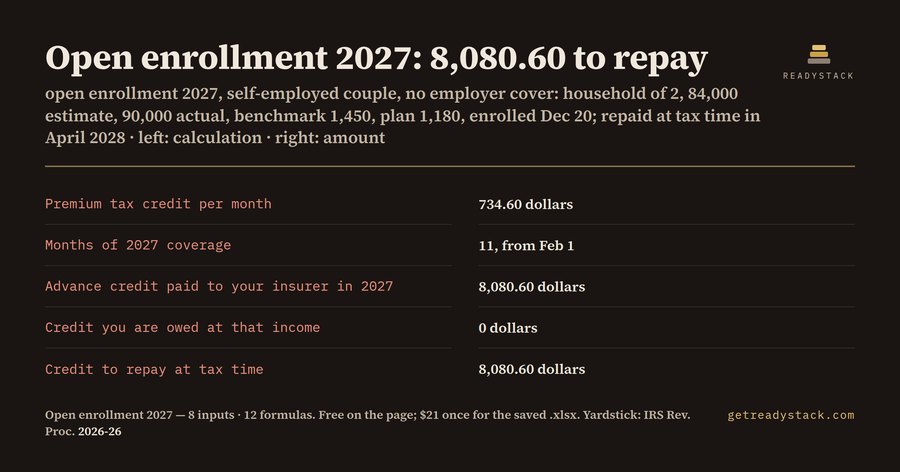
A self-employed couple in the US who estimated 84,000 dollars for 2027, enrolled on December 20 and then earned 90,000 dollars will repay 8,080.60 dollars of premium tax credit at tax time. Here is the whole calculation, line by line, with the 2027 rules:
| Line | Value |
|---|---|
| Poverty line for a household of 2 (2026 HHS guideline) | 21,640 dollars |
| 84,000 as % of the poverty line | 388.17% |
| 2027 applicable percentage (IRS Rev. Proc. 2026-26) | 10.22% |
| Expected contribution for 2027 | 8,584.80 dollars |
| Premium tax credit per month (benchmark 1,450) | 734.60 dollars |
| Coverage start (enrolled Dec 20) | Feb 1, 2027, 11 months |
| Advance credit paid to the insurer | 8,080.60 dollars |
| Credit owed at 90,000 (415.9% of the poverty line) | 0 dollars |
| Credit to repay at tax time | 8,080.60 dollars |
Why the number is so large
Three 2027 rules stack on top of each other. First, the enhanced credits that ran from 2021 through 2025 were not renewed, so the original formula is back: the credit stops completely above 400% of the poverty line. For a household of two that line is 86,560 dollars (4 x 21,640). The couple's estimate of 84,000 sat 2,560 dollars under it. A 6,000 dollar invoice pushed them over.
Second, the expected contribution for 2027 is set by IRS Rev. Proc. 2026-26. The table runs from 2.15% below 133% of the poverty line to 10.22% from 300% to 400%. Between band edges it rises in a straight line: a single freelancer at 45,000 dollars pays 9.66%.
Third, the repayment caps are gone. The IRS lists the removal of those limits for tax years beginning after December 31, 2025 among the One Big Beautiful Bill Act changes (P.L. 119-21). For 2027 coverage, every dollar of advance credit that turns out to be too much comes back on your return.
The date matters too
HealthCare.gov sets the 2027 calendar. Open Enrollment starts November 1, 2026. December 15 is the last day to enroll or change plans for coverage that starts January 1, as long as you pay the first premium. If you enroll from December 16 to January 15, coverage starts February 1. After January 15 you need a Special Enrollment Period. The couple enrolled on December 20, so they had 11 months of coverage and no plan in January.
Three situations, three different answers
- Enrolled December 10, income stays at 84,000: coverage from January 1, 12 months of credit, 8,815.20 dollars paid in advance and 0 to repay.
- Enrolled December 20, income lands at 90,000: coverage from February 1, 8,080.60 paid in advance and all of it repaid.
- Single freelancer, 45,000 estimate, 50,000 actual, benchmark 620, plan 540: 257.75 dollars a month, 2,835.25 paid in advance, 699.42 to repay.
What the free page does and what the file adds
The page gives the complete check for free: credit per month, start month, advance credit for the year and the repayment at your what-if income. It runs in your browser. The .xlsx keeps the same formulas with your numbers saved and adds your net monthly premium and the income room left before the 400% cliff, so you can re-run it when a client pays late and report the change to the Marketplace before the year closes.
Before you enroll
Use the same income estimate on HealthCare.gov that you use here. If the room before the cliff is small, take a smaller advance credit. The Form 8962 tables round the poverty-line percentage to whole numbers, so your return can differ from this page by a few dollars.
15 seconds — what it actually does
Questions people ask
What does this open enrollment 2027 calculator do?
It takes your household size, 2027 income estimate, the benchmark silver premium and your plan's premium, then applies the IRS 2027 applicable percentage table (2.15% to 10.22%) to give your premium tax credit per month. It also tells you whether coverage starts January 1 or February 1 from your enrollment date, and what you repay at tax time if your income lands higher.
Who is this built for?
Self-employed people, freelancers, 1099 contractors and small-business owners in the US who have no employer coverage and buy a HealthCare.gov Marketplace plan for 2027. Your income moves during the year, so the estimate you give the Marketplace in November decides how much advance credit you take and how much you may owe back.
Why not just use the HealthCare.gov estimate?
The HealthCare.gov plan preview shows a credit for the income you type today. It does not show what happens if a late client payment pushes your 2027 income higher. Since tax year 2026 the repayment caps are gone, so every dollar of excess advance credit is repaid. This page puts that repayment next to the credit.
What is free and what is in the paid file?
The page is free and complete: one full 2027 check with your credit, coverage start month, advance credit paid and repayment at a what-if income. The paid .xlsx keeps the same 12 live formulas with your numbers saved, adds your net monthly premium and the income room left before the 400% cliff, and is yours to re-run all year.
What does getting this wrong cost?
For the example household of two with an 84,000 dollar estimate who enrolls on December 20, the advance credit is 8,080.60 dollars over 11 months. If 2027 income lands at 90,000 dollars, that is above 400% of the poverty line (86,560 dollars), the credit is zero and all 8,080.60 dollars is repaid at tax time.
When do these numbers change next?
December 15, 2026 is the last day to enroll for January 1 coverage, and Open Enrollment ends January 15, 2027 (HealthCare.gov). The IRS publishes the 2028 applicable percentage table in a revenue procedure each summer (the 2027 one was Rev. Proc. 2026-26, July 2026), and HHS publishes new poverty guidelines each January.
Ask about this tool
One question, answered by the person who built it. Your email only if you want the answer sent.