· ReadyStack
Worked example
Real numbers from this tool, line by line.
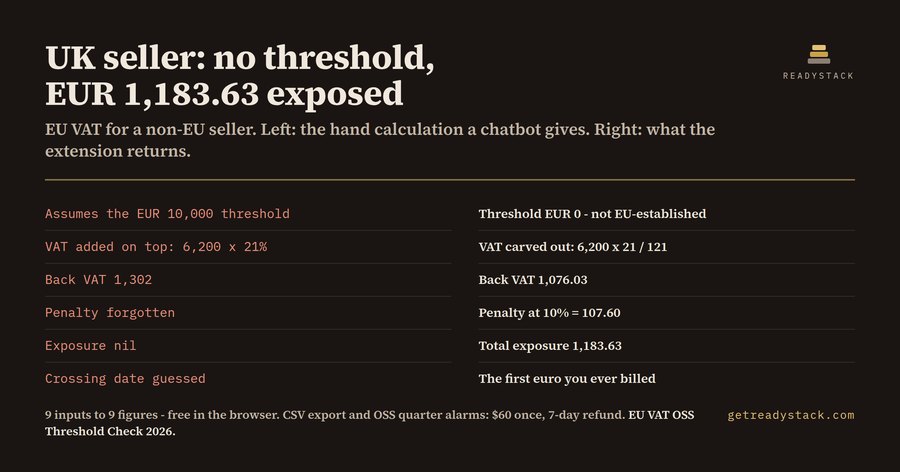
EUR 1,183.63 is what a UK Shopify seller with EUR 6,200 of digital sales to EU consumers is carrying today, and nearly every one of them believes the number is zero.
The belief comes from one line of law read a step too fast. Article 59c of the VAT Directive gives a EUR 10,000 EU-wide threshold to a supplier established in one member state and not established in any other. Brexit took UK sellers out of that sentence. A US seller was never in it. For them the threshold is EUR 0, and destination VAT is due on the first euro of B2C sales into the EU: a download, a course, a plugin licence, or goods in a consignment up to EUR 150.
Ask a general chatbot when you have to register for EU VAT and it hands back the EUR 10,000 line, because that is the sentence written most often on the web. It is correct for a seller in Dublin. It is the opposite of the rule for the seller in Manchester or Austin who is asking.
The second mistake costs money in the other direction. Sellers who do work it out reach for VAT added on top: 6,200 x 21% = 1,302. A tax office treats money you already took from a consumer as VAT-inclusive, so the figure is 6,200 x 21 / 121 = 1,076.03 - EUR 225.97 lower, about 17% of the bill. Add the penalty rate your own tax office applies, 10% in this example, and you get EUR 107.60 on top. Total exposure today: EUR 1,183.63.
Change one input and the answer changes completely, which is the point. Take an EU-established micro-seller instead: 8,400 EUR of EU sales so far, 1,800 EUR a month, eight months of the year sold, 19% average destination rate. Threshold 10,000 EUR. Untaxed base 0. Exposure 0. What the tool returns instead is a date - the line is crossed in September 2026, one month out. That seller does not need a bill, they need to register before the sale that breaks the threshold rather than after it.
Take a US seller shipping low-value goods who is already well past the line: 42,000 EUR sold, 5,000 EUR a month, eleven months in, 23% destination rate, 15% penalty rate. Back VAT 7,853.66 EUR, penalty 1,178.05 EUR, total exposure 9,031.71 EUR. Same nine inputs, an answer nearly eight times larger.
Two ticks take the number back to zero, and both are places where general advice gets it wrong in the seller's favour. If a marketplace is the deemed supplier on those sales - Amazon, Etsy, an app store - the platform accounts for the VAT and you do not. And if you are already registered for OSS or IOSS, the question stops being exposure and becomes rhythm: OSS returns are quarterly, and the Q4 2026 return is due 31 January 2027.
The tool itself is a browser extension, the same one zip on Chrome, Edge and Firefox, with a free web page that runs the identical calculation. Nine inputs go in, starting with where you are established. Nine figures come out: the threshold that is actually yours, the month you cross it, months until then, untaxed base, back VAT, penalty, total exposure, what the sales are counted as, and the next action in a sentence.
None of your figures leave the browser, and the calculation never asks for a key: free in the popup, free on the web page, no sign-up and no limit.
The $60 full version sits on a different axis - what you keep and what repeats. It downloads the worked result as a .csv row you can hand to an accountant, and it sets a browser alarm for each OSS quarter deadline, the last day of the month after each quarter. One licence key per person or team seat. A VAT adviser bills about $150/hour, and a cross-border threshold review is rarely one hour.
Questions people ask
What does this extension actually do?
It answers one question: which EU VAT threshold applies to your cross-border B2C sales, and what you owe if you have been selling without registering. Enter where your business is established, your year-to-date EU sales, your run rate and the average destination VAT rate, and it returns the threshold, the crossing month, the back VAT, the penalty and the total exposure.
Who is it for?
Shopify, Etsy and Gumroad sellers established outside the EU, in the UK, the US or anywhere else, plus EU-established micro-sellers sitting near the EUR 10,000 line. If you sell downloads, courses, software or low-value goods to EU consumers and you file your own returns, this is built for you.
Why is a free chatbot or VAT calculator not enough?
General chatbots repeat the EUR 10,000 EU-wide threshold as if every seller gets it. Article 59c of the VAT Directive gives it only to a seller established in one member state, so a UK or US seller has no threshold at all. Ordinary VAT calculators also add VAT on top of your price, when the tax office treats money you already took as VAT-inclusive.
What is free and what does the $60 licence add?
All 9 figures the calculator produces are free and unlimited, in the popup and on the web page, with no key and no sign-up: threshold, crossing month, months to cross, untaxed base, back VAT, penalty, total exposure, what it is counted as, next action. The licence adds what you keep and repeat, a .csv row of the worked result for your accountant and an alarm for each OSS quarter deadline.
What would this cost without the extension?
A VAT adviser bills about $150 an hour, and a cross-border threshold review is rarely a single hour. Outsourced OSS registration and filing is sold as an annual retainer on top of that. The extension is $60 once, one licence key per person or team seat,, and the calculation itself stays free.
Ask about this tool
One question, answered by the person who built it. Your email only if you want the answer sent.