· ReadyStack
Worked example
Real numbers from this tool, line by line.
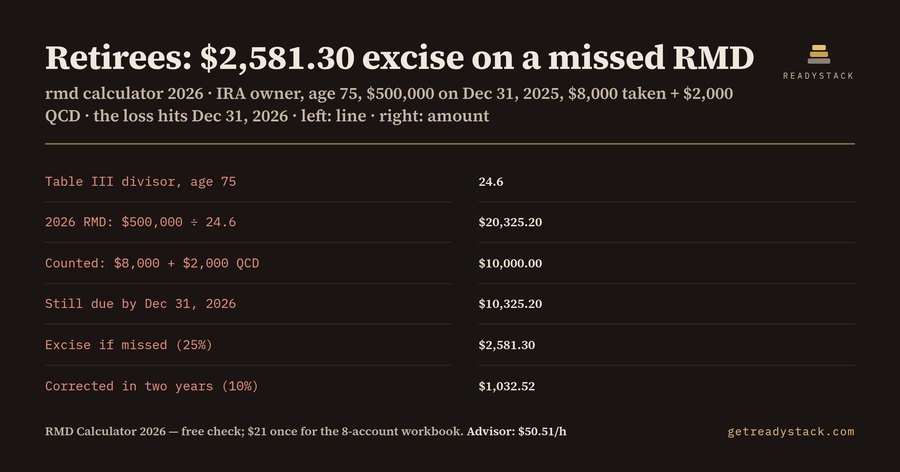
A 75-year-old IRA owner with $500,000 on December 31, 2025 who has taken only $8,000 plus a $2,000 QCD this year faces a $2,581.30 excise tax if the rest is not out by December 31, 2026. Here is the whole result from the rmd calculator 2026 page:
| Line | Amount |
|---|---|
| IRS Table III divisor at age 75 | 24.6 |
| 2026 RMD ($500,000 ÷ 24.6) | $20,325.20 |
| Counted so far ($8,000 + $2,000 QCD) | $10,000.00 |
| Still to withdraw by December 31, 2026 | $10,325.20 |
| Excise tax if missed (25%) | $2,581.30 |
| Excise tax if corrected within two years (10%) | $1,032.52 |
Where the number comes from
The 2026 RMD is your balance on December 31, 2025 divided by the divisor next to your age on your 2026 birthday in IRS Publication 590-B, Table III. At 75 that divisor is 24.6, the same figure the IRS uses in its own example ($100,000 ÷ 24.6 = $4,065). At 80 it is 20.2, at 85 it is 16.0, at 90 it is 12.2.
Why people get it wrong
Three things trip retirees up. First, the balance is last year's December 31 value, not today's. Second, a custodian computes the RMD for its own account only and does not know about your other IRAs or the QCDs you sent to charity. Third, the rules differ by account type: you may total the RMDs of all your IRAs and take the sum from any one of them, but each 401(k) plan must pay its own RMD from that plan.
What happens if you miss December 31
The IRS charges a 25% excise tax on the amount you did not take. If you take the missing amount and report it within the correction window, generally two years, the rate drops to 10%. You report it on Form 5329. In the example above that is $2,581.30 or $1,032.52, on top of the income tax you pay on the withdrawal anyway: at a 22% bracket, $2,271.54 on the remaining $10,325.20.
The first-year exception
If you turn 73 in 2026, your first RMD may wait until April 1, 2027. Waiting means two RMDs in 2027, both taxable that year. Every later RMD is due by December 31.
Three situations, three answers
Age 80 with $250,000 and nothing taken yet: the RMD is $12,376.24, all of it still due. Age 90 with $300,000 who already withdrew $25,000: the RMD is $24,590.16, nothing is left, and the extra $409.84 does not count toward 2027. Age 75 with $500,000, $8,000 taken and a $2,000 QCD: $10,325.20 still due.
What the free page does
You type four numbers: your age on your 2026 birthday, your balance on December 31, 2025, what you withdrew in 2026 and your QCDs. The page shows the divisor, the RMD, what is counted, what is left, both excise amounts and the tax at your bracket. Nothing is uploaded; it runs in your browser.
When you need the workbook
The page treats your balance as one pot. If you hold two IRAs and an old 401(k), the workbook keeps 8 account rows apart, totals the IRAs, shows each 401(k) shortfall on its own line, projects every RMD from 2026 to 2035 and prints a dated record for your tax preparer. It is $21, paid once.
15 seconds — what it actually does
Questions people ask
What does this RMD calculator 2026 work out?
You type four numbers: your age on your 2026 birthday, your traditional IRA or 401(k) balance on December 31, 2025, what you have withdrawn so far in 2026, and any qualified charitable distributions. It divides the balance by your IRS Uniform Lifetime Table divisor and shows the 2026 RMD, what is still left to take by December 31, 2026, and the 25% or 10% excise tax on that shortfall.
Who is this for?
Retirees age 73 and older who own a traditional, SEP or SIMPLE IRA or a 401(k), and their adult children or bookkeepers who check the withdrawal before year end. It uses IRS Table III, which applies unless your spouse is the sole beneficiary and more than 10 years younger. Roth IRAs need no RMD while the owner is alive.
Why not just ask a chatbot or my custodian?
A custodian calculates one account at a time and does not know about withdrawals from your other IRAs or your QCDs. A chatbot can quote an old divisor table or the old 50% penalty. This page uses the Table III divisors printed in IRS Publication 590-B and the 25%/10% excise rates on the IRS RMD page, and runs on your own numbers.
What is free and what is in the $21 workbook?
Free, with no account: the full 2026 check for your combined balance, including the divisor, the RMD, what is left, both excise tax amounts and the income tax at your bracket. The $21 workbook (one payment) keeps up to 8 accounts apart, because each 401(k) plan must pay its own RMD, projects RMDs from 2026 to 2035, and holds the whole Table III.
How does this compare with paying a person?
BLS OEWS May 2025 puts the median wage of personal financial advisors at $50.51 an hour, before any firm markup, and advisors often charge a fee on assets. The sum itself is one division, but missing it costs 25% of the shortfall. Example: age 75 with $500,000 leaves a $20,325.20 RMD, and a $10,325.20 shortfall costs $2,581.30.
Ask about this tool
One question, answered by the person who built it. Your email only if you want the answer sent.