· ReadyStack
Worked example
Real numbers from this tool, line by line.
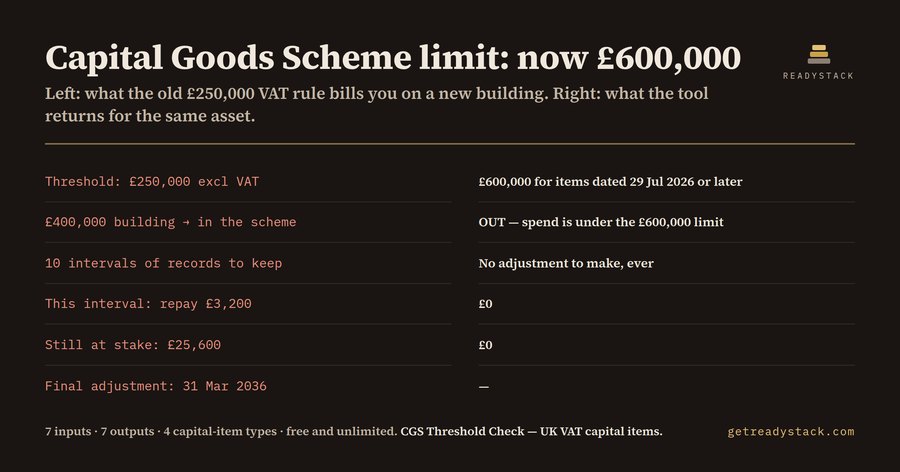
£600,000 — UK finance managers and practice accountants, that is the Capital Goods Scheme limit on a building now, and this is what it does to a £400,000 office acquired on 30 September 2026:
Limit that applies to this item £600,000 — items dated on or after 29 Jul 2026 In or out of the scheme OUT — spend is under the £600,000 limit Interval you are in — Adjustment for this interval £0 Which way the money moves Nothing to adjust, ever Still at stake if use stays as it is £0 Final adjustment falls on —
Seven answers, and every figure in them is zero. Now move the acquisition date back to 28 July 2026 and the same office, the same price, the same £80,000 of input VAT comes back completely different: in the scheme, ten intervals, interval 2 of 10, repay £3,200 to HMRC this interval, £25,600 still at stake, final adjustment 31 March 2036. One day on a completion statement, ten years of VAT.
The split comes from Revenue and Customs Brief 7 (2026). From 29 July 2026 the capital expenditure threshold for land, buildings and civil engineering works rose from £250,000 to £600,000, excluding VAT. The new limit applies to land acquired on or after that date, and to buildings and civil engineering works acquired, constructed, refurbished, fitted out, altered or extended on or after it. Computers and computer equipment acquired on or after 29 July 2026 left the scheme entirely. Ships, boats and aircraft are unchanged.
Two things make this expensive.
The first is that the change does not release anything. An item already a capital item under the old threshold stays in the scheme to the end of its adjustment period. So a warehouse bought on 28 July 2026 for £400,000 is in for ten intervals, and a near-identical one bought on 30 September 2026 is out.
The second is that every free answer still quotes the old figure. Type the question into a chatbot and it returns £250,000, the number in almost every page ever written about the scheme. The failure is silent: nobody gets an error, the business simply starts making adjustments it does not owe, or keeps ten years of records for an asset that left the scheme the day it was bought.
CGS Threshold Check is a browser extension plus a free web page running the identical code. You give it seven things: the kind of capital item, the spend excluding VAT, the date it was acquired or the work was done, the input VAT charged, taxable use in the first interval, taxable use in this interval, and the date this interval ends.
It returns the seven lines above. Which limit applies and why. In the scheme or out. Which interval you are in, out of how many. The adjustment for this interval. Which way the money moves — repay to HMRC or reclaim. What is still at stake if taxable use stays where it is. And the date the final adjustment falls.
The arithmetic behind the £3,200 is the standard one: total input VAT divided by the number of intervals, multiplied by the change in taxable use since the first interval. £80,000 over ten intervals, against a forty point drop in taxable use. The tool picks the right number of intervals, and the right threshold, from the date you type — four kinds of capital item, one date that decides all of it.
The check is free, unlimited, with no key and no sign-up, in the popup and on the web page. Nothing you type leaves the browser. The paid version sits on a different axis: it exports the whole interval schedule as .csv so it can live in the working papers, and it sets reminders so each interval end reaches you before the return is filed. $29 once, one licence key per person or team seat. A UK VAT specialist bills roughly £150 to £300 an hour, and a written opinion on one capital item runs to several hours.
15 seconds — what it actually does
Full walk-through
Questions people ask
What does CGS Threshold Check actually do?
You type the capital spend excluding VAT, the date the item was bought or built, the input VAT charged, and taxable use in the first interval and this one. It answers which threshold binds that item, whether it is in the Capital Goods Scheme, the interval number, this interval's adjustment, and the date of the final one.
Who is this for?
UK finance managers and practice accountants who handle VAT on property and large capital spend, plus VAT-registered landlords who have opted to tax. If you sign a VAT return that carries a Capital Goods Scheme adjustment, or decide whether an asset needs one at all, this is your check.
Why will a free chatbot not answer this?
The land and buildings threshold moved from £250,000 to £600,000 on 29 July 2026 under Revenue and Customs Brief 7 (2026). Models and older calculators still answer £250,000, which puts an asset into ten years of adjustments it never owed. This tool splits on the date you type.
What is free and what needs the $60 key?
Every check is free and unlimited: the threshold, in or out, the interval, the adjustment and the final date, in the popup and on the web page, with no key and no sign-up. The $60 licence key adds .csv export of the schedule for your working papers and reminders before each interval ends.
What would this cost from an adviser?
A UK VAT specialist bills roughly £150 to £300 an hour, and £700 to £1,000 or more a day at senior level. A written opinion on a single capital item runs to several hours. The key is $60 once,.
Ask about this tool
One question, answered by the person who built it. Your email only if you want the answer sent.