· ReadyStack
Worked example
Real numbers from this tool, line by line.
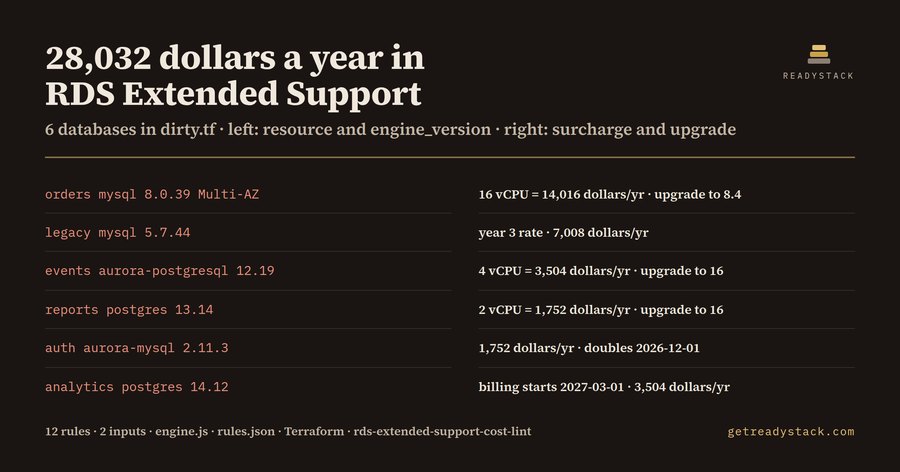
A platform team with 6 Terraform-managed databases on AWS is paying 28,032 dollars a year in RDS Extended Support surcharge right now, measured on the sample dirty.tf with today set to 2026-09-27. It shows up on the invoice, one line per vCPU-hour.
What changed on 2026-08-01
RDS for MySQL 8.0 left standard support on 2026-07-31. AWS did not stop the databases. It enrolled every instance still on the 8.0 major version into RDS Extended Support and started billing it the next day. The US East rate is 0.100 USD per vCPU-hour for years 1 and 2 and 0.200 USD in year 3. For MySQL 8.0, year 3 pricing starts on 2028-08-01 and Extended Support ends on 2029-07-31.
Two details make the bill bigger than people expect. First, AWS documents that Extended Support charges apply to standby instances in Multi-AZ deployments, so a Multi-AZ db.r6g.2xlarge counts as 16 vCPU, not 8. Second, the charge is per vCPU of the instance class, not per database, so a count = 2 cluster instance block is two meters.
The calendar also moved under people's feet. In June 2026 AWS extended MySQL 5.7 Extended Support, for both RDS and Aurora MySQL version 2, to 2029-06-30 from the earlier end of 2027-02-28, at year 3 pricing throughout. Anything written before June still gives the 2027 date.
What the extension does
It reads the Terraform file you have open. For every aws_db_instance it takes engine, engine_version, instance_class, multi_az, count and engine_lifecycle_support. For Aurora it follows cluster_identifier = aws_rds_cluster.NAME.id from each aws_rds_cluster_instance back to the cluster and uses the cluster's engine and version with the instance's class and count.
Then it matches the major version against 12 rules: RDS for MySQL 5.7 and 8.0, RDS for PostgreSQL 11, 12, 13 and 14, Aurora MySQL version 2 and 3, and Aurora PostgreSQL 11, 12, 13 and 14. Each rule carries four dates from the AWS release calendars: end of standard support, start of year 1 billing, start of year 3 billing and end of Extended Support.
The sample file
The dirty.tf fixture has six databases. The results at 2026-09-27:
- orders, mysql 8.0.39, db.r6g.2xlarge, Multi-AZ: 16 vCPU x 0.100 x 8,760 hours = 14,016 dollars a year.
- legacy, mysql 5.7.44, db.m5.xlarge: already at the year 3 rate since 2026-03-01, 7,008 dollars a year.
- events, aurora-postgresql 12.19, two db.r6g.large instances: 3,504 dollars a year, doubling on 2027-03-01.
- reports, postgres 13.14, db.r6i.large: 1,752 dollars a year.
- auth, aurora-mysql 2.11.3, db.t3.medium: 1,752 dollars a year, doubling on 2026-12-01.
- analytics, postgres 14.12, db.r6g.xlarge: not billed yet, but billing starts 2027-03-01 at 3,504 dollars a year, so it is a warning 155 days ahead.
Five of the six are billing now, and together they come to 28,032 dollars a year. The clean fixture, with the same fleet on MySQL 8.4, PostgreSQL 15 and 16 and Aurora MySQL 3, returns zero findings.
The date is an input
The second input is the date. Move it to 2027-03-15 and the PostgreSQL 14 instance turns from a warning into a billed line, and the PostgreSQL 12 cluster moves to the year 3 rate. Move it back to 2026-02-15 and the MySQL 5.7 instance is still at 0.100, so it costs half as much.
Free and full
The free tier checks the open file in VS Code and in the web page and lists every billed database with its line, vCPUs, yearly surcharge, year 3 date and the version to upgrade to. The full version scans every .tf file in the workspace in one run and exports one Markdown report for the budget or upgrade ticket.
15 seconds — what it actually does
Questions people ask
What does RDS Extended Support Cost Lint do?
It reads Terraform aws_db_instance, aws_rds_cluster and aws_rds_cluster_instance blocks, matches engine and engine_version against 12 rules covering RDS MySQL 5.7 and 8.0, RDS PostgreSQL 11 to 14, Aurora MySQL 2 and 3 and Aurora PostgreSQL 11 to 14, and prices the Extended Support surcharge: vCPU x 0.100 or 0.200 USD x 8,760 hours. It takes 2 inputs: the file text and the date.
Who is it for?
Platform, DevOps and FinOps engineers who keep AWS databases in Terraform and still run RDS for MySQL 8.0, MySQL 5.7, PostgreSQL 13 or older, or Aurora MySQL version 2. MySQL 8.0 started billing Extended Support on 2026-08-01, so any team that has not finished the 8.4 upgrade is paying for every vCPU, including Multi-AZ standbys.
Why not ask a chatbot or read the AWS calendar?
The dates keep moving. In June 2026 AWS extended MySQL 5.7 Extended Support to 2029-06-30, from 2027-02-28, so older answers quote the wrong end. A calendar also does not know your instance classes, count values or Multi-AZ flags. This extension reads your own .tf file and multiplies the real vCPUs by the rate for today's date.
What is free and what needs a key?
Free, with no key: the open .tf file is checked in the editor and in the web page, and every database billed for Extended Support is listed with its line, vCPU count, yearly surcharge, the year 3 date and the version to upgrade to. With a key: every .tf file in the workspace in one run, exported as one Markdown report for the budget or upgrade ticket.
What does doing nothing cost?
At the US East rate of 0.100 USD per vCPU-hour, one 4-vCPU instance left on MySQL 8.0 costs 3,504 dollars a year, and 7,008 dollars a year from year 3. The sample dirty.tf with 6 databases totals 28,032 dollars a year already billing. The full version is a one-time 29 dollars per person or team seat.
Why not just ask ChatGPT or another AI chat?
A general AI chat answers from training data with a cutoff date, cannot read your repository and names no rule version. RDS Extended Support Cost Lint for Terraform checks the file you open against 12 rules from a rule set dated 2026-09-27, and points at the exact line. For a filing, an audit or a client you need that dated result on your own files.
Ask about this tool
One question, answered by the person who built it. Your email only if you want the answer sent.