· ReadyStack
Worked example
Real numbers from this tool, line by line.
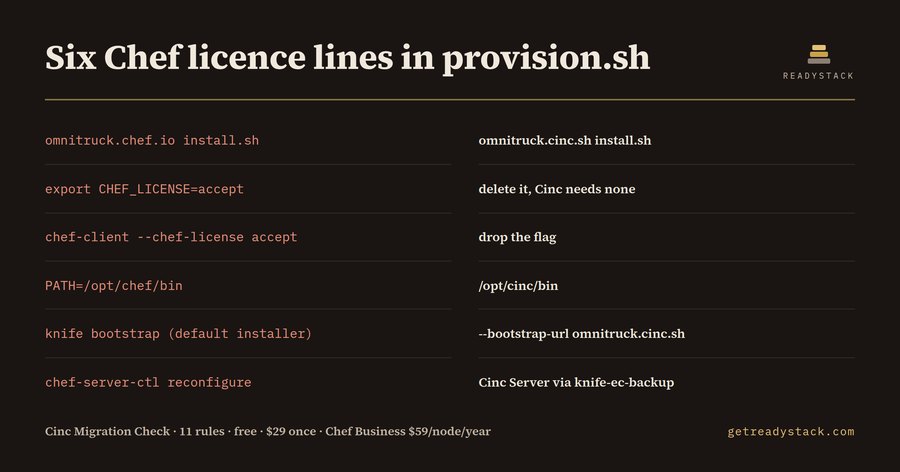
Migrate from Chef Infra Client to Cinc: six lines in a provision.sh that still pull licensed Chef
6 lines in a sample provision.sh still pull licensed Chef, and DevOps engineers and SREs moving a Chef fleet to Cinc usually find them one converge at a time. Since Chef Infra Client 15, Chef's own binaries stop until the Chef licence is accepted (docs.chef.io/chef_license_accept). Progress has also announced that the open-source Chef Infra Server reaches end of life on 2026-11-30, with no security fixes after the end of October 2026. Cinc is the Apache-2.0 build of the same source, and Cinc Client asks for no licence acceptance.
The sample file
The sample is a short provision.sh that installs Chef Infra Client 18 on a web node, runs one role, bootstraps a second node and reconfigures the config server. Cinc Migration Check gives 6 findings on it: 4 errors and 2 warnings. The Cinc rewrite of the same script gives 0.
| Line that pulls licensed Chef (left) | Cinc fix (right) |
|---|---|
| omnitruck.chef.io install.sh | omnitruck.cinc.sh install.sh |
| export CHEF_LICENSE=accept | delete it, Cinc needs none |
| chef-client --chef-license accept | drop the flag |
| PATH=/opt/chef/bin | /opt/cinc/bin |
| knife bootstrap (default installer) | --bootstrap-url omnitruck.cinc.sh |
| chef-server-ctl reconfigure | Cinc Server via knife-ec-backup |
Why each line matters
The install line fetches install.sh from omnitruck.chef.io, which installs Chef's licensed build. The Cinc omnitruck at omnitruck.cinc.sh takes the same -v flag, so the line change is one host name.
export CHEF_LICENSE=accept and --chef-license accept both accept the Chef licence for the node. They are easy to miss because the run succeeds; the licence was accepted silently. After the switch to Cinc they are dead weight and should go, so that nobody later reinstalls Chef's build and inherits the acceptance.
The PATH line hard-codes /opt/chef/bin. Cinc packages install under /opt/cinc. The Cinc binaries include wrappers for the upstream names (chef-client, chef, inspec), so calls that go through PATH keep working, but a hard-coded path does not.
knife bootstrap without --bootstrap-url installs Chef Infra Client from Chef on the new node, even when every existing node runs Cinc. Adding --bootstrap-url https://omnitruck.cinc.sh/install.sh fixes it.
chef-server-ctl reconfigure shows the script still manages an open-source Chef Infra Server. The finding counts the days to 2026-11-30 from the check date: 62 days on 2026-09-29. The Cinc migration guide moves the server with a knife-ec-backup backup and restore; nodes re-attach when the FQDN is unchanged.
What grep and chatbots miss
Grep for chef matches every cookbook, role, resource and directory name, so the six licence lines drown in noise. Chatbots tend to answer "install Cinc" and stop; they rarely mention knife's default installer, Test Kitchen's product_name: cinc switch, or the Chef Infra Server date.
The other file types
The same 11 rules read kitchen.yml (product_name: chef, chef_license: accept), client.rb, Dockerfiles that start FROM chef/chef, package installs of chef, chef-workstation or inspec, and GitHub workflows that use actionshub/chef-install.
Try it
Install Cinc Migration Check in VS Code or open the free web page, paste a bootstrap script or kitchen.yml, and read the findings with their Cinc fix. For comparison, Progress lists Chef Business at $59 per node per year.
15 seconds — what it actually does
Questions people ask
What does Cinc Migration Check do?
It reads a bootstrap script, kitchen.yml, client.rb, Dockerfile or CI workflow and flags every line that still pulls licensed Chef: Chef's omnitruck install script, CHEF_LICENSE=accept, --chef-license accept, chef_license in config, product_name: chef, Chef images and packages, the default knife bootstrap installer, /opt/chef paths and the open-source Chef Infra Server. Each finding names the Cinc replacement. It has 11 rules and runs locally.
Who is Cinc Migration Check for?
DevOps engineers, SREs and platform teams who run Chef Infra Client, Test Kitchen or a self-hosted Chef Infra Server and are moving to Cinc, the Apache-2.0 build of the same Chef source. It suits teams that do not want to accept the Chef licence on every node, and teams whose open-source Chef Infra Server reaches end of life on 2026-11-30.
Why not just grep for chef or ask a chatbot?
Grep for chef hits every cookbook, role and resource name, so the licence lines drown. A chatbot rarely knows that knife bootstrap installs Chef's own build unless --bootstrap-url is set, that Test Kitchen skips licence acceptance only with product_name: cinc, or that Progress ends the open-source Chef Infra Server on 2026-11-30. This check flags those lines and gives the Cinc fix.
What is free and what does the paid version add?
Free: check the open file in VS Code, or paste it into the web page, and every finding is shown with its line number and Cinc fix, with no key and no limit. Paid, $29 once: scan the whole repository in one pass and export one Markdown migration checklist per file for the change ticket. One licence key per person or team seat.
What does staying on licensed Chef cost compared with this check?
Staying on Chef's commercial licence is priced per node: Progress lists Chef Business at $59 per node per year and Enterprise at $189 per node per year on chef.io/how-to-buy. Cinc itself is free under Apache-2.0. The free check of one file costs nothing, and the repository scan with checklist export costs $29 once.
Ask about this tool
One question, answered by the person who built it. Your email only if you want the answer sent.