· ReadyStack
Worked example
Real numbers from this tool, line by line.
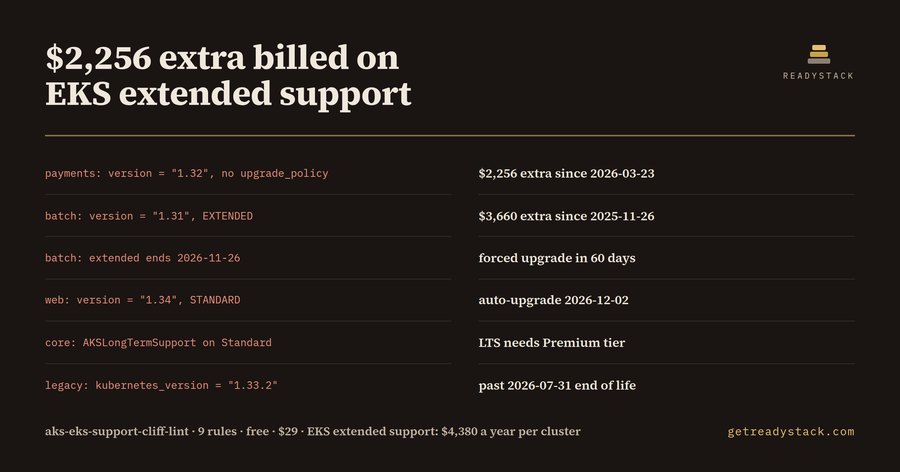
$2,256 in extra EKS fees: that is what one Terraform-managed Amazon EKS cluster pinned to version = "1.32", with no upgrade_policy block, had been billed on top of the standard rate between 2026-03-23 and 2026-09-27. This is for platform engineers, DevOps and SRE teams, and FinOps reviewers who run EKS or Azure Kubernetes Service (AKS) clusters as Terraform code.
Where the money goes
Amazon EKS gives each Kubernetes minor version 14 months of standard support, then 12 months of extended support. Standard support costs $0.10 per cluster-hour. Extended support costs $0.60 per cluster-hour. Billing switches at the start of the day standard support ends, in UTC. For version 1.32 that day was 2026-03-23.
The part most people miss: when an aws_eks_cluster block has no upgrade_policy, AWS treats the cluster as EXTENDED. terraform plan shows no diff. From 2026-03-23 to 2026-09-27 is 188 days, so 188 x 24 hours x $0.50 = $2,256. In the sample file used to build this tool, a second cluster pinned to 1.31 with support_type = "EXTENDED" had been in extended support since 2025-11-26: $3,660. Together that is $5,916, and the meter keeps running at $365 a month per cluster.
The other side of the cliff
Extended support does not last. EKS 1.31 extended support ends on 2026-11-26. After that date AWS upgrades the control plane on its own schedule, without a notice, and managed node groups stay on the old version. A cluster set to support_type = "STANDARD" avoids the fee but gets the auto-upgrade at the end of standard support instead: for 1.34 that is 2026-12-02.
AKS has its own version of the trap. Microsoft gives each version one year of community support and, with Long Term Support (LTS), one more year. LTS is only available on the Premium tier, which is $0.60 per cluster-hour against $0.10 for Standard. So support_plan = "AKSLongTermSupport" next to sku_tier = "Standard" is a request for something the tier does not include. A cluster on 1.33 without LTS left community support on 2026-07-31: platform support only, no Kubernetes security patches, and no new clusters at that version.
What the lint does
AKS LTS & EKS Extended Support Lint for Terraform reads every aws_eks_cluster and azurerm_kubernetes_cluster block and checks version, upgrade_policy, sku_tier and support_plan against the EKS calendar (1.31 to 1.36) and the AKS calendar (1.29 to 1.37), both checked on 2026-09-27. It has 9 rules. On the sample clusters.tf it returned 7 findings:
- payments, 1.32, no upgrade_policy: $2,256 extra since 2026-03-23
- batch, 1.31, EXTENDED: $3,660 extra since 2025-11-26
- batch: forced control-plane upgrade after 2026-11-26, 60 days out
- web, 1.34, STANDARD: auto-upgrade on 2026-12-02, 66 days out
- core: AKSLongTermSupport on the Standard tier
- legacy, 1.33.2 without LTS: past the 2026-07-31 end of life
- analytics: Premium tier for LTS while 1.35 is in community support until 2027-03-31
The corrected file (EKS 1.35 with STANDARD, AKS 1.32 on Premium with LTS, AKS 1.36 on Standard) returns zero findings.
Why the usual checks miss it
terraform validate checks syntax and provider schema. terraform plan compares state. Neither knows a date. The lint carries the dates as data and computes the dollar amount for the day you run it.
Free and full version
The free version lints the open .tf file in VS Code, or a pasted file in the web version, with all 9 rules and every message. The full version scans the whole workspace and exports a per-cluster CSV of fees, cliff dates and fixes for a platform or FinOps review.
15 seconds — what it actually does
Questions people ask
What does AKS LTS & EKS Extended Support Lint do?
It reads Terraform aws_eks_cluster and azurerm_kubernetes_cluster blocks and compares the pinned Kubernetes version with the published EKS and AKS calendars. It reports extended-support fees already billed in dollars, forced control-plane upgrade dates, AKS versions past end of life, and support_plan AKSLongTermSupport set on a tier other than Premium, with the line number of each problem.
Who is this Terraform Kubernetes version lint for?
Platform engineers, DevOps and SRE teams, and FinOps reviewers who manage Amazon EKS or Azure Kubernetes Service clusters as Terraform code. It suits teams that pin Kubernetes versions in .tf files and review changes in VS Code or in pull requests, and anyone who inherited clusters whose upgrade_policy or sku_tier nobody has looked at since creation.
Why don't terraform plan or a chatbot catch EKS extended support fees?
terraform validate and terraform plan only check syntax and provider schema, so version = "1.32" passes even after standard support has ended. A missing upgrade_policy block defaults to EXTENDED, which bills $0.60 instead of $0.10 per cluster-hour. Chatbots often quote outdated version dates. This lint carries the dated EKS and AKS calendars checked on 2026-09-27.
What is free and what does the full version add?
The free version lints the open .tf file with all 9 rules and shows every finding, including the dollar amount billed so far, with no key and no limit. The full version, $29 once, scans the whole workspace and exports a per-cluster CSV of fees, cliff dates and fixes that a platform team or FinOps review can file.
How much does an EKS cluster left in extended support cost?
Amazon EKS bills $0.10 per cluster-hour in standard support and $0.60 in extended support, so one cluster left on an old version costs $365 more a month, or $4,380 a year. In the sample file, a 1.32 cluster had billed $2,256 extra by 2026-09-27 and a 1.31 cluster $3,660. AKS Premium tier for LTS is likewise $0.60 against $0.10.
Why not just ask ChatGPT or another AI chat?
A general AI chat answers from training data with a cutoff date, cannot read your repository and names no rule version. AKS LTS & EKS Extended Support Lint for Terraform checks the file you open against 9 rules from a rule set dated 2026-09-27, and points at the exact line. For a filing, an audit or a client you need that dated result on your own files.
Ask about this tool
One question, answered by the person who built it. Your email only if you want the answer sent.