· ReadyStack
Worked example
Real numbers from this tool, line by line.
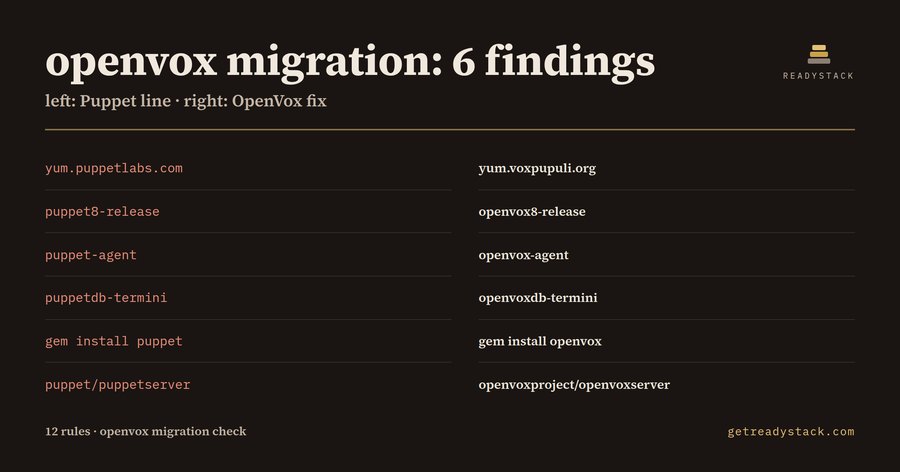
openvox migration: 6 findings in one 10-line Rocky 9 bootstrap script. That is what a platform engineer moving a Puppet fleet to OpenVox gets back when the script that builds every new node is checked line by line.
What Perforce changed, and when
In November 2024 Perforce announced that new Puppet binaries would move to a private, licence-gated location. The product is now Puppet Core: a free developer licence covers up to 25 nodes, and a subscription is needed above that. The old open source repos at yum.puppetlabs.com and apt.puppetlabs.com stay online, but the last release to them was Puppet 8.10 on 2024-10-22. On 2026-09-29 that is 707 days without a package. Open source Puppet 7 reached end of life on 2025-04-30.
The community answer is OpenVox, the Vox Pupuli fork, first released on 2025-01-21. From 8.11 it is functionally equivalent to Puppet: the commands are the same and the config paths are the same. What changes is everything your automation names: packages, repos, container images and the Ruby gem.
The script
Here is the bootstrap we checked, a normal one for a Rocky 9 node:
curl -fsSLo /etc/yum.repos.d/puppet8.repo https://yum.puppetlabs.com/el/9/puppet8/x86_64/
dnf install -y puppet8-release
dnf install -y puppet-agent
dnf install -y puppetdb-termini
gem install puppet -v 8.10.0
docker pull puppet/puppetserver:8.10.0
/opt/puppetlabs/bin/puppet agent --test --server puppet.example.internal
The check returns six findings:
- L4 OVX001: yum.puppetlabs.com → yum.voxpupuli.org
- L5 OVX003: puppet8-release → openvox8-release
- L6 OVX004: puppet-agent → openvox-agent
- L7 OVX006: puppetdb-termini → openvoxdb-termini
- L8 OVX009: gem puppet → gem openvox
- L9 OVX008: puppet/puppetserver → ghcr.io/openvoxproject/openvoxserver
The last line, puppet agent --test, is not flagged. OpenVox keeps that command and the /opt/puppetlabs path. That is exactly why a search-and-replace on the word "puppet" fails: it rewrites the lines that must stay and still misses the release package name.
Why a chatbot is not enough here
Ask an assistant for a Puppet agent install and it will usually write dnf install puppet-agent from yum.puppet.com, because that is what years of docs say. The repo still answers, so nothing errors; you just keep installing a build frozen at 8.10. The check knows the replacement for each line.
The 12 rules
Repos (yum and apt), release packages, puppet-agent, puppetserver, puppetdb and puppetdb-termini, puppet-bolt (now openbolt), the three Perforce images, the puppet gem, Puppet 7 pins, Puppet Core repo hosts, and one rule for a file that installs OpenVox while still installing a Puppet package. Vox Pupuli is explicit that you cannot install both on the same system, so a half-migrated profile is a real failure.
Package rules only fire on install, package or ensure lines, so puppetserver ca list in a runbook stays quiet. Comment lines are skipped and backslash-continued shell lines are joined before matching.
Try it on your own file
The free web page and the VS Code extension use the same engine. Paste one bootstrap script, manifest, Dockerfile or CI file and every Puppet line comes back with its OpenVox fix; the clean OpenVox version of the script above returns 0 findings. A licence key adds a whole-repository scan and one Markdown migration checklist for the change ticket.
15 seconds — what it actually does
Questions people ask
What does OpenVox Migration Check do?
It reads bootstrap scripts, Puppet manifests, Dockerfiles, Gemfiles and CI YAML and flags every line that still pulls Perforce Puppet: yum or apt.puppetlabs.com repos, puppet8-release, puppet-agent, puppetserver, puppetdb, puppet-bolt, Docker images, the puppet gem and Puppet 7 pins. Each finding names the exact OpenVox replacement, such as openvox-agent or yum.voxpupuli.org. It runs 12 rules.
Who is this for?
Platform, DevOps and infrastructure engineers who run a Puppet fleet on open source packages and are moving it to OpenVox, the Vox Pupuli fork, after Perforce put new Puppet builds behind the Puppet Core licence. It suits teams with more than 25 nodes, where the free Puppet Core developer licence no longer covers the fleet.
Why not just search and replace 'puppet' or ask a chatbot?
OpenVox keeps the same commands and config paths, so /opt/puppetlabs/bin/puppet agent and puppetserver ca list must stay unchanged while package names, repos, images and the gem change. A blind replace breaks the first group. Chat assistants still suggest dnf install puppet-agent from yum.puppet.com, a repo with no release since 2024-10-22.
What is free and what needs a licence key?
Checking one file is free and complete: open a script or manifest, run the check, and every Puppet line appears with its OpenVox replacement, in VS Code or on the web page. A licence key adds scanning every file in the repository at once and exporting one Markdown migration checklist you can attach to a change ticket.
What does staying on Puppet cost instead?
Perforce offers new Puppet builds as Puppet Core. The free developer licence covers up to 25 nodes; above that Perforce requires a subscription. The old open source repos stay online but have shipped nothing since Puppet 8.10 on 2024-10-22, and open source Puppet 7 reached end of life on 2025-04-30.
Ask about this tool
One question, answered by the person who built it. Your email only if you want the answer sent.