· ReadyStack
Worked example
Real numbers from this tool, line by line.
Eight findings in one 30-line Agentforce topic file - six errors and two warnings - is what a Salesforce developer at an EU retailer gets the first time they run Agentforce Action Audit over the agent metadata they were about to deploy. The clean version of the same file returns zero. Both numbers come from the fixtures shipped with the extension, measured on 2026-09-20.
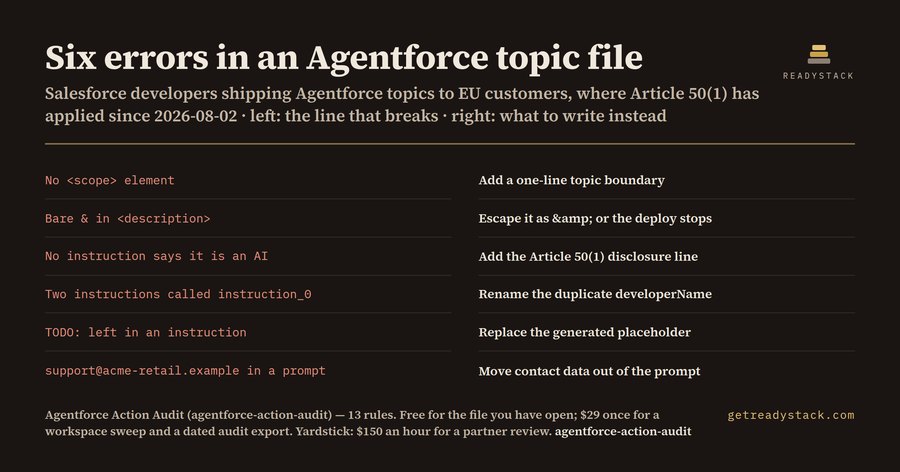
The eight are ordinary. No <scope>, so nothing bounds what the topic will answer. An <apiVersion> of 59.0, below the 62.0 release Agentforce topics shipped in. A bare & in <description>. A Cancel_Order function that no instruction ever names, so the planner rarely selects it. Two instructions both called instruction_0. A TODO: still sitting in text the agent will read to a customer. A mailbox, [email protected], inside a prompt that is sent to the model on every turn. And no instruction anywhere that tells the person they are talking to an AI.
Seven of those eight deploy cleanly. Only the bare ampersand fails at parse time, which is the cheap failure - you see it in the terminal. The sf CLI validates agent metadata against the XML schema, and a topic with no scope, a duplicate instruction name and a TODO in its text is perfectly schema-valid. It ships, and it fails in front of a customer instead.
The last of the eight changed category on 2026-08-02. EU AI Act Article 50(1) began to apply on that date: a system that interacts directly with natural persons must be designed so those persons are informed that they are interacting with an AI, unless that is obvious from the context. In an Agentforce topic there is exactly one place that line can live - a <genAiPluginInstructions> entry - and nothing in the deploy pipeline looks for it. Article 99(4) puts the ceiling for that class of breach at 15 million euro or 3 percent of worldwide annual turnover, whichever is higher.
This is also where generated metadata is weakest. Ask an assistant for a topic that handles delivery questions and it returns a well-formed file with a description, functions and instructions. It does not know which org you sell into, so it does not volunteer a disclosure line. It does not know that the mailbox you pasted into an instruction has just become prompt text. It will happily leave the TODO it wrote for you.
Agentforce Action Audit runs 13 rules over the file: missing masterLabel, missing description, missing scope, thin scope, no instructions, duplicate instruction name, placeholder text, unreferenced function, no AI disclosure, contact data in a prompt, insecure endpoint, unescaped ampersand, stale apiVersion. Nine are errors and four are warnings. The engine is one file, ext/engine.js, reading ext/rules.json, and the same file runs in the one-page web edition with no server and no upload - agent metadata is not something you paste into a web form.
Free: the file you have open, all 13 checks, every finding with its line number. Nothing is blurred, timed or counted down; that audit finishes on its own. The full version is $29 once and changes the axis, not the depth: it sweeps every genAiPlugin and genAiPlannerBundle in the workspace in one run and exports a dated AGENTFORCE-AUDIT.md you can attach to the change request. A Salesforce partner bills metadata review at about $150 an hour, and one topic file takes roughly 20 minutes to read by hand, so a 12-topic agent is most of a billable day. One licence key per person or team seat.
15 seconds — what it actually does
Questions people ask
What does Agentforce Action Audit actually do?
It reads a Salesforce Agentforce topic file - genAiPlugin or genAiPlannerBundle metadata - and reports 13 defects with line numbers: missing scope, duplicate instruction names, a bare ampersand that stops the deploy, generated placeholder text, contact data sitting inside a prompt, and the missing line that tells a person they are talking to an AI.
Who is it for?
Salesforce DX developers and admins who ship Agentforce topics to production, and the partner consultants who review their pull requests. It is aimed at teams whose agents talk to customers in the European Union, where an agent that never discloses it is an AI is an Article 50 problem rather than a style problem.
Why will a chatbot or the sf CLI not do this?
A general chatbot cannot see the genAiPlugin XML sitting in your repository, and pasting it turns customer instructions into prompt text. The sf CLI validates the XML schema, not the behaviour: sf project deploy start happily accepts a topic with no scope, no disclosure line, and a TODO still left in an instruction.
What is free and what does the full version add?
Free: the file you have open, all 13 checks, every finding with its line number. The 13 are missing masterLabel, missing description, missing scope, thin scope, no instructions, duplicate instruction name, placeholder text, unreferenced function, no AI disclosure, contact data in a prompt, insecure endpoint, unescaped ampersand, and stale apiVersion. The full version sweeps the whole workspace and exports a dated AGENTFORCE-AUDIT.md.
What does this cost compared with having a person do it?
A Salesforce partner bills metadata review at about $150 an hour, and one topic file takes roughly 20 minutes to read by hand, so a 12-topic agent is most of a billable day. The full version is $29 once, one licence key per person or team seat,.
Why not just ask ChatGPT or another AI chat?
A general AI chat answers from training data with a cutoff date, cannot read your repository and names no rule version. Agentforce Action Audit checks the file you open against 13 rules from a rule set dated 2026-09-20, and points at the exact line. For a filing, an audit or a client you need that dated result on your own files.
Ask about this tool
One question, answered by the person who built it. Your email only if you want the answer sent.