· ReadyStack
Worked example
Real numbers from this tool, line by line.
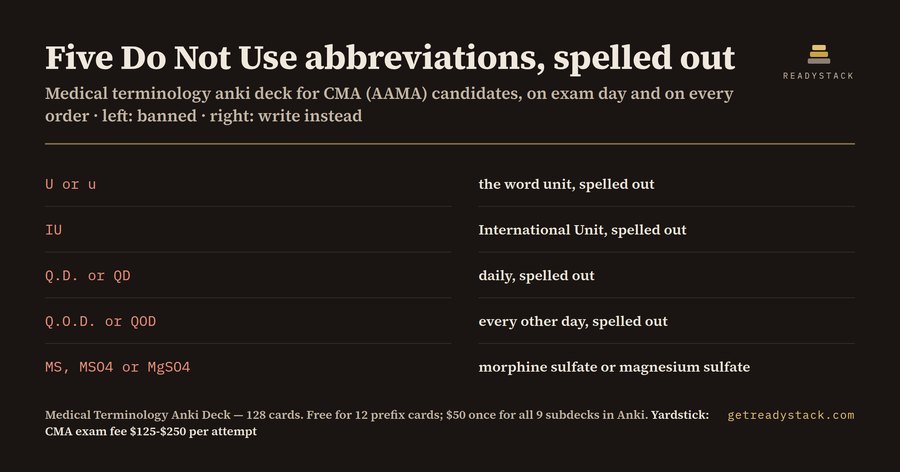
Five Do Not Use abbreviations, spelled out: the answers US medical assistants sitting the CMA (AAMA) exam must write on every order.
- U or u → the word unit, spelled out
- IU → International Unit, spelled out
- Q.D. or QD → daily, spelled out
- Q.O.D. or QOD → every other day, spelled out
- MS, MSO4 or MgSO4 → morphine sulfate or magnesium sulfate
Medical terminology is where many medical assistant students lose easy points. It is not hard material, but it is wide: a first course throws hundreds of word parts at you, and the CMA (AAMA) exam lists medical terminology in the General section of its content outline. If you fail the exam, AAMA charges the fee again for every attempt: $125 for AAMA members and $250 for nonmembers.
I built a 128-card Anki deck for exactly that. It is split into 9 subdecks: 15 prefixes, 15 suffixes, six body-system groups of 14 cards each (cardiovascular and blood, respiratory, digestive, musculoskeletal and skin, nervous-endocrine-sensory, urinary and reproductive), and 14 cards on abbreviations and The Joint Commission Official Do Not Use list. I counted every number here from the built .apkg file: 128 notes, 3 fields each, 9 subdecks.
Why word parts first? Because they multiply. Once you know that hyster/o means uterus and -ectomy means surgical removal, hysterectomy needs no card of its own. The same -ectomy then decodes cholecystectomy, as long as you also know cholecyst/o is the gallbladder. That is why every card in the deck carries a hint with the parts, such as hem/o + -ptysis for hemoptysis (coughing up blood) or dys- + -phagia for dysphagia (difficulty swallowing). You learn a small system, not 128 unrelated words.
Why these five? U for unit can be read as 0, 4 or cc. IU can be read as IV or 10. Q.D. and Q.O.D. get confused with each other. MS, MSO4 and MgSO4 can mean either morphine sulfate or magnesium sulfate. The other two cards on The Joint Commission Official Do Not Use list are about zeros: a trailing zero, as in 5.0 mg, can turn into 50 mg if the decimal point is missed, so you write 5 mg; a missing leading zero, as in .5 mg, can turn into 5 mg, so you write 0.5 mg. Seven cards cover that list, and seven more cover everyday orders and charting abbreviations such as NPO, PRN, b.i.d., t.i.d., STAT, SOB and HTN. It is the subdeck students skip and working MAs get corrected on.
You can try the method before you pay for anything. The free page has the first 12 prefix cards: brady-, tachy-, hyper-, hypo-, dys-, a-/an-, peri-, endo-, epi-, inter-, intra- and poly-. The first card opens already answered. Mark each one Got it or Missed and the score line shows how many you know and names the ones you missed. Those 12 cards are also available as a small .apkg if you want to see how the deck looks inside Anki.
What the free page cannot do is remember. Close the tab and your misses are gone. The full deck puts all 128 cards into Anki, where spaced repetition schedules each card you press Again on to come back sooner and each card you know to come back later. A simple plan is to set New cards per day to 15 and open one subdeck a day. After nine days every card is in rotation, and the daily review queue is the list of terms you still need before your exam date.
Installing takes two steps. Back up your collection first (recent Anki versions have File > Create Backup; menu names differ by version and language). Then use File > Import and choose the .apkg, or just double-click the file. Press Study Now and each body system appears as its own subdeck.
The full deck is a single payment, not a subscription. Drill the free 12 first, and only buy the rest if the card style suits how you study.
15 seconds — what it actually does
Questions people ask
What does this medical terminology Anki deck contain?
128 flashcards in 9 subdecks: 15 prefixes, 15 suffixes, six body-system groups of combining forms and built terms (cardiovascular, respiratory, digestive, musculoskeletal and skin, nervous-endocrine-sensory, urinary-reproductive), and 14 cards on charting abbreviations and The Joint Commission Official Do Not Use list. Each card asks one term and shows one short answer plus a word-part hint.
Who is this deck for?
Medical assistant students and working MAs in the US preparing for the CMA (AAMA) exam, where medical terminology sits in the General section of the content outline. It also fits anyone in a first medical terminology course who needs to decode words like cholecystectomy or hemoptysis from their parts instead of memorising each one.
Why not use a free shared deck or a chatbot?
Shared decks are often thousands of mixed cards with no body-system order, and a chatbot list does not schedule reviews. This deck is sized to the terminology an MA exam draws on, split by body system into subdecks, and Anki's spaced repetition brings back exactly the cards you missed until exam day.
What can I use for free?
The first 12 prefix cards work in your browser with no install and no account: flip each card, mark Got it or Missed, and see your score and the terms you missed. The same 12 cards also come as a free .apkg sample. The full deck adds the scheduled review of all 128 cards inside Anki.
How does the price compare with failing the exam?
The CMA (AAMA) exam fee is $125 for AAMA members and $250 for nonmembers, and AAMA charges it again for every attempt. The full deck is $50, paid once, not a subscription. Before paying you can drill the free 12 cards and check whether the card style suits how you study.
Ask about this tool
One question, answered by the person who built it. Your email only if you want the answer sent.