· ReadyStack
Worked example
Real numbers from this tool, line by line.
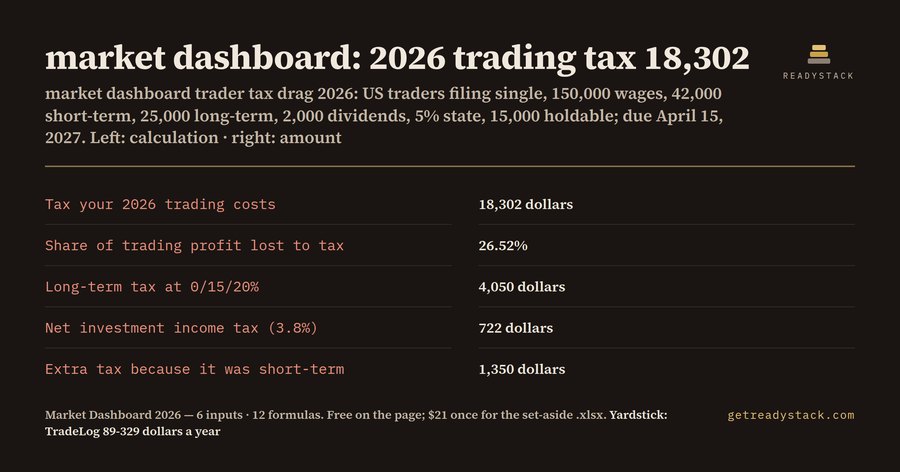
A US trader filing single with 150,000 dollars of wages and 69,000 dollars of 2026 trading profit pays 18,302 dollars of tax on that profit: 26.52% of it. That is the worked example in the free calculator, and every line below comes from its 12 formulas.
| Line | 2026 amount |
|---|---|
| Taxable income after the 16,100 standard deduction | 202,900 dollars |
| Ordinary-bracket tax (10-37%) | 34,814 dollars |
| Long-term tax at 0/15/20% | 4,050 dollars |
| Federal tax on wages alone | 24,734 dollars |
| Net investment income tax (3.8%) | 722 dollars |
| State tax on your gains (5%) | 3,450 dollars |
| Tax your 2026 trading costs | 18,302 dollars |
| Extra tax because 15,000 was short-term | 1,350 dollars |
Why the broker number is not the tax number
Your broker's realized gain/loss page shows 42,000 dollars short-term and 25,000 long-term. It does not show the stacking. Short-term gains are ordinary income, so they sit on top of your wages. In this example the wages alone already fill the 22% bracket, which in 2026 ends at 105,700 dollars of taxable income (IRS Rev. Proc. 2025-32), so the short-term gain is taxed at 24%.
Long-term gains and qualified dividends sit on top of that again. The 0% rate only covers taxable income up to 49,450 dollars in 2026, and ordinary income has already used all of it here, so all 27,000 dollars of long-term gain and dividends is taxed at 15%. The 20% rate starts at 545,500 dollars.
Then the net investment income tax: 3.8% on the smaller of your investment income or the amount your modified AGI is over 200,000 dollars (IRC 1411, single). Wages plus gains here come to 219,000 dollars, so 19,000 dollars is exposed: 722 dollars.
The holding-period line
The calculator asks one more number: a short-term gain you could have held past one year. Move 15,000 dollars from short-term to long-term and the rate on it drops from 24% to 15%: 1,350 dollars.
This is arithmetic on rates, not a trading signal. Whether to hold a position is your call; the sheet only tells you what each choice costs in tax.
When it bites
The 2026 return is due April 15, 2027. The fourth 2026 estimated-tax payment is due January 15, 2027 (Form 1040-ES). A trader who sets aside a flat 15% in this example would hold back 10,350 dollars against a real bill of 18,302: short by 7,952 dollars.
Three situations that change the answer
- Day job plus short-term trading only: everything stacks at your top bracket, and the share lost climbs with your wages.
- Low wages, mostly long-term gains: with 40,000 dollars of wages and 20,000 long-term, taxable income is 43,900, under 49,450, so the federal tax on the gain is 0 and only the 1,000-dollar state tax remains.
- High earner: with 600,000 dollars of wages, 100,000 short-term and 50,000 long-term, the 37% bracket, the 20% band and 5,776 dollars of NIIT push the share lost to 39.2%.
Free and paid
The page is free and complete: six numbers in, the answer on screen, nothing uploaded. The paid workbook (one payment, not a subscription) keeps your numbers in an .xlsx with 18 live formulas and a set-aside sheet: 4,576 dollars per quarterly date in this example, plus the room left before the NIIT line and each long-term band, so you can re-run it after every closed trade.
Scope: single filer, net gains of 0 or more. Not tax advice; give the sheet to your tax preparer.
15 seconds — what it actually does
Questions people ask
What does this market dashboard calculate?
It takes your 2026 wages, net short-term gain, net long-term gain, qualified dividends and state tax rate, stacks the gains on top of your wages at the 2026 IRS brackets, applies the 0/15/20% long-term bands and the 3.8% NIIT, and shows the tax your trading costs this year and the share of your trading profit it takes.
Who is this built for?
US retail and active traders who file single: day traders, swing traders and options traders with a day job. Your short-term gains are taxed like extra salary on top of your wages, so the amount you must set aside for April is larger than a flat guess, and a broker statement never shows it.
Why not just use my broker's gain/loss page?
The broker shows realized profit before tax. It does not stack short-term gains on your wages at the 10-37% brackets, apply the 0% band up to 49,450 dollars of taxable income and the 15% band to what is left, or add the 3.8% NIIT above 200,000 dollars. This page does all three with the 2026 IRS figures.
What is free and what is in the paid workbook?
The page is free and complete: you type six numbers and see the tax your trading costs, your NIIT and the extra tax from a gain being short-term. The paid .xlsx keeps those formulas with your numbers and adds a set-aside sheet: the amount per quarterly estimated-tax date and the room left before the NIIT line and each long-term band.
How does the cost compare with trader tax software?
TradeLog, a trader tax software, lists plans from 89 to 329 dollars a year according to Benzinga. Those tools build Form 8949 from your trade history. This workbook does one different job for a single payment: it tells you how much of this year's profit to set aside before you file, using the 2026 IRS brackets and bands.
When do these numbers change next?
The fourth 2026 estimated-tax payment is due January 15, 2027 (IRS Form 1040-ES). On January 1, 2027 a new tax year starts, and the IRS publishes new inflation-adjusted brackets and bands in a Revenue Procedure; the 2026 figures used here come from Rev. Proc. 2025-32.
Ask about this tool
One question, answered by the person who built it. Your email only if you want the answer sent.