How the calculator works
- Marital part of each item = value − separate part. Debts count as minus. Net marital estate = sum of the marital parts. Separate property is listed apart and is not divided.
- Target for each spouse = net marital estate × that spouse's percent. Kept = the marital parts of the items that spouse keeps; an item marked "sell and split" is shared by the same percent.
- Equalization payment (face value) = what spouse A keeps − spouse A's target. Above zero, A pays B; below zero, B pays A.
- Tax on cash-in (marital part only): pre-tax retirement = value × your income tax rate; brokerage or business = (value − cost basis) × your capital-gains rate; home = (value − cost basis − exclusion) × your capital-gains rate, never below zero. Cash, Roth money, vehicles and debts: none. After-tax payment = the same even-up measured on value minus that tax.
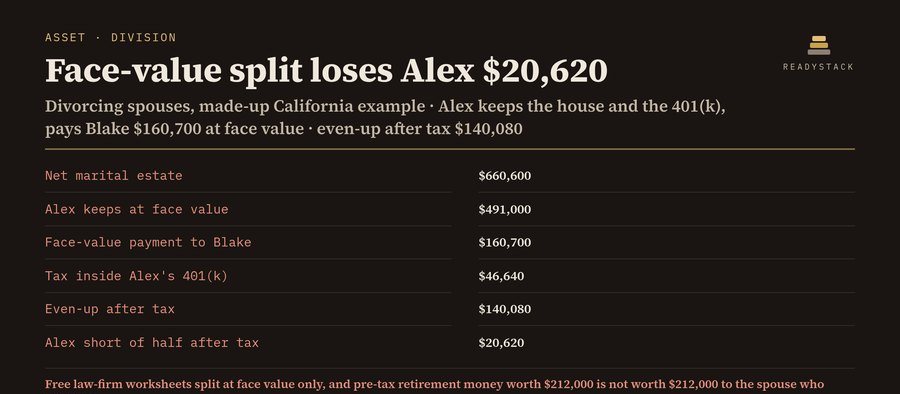
- Worked example A: estate $640,000 − $385,000 + $18,000 + $212,000 + $48,000 + $96,000 + $24,000 + $17,000 − $9,400 = $660,600; half = $330,300. Alex keeps $640,000 − $385,000 + $212,000 + $24,000 = $491,000, so Alex pays $491,000 − $330,300 = $160,700. Tax: Alex's 401(k) $212,000 × 22% = $46,640; brokerage ($96,000 − $60,000) × 15% = $5,400; home gain $230,000 is under the $250,000 exclusion. After tax the estate is $608,560 and half is $304,280; Alex keeps $491,000 − $46,640 = $444,360, so the after-tax payment is $140,080. Paying $160,700 instead leaves Alex $283,660, which is $20,620 less than half.
Community property or equitable distribution
IRS Publication 555 (Rev. 12-2024) lists 9 community property states: Arizona, California, Idaho, Louisiana, Nevada, New Mexico, Texas, Washington and Wisconsin. The calculator starts those at 50/50. The other states and DC divide by equitable distribution, which means fair, not always equal: type the percent you agreed or are asking for. Alaska, South Dakota and Tennessee also have state-law community property elections that a couple must choose.
IRS Publication 504 (2025): generally no gain or loss is recognized when property moves to a spouse or, incident to the divorce, to a former spouse; the one who receives it also receives the tax that is still built into it. That is why the after-tax column exists. IRS Publication 523: a single filer who meets the ownership and use tests may exclude up to $250,000 of gain on a main home ($500,000 if married filing jointly).
Sources read 2026-11-18: irs.gov/pub/irs-pdf/p555.pdf · p504.pdf · p523.pdf. Courts in many states divide at face value unless a tax is immediate and certain; use the after-tax column to negotiate and ask your attorney how your court treats it. A record-and-calculation tool for your own numbers: not legal or tax advice.
 realtor commission calculator | split, cap, royalty, 2026 tax set-aside and due date
 Dividend tracker spreadsheet with withholding tax by country: monthly dividend calendar, yield on cost, DRIP
 trading journal + wash sale tracker: all brokers, IRA, Form 8949, re-buy dates