· ReadyStack
Worked example
Real numbers from this tool, line by line.
Fall grades post in December. For a student on a Pell Grant or federal loans, that is also when the school can run its Satisfactory Academic Progress review, and a plain gpa calculator does not answer the question that review asks.
The rule sits in 34 CFR 668.34. Every school that pays out federal aid must have a SAP policy with two tests. The first is grades: by the end of the second academic year a student must have at least a C average or its equivalent, which on a 4-point scale is a 2.00. The second is pace: hours successfully completed divided by hours attempted. The federal rule tells the school to measure pace; the school sets the minimum, so look up yours in its SAP policy. Withdrawals, failed courses, incompletes and accepted transfer hours can all count as attempted. That is the part most students miss: a W does not touch your GPA, but it does pull your pace down.
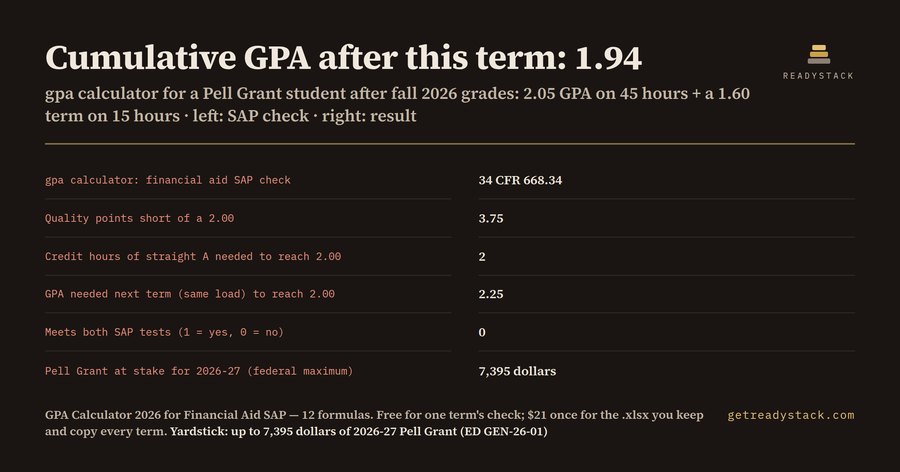
Here is the worked example on the free page. A student has a 2.05 cumulative GPA on 45 graded hours, so 92.25 quality points. This fall they take 15 hours, pass 12, fail one 3-hour course, and finish the term with a 1.60. That adds 24 quality points. The cumulative GPA after this term is 116.25 over 60 hours: 1.94. They are 3.75 quality points short of a 2.00. Two credit hours of straight A would close the gap; with the same 15-hour load next term they need a 2.25 term GPA to get back to 2.00.
Pace tells a different story. Before this term they had attempted 54 hours and earned 42. After it, 69 attempted and 54 earned, a completion pace of 78.26%. With a 67% school minimum, pace passes. So one test passes and one fails, and the check reads 0: this student does not meet both SAP tests.
Change one number and the answer moves. If the same student had earned only 30 of their first 54 hours and passed only 9 this term, pace drops to 56.52%, and they would need to pass 22 more hours without failing any to reach 67%. If instead the fall term went well, a 3.40 term on top of a 3.10, the GPA lands at 3.18 and both tests pass.
What is at stake? For 2026-27 the Federal Pell Grant is up to 7,395 dollars a year, according to the US Department of Education's announcement GEN-26-01 of January 30, 2026. A student who fails SAP loses federal aid until they regain eligibility or the school grants an appeal. Schools usually ask for an academic plan with an appeal, which means you need these exact numbers anyway.
The free calculator does the whole one-term check in your browser with your own numbers: 8 inputs and 12 formulas, nothing uploaded, no account. The workbook version holds the same 12 formulas in an .xlsx file you keep, so you can copy the sheet for every later term and bring it to an advising meeting.
What to do with a 0. Read your school's SAP policy for its warning and appeal rules, book an advising appointment before spring registration, and plan the next load around two numbers from the check: the GPA you need next term and the hours you must pass.
Two honest limits. Some registrars truncate a GPA instead of rounding it; the calculator rounds to two decimals. And it does not check the maximum timeframe, 150% of your program's published length. Your school's SAP policy has the final word.
15 seconds — what it actually does
Questions people ask
What does this gpa calculator check?
From 8 inputs, 12 formulas compute: quality points, graded hours, your cumulative GPA after this term, quality points short of 2.00, hours of straight A needed, the GPA needed next term, hours attempted, hours earned, completion pace, hours to reach your pace minimum, whether you meet both SAP tests, and the Pell amount at stake.
Who is it for?
US undergraduates on a Pell Grant or federal student loans whose school reviews Satisfactory Academic Progress after fall grades post. Under 34 CFR 668.34 you need at least a C average (2.00) by the end of your second academic year and must keep the completion pace your school sets, or federal aid stops.
Why not use any free gpa calculator?
A plain gpa calculator stops at the GPA. It does not count withdrawn and failed hours against your completion pace, does not compare you with the 2.00 federal floor, and does not tell you the GPA you need next term or how many hours you must pass to get back above your school's pace minimum.
What is free?
The whole one-term check in your browser, with no account: type your own numbers and see your cumulative GPA after this term, how far you are from 2.00, the GPA you need next term, your completion pace, the hours you must pass, and whether you meet both SAP tests. Only the .xlsx workbook is paid.
What is at stake if I get it wrong?
Failing SAP stops federal student aid until you regain eligibility or win an appeal. For 2026-27 the Federal Pell Grant is up to 7,395 dollars a year (US Department of Education GEN-26-01, 2026-01-30). The workbook is a one-time payment, not a subscription, and you reuse it every term.
Ask about this tool
One question, answered by the person who built it. Your email only if you want the answer sent.