The lawful maximum you may withhold on one paycheck, under the 2026 federal CCPA test and the stricter state rule

What you get: Full version · $60 →
Updated 2026-09-18 · ReadyStack
The lawful maximum you may withhold on one paycheck, under the 2026 federal CCPA test and the stricter state rule
| Lawful maximum to withhold this period | — | USD |
|---|---|---|
| Federal CCPA cap | — | USD |
| State cap | — | USD |
| Protected earnings floor for this period | — | USD |
| Over-withheld on this check | — | USD |
| Over-withheld per year at this rate | — | USD |
| Room left to withhold this period | — | USD |
| Which rule binds | — |
Keep this calculation in the employee file.
Every cap on this page is free, with no key and no limit. The full version adds CSV export of this worksheet (inputs, binding rule, every cap) and a renewal alarm on the date a state minimum wage changes and the protected floor moves.
Get the full version — $60$60 once · one licence key per person or team seat · A US payroll compliance attorney bills $250-$400 an hour, and reviewing one earnings withholding order is about an hour of that time.
Free for the file open in your editor - no key, no limit. The workspace sweep and the report ask for a key.
Microsoft Edge Add-onsA $60 key adds CSV export of the worksheet (inputs, binding rule, every cap) for the employee file, and a renewal alarm on the date a state minimum wage changes and the protected floor moves.
One payment, one licence key for this tool. The key is shown right after payment.
A US payroll compliance attorney bills $250-$400 an hour, and reviewing one earnings withholding order is about an hour of that time.
Buy the full version — $60I have a keyThis tool is 1 of 266 paid tools in English. All 266 with one key: Freelancer & Small Business Pass — $9.99/month · $79/year · Deadline reminders by email (free)
Need more than this one? ReadyStack Pass opens all 675 files and 555 full versions — $29/month or $199/year. See the Pass →
· ReadyStack
Real numbers from this tool, line by line.
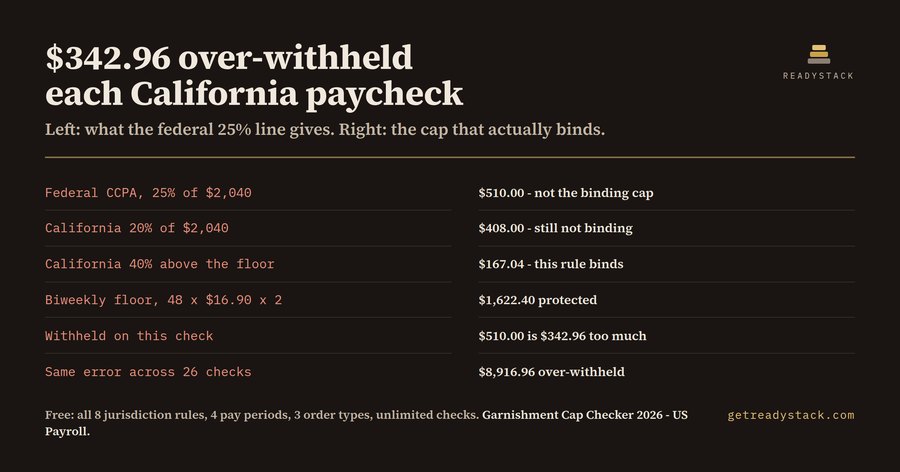
A California payroll clerk who withholds the federal 25% line on a $2,040 biweekly disposable paycheck takes $342.96 too much, on every check.
The employee grosses $2,600 a paycheck and has $2,040 in disposable earnings after legally required deductions. A creditor garnishment lands on payroll. The clerk runs the two halves of the federal rule everyone knows, the Consumer Credit Protection Act Title III: 25% of disposable earnings, which is $510.00, or the amount above 30 times the federal minimum wage, which for a biweekly period is $435.00. The lesser is $510.00, so the clerk withholds $510.00.
California says $167.04.
Under Cal. Code Civ. Proc. 706.050 the cap is the lesser of 20% of disposable earnings, which is $408.00, or 40% of the amount by which disposable earnings exceed 48 times the state minimum hourly wage. California's minimum wage is $16.90 an hour in 2026, so the weekly protected floor is $811.20 and the biweekly floor is $1,622.40. Disposable earnings exceed that floor by $417.60, and 40% of $417.60 is $167.04. That is the lawful maximum. The federal 25% test never binds on this paycheck; it is simply the looser of the two.
The gap is $342.96 on one check. Across 26 biweekly checks it is $8,916.96, all of it money taken out of an employee's pay without the authority to take it.
The mistake is expensive both ways: withhold too much and the excess is wages you still owe the employee, withhold too little and in most states the creditor can pursue the employer for the shortfall.
What makes this a 2026 problem is that the cap is not a fixed percentage. Every strict state ties its protected floor to a minimum wage that moves: California 48 x $16.90 = $811.20 a week, Washington 35 x $17.13 = $599.55, Illinois 45 x $15.00 = $675.00, Massachusetts 50 x $15.00 = $750.00, New York 30 x $17.00 = $510.00 in New York City, Long Island and Westchester and 30 x $16.00 = $480.00 elsewhere, on top of a 10%-of-gross ceiling that often binds first. Put that employee in New York City on a weekly cycle with $1,300 gross and $1,020 disposable and the lawful maximum is $130.00, not the federal $255.00. Move the order to Texas, Pennsylvania, North Carolina or South Carolina and an ordinary consumer judgment cannot reach wages at all: the lawful maximum is $0.00.
This is where a general-purpose chatbot is confidently wrong: it knows the shape of the rule and quotes the floor from whichever year its training data ended, and a floor one minimum-wage increase stale produces a cap tens of dollars off while looking correct. Free calculators have the opposite problem - they run the federal test only, the test that does not bind where most people work.
Garnishment Cap Checker 2026 is a browser extension and a web page running the same calculation. You enter gross pay, disposable earnings, pay period, jurisdiction and order type, and it returns the federal cap, the state cap, the protected floor, the lawful maximum, and the over-withholding on that check and across the year. It names which rule binds, so the reasoning goes in the file, not just the number.
All of that is free, with no key and no limit: 8 jurisdiction rules, 4 pay periods and 3 order types, including child support at the 50/55/60/65% CCPA rates and student loan administrative wage garnishment at 15%. A $60 key adds CSV export of the worksheet for the employee file and a renewal alarm on the date a state minimum wage changes. For comparison, a US payroll compliance attorney bills $250-$400 an hour, and reviewing one earnings withholding order is about an hour of that time.
It takes one paycheck - gross pay, disposable earnings, pay period, state and order type - and returns the largest amount you may lawfully withhold on that check. It runs both halves of the federal CCPA Title III test and the stricter 2026 state cap, then tells you which of the two rules binds.
US payroll clerks and small-business bookkeepers who process an earnings withholding order by hand, without a payroll bureau. If you have ever applied the federal twenty-five percent line to a California or New York order, this is the check that catches it before the paycheck goes out.
The cap moves with the state minimum wage, so the protected floor changed again for 2026: California is 48 x $16.90, Washington 35 x $17.13, New York metro 30 x $17.00. A model trained earlier quotes last year's floor with total confidence, and a generic calculator usually applies the federal test only.
Every calculation is free and unlimited: all 8 jurisdiction rules, all 4 pay periods, all 3 order types, in the popup and on the web page, with no key and no watermark. The $60 key adds CSV export of the worksheet for the employee file and a renewal alarm when a state minimum wage changes and the protected floor moves.
A US payroll compliance attorney bills $250-$400 an hour, and reviewing one earnings withholding order is about an hour of that time. Getting it wrong costs both ways: withhold too much and you owe the employee the excess, withhold too little and most states let the creditor pursue you for the shortfall.
One question, answered by the person who built it. Your email only if you want the answer sent.
Paste this code into your page. It runs in your visitor’s browser and stays up to date. Nothing your visitors type is stored.
For businesses: your name and logo instead of ours, and each visitor’s result + e-mail in your inbox (only when they tick consent) — Pro from $19/month. See Pro →
For a team or company: for an invoice with your company details, a quote or several licences, write to [email protected].
Startup Financial Model Template: 2026 US Payroll RunwayYour runway is shorter than salaries say: every 2026 US hire also costs 6.2% Social Security up to the 184,500 wage base, 1.45% Medicare…FreeFull version $21
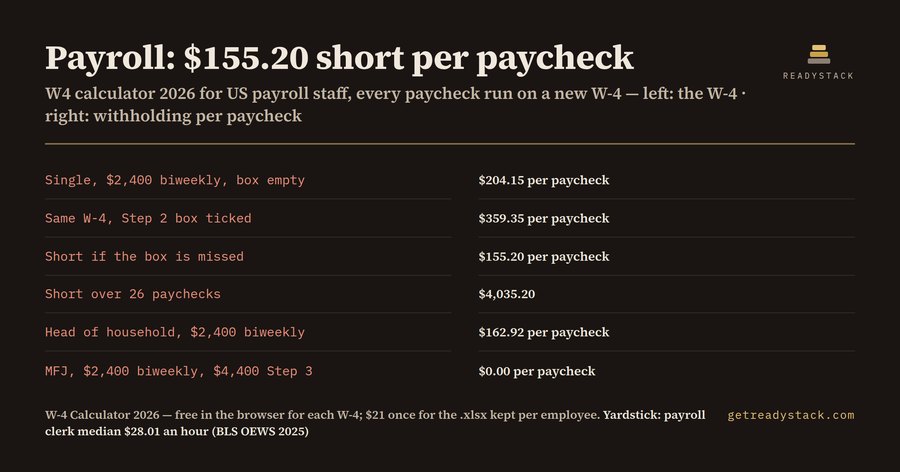
W4 Calculator 2026: Step 4(c) Extra Withholding Per Paycheck for Two-Job CouplesTwo jobs, two payrolls, each applying the married standard deduction (32,200 in 2026) and the 10% and 12% bands again. Owing 1,000 or more…FreeFull version $21
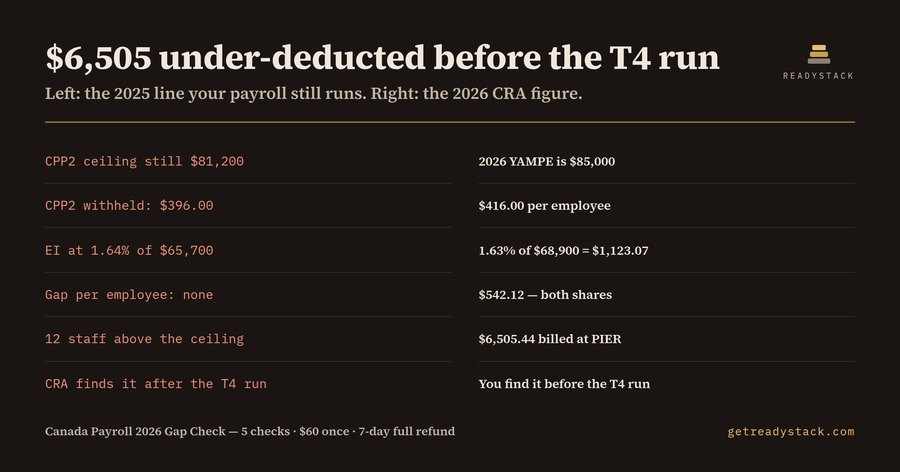
2026 CPP / CPP2 / EI deduction and under-deduction gapReads a salary against the 2026 CRA ceilings and shows what a payroll still on 2025 tables under-deducts for CPP, CPP2 and EI before a PIER…FreeFull version $60
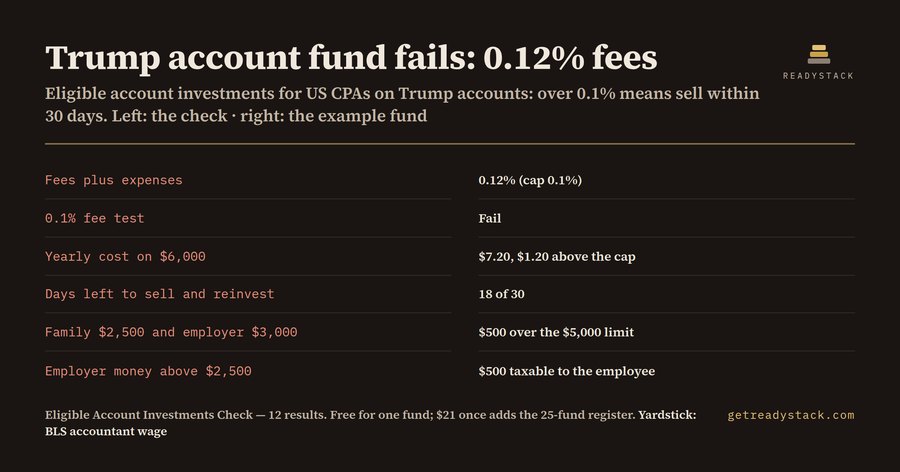
Eligible Account Investments Check (Trump Account, 2026)Eligible account investments check for Trump accounts: fees plus expenses vs the 0.1% cap, the 30-day sell rule, the $5,000 limit, $2,500…FreeFull version $21
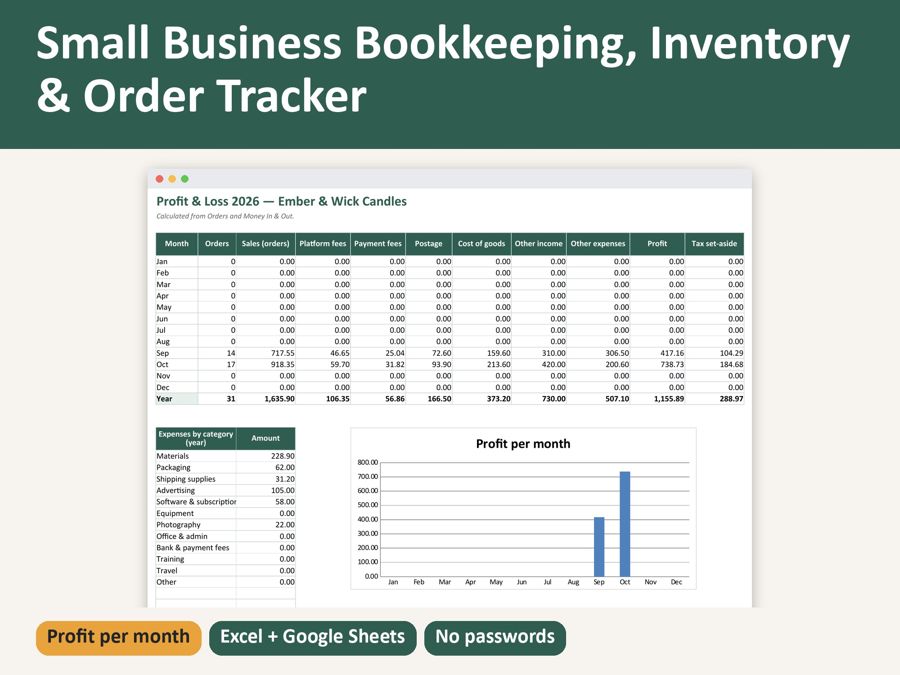
Small Business Bookkeeping SpreadsheetKnow your real profit per order and per month. Your orders count your inventory down, platform and payment fees come off each order, and…FreeFull version $8.99
Monthly Email Campaign Template + 2026 Gmail Spam CheckUS small businesses emailing monthly: Gmail stops delivery support at a 0.3% spam rate, and CAN-SPAM fines reach $53,088 per email. Check…FreeFull version $21ReadyStack
Calculators, templates and deadlines for the rules that change every year — free in your browser.