· ReadyStack
Worked example
Real numbers from this tool, line by line.
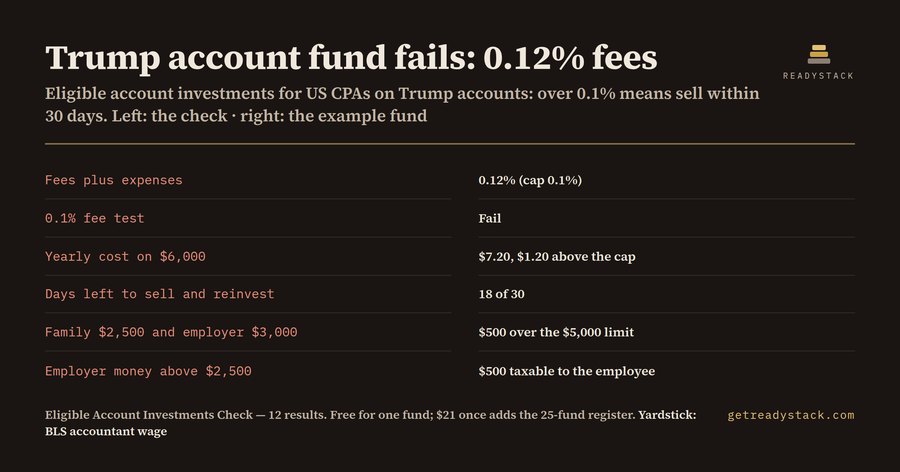
A fund with 0.04% expenses and 0.08% in fund fees totals 0.12%, and for the US CPA or payroll accountant advising on a Trump account in 2026 that means the fund fails. The cap is 0.1%. The free check shows it in two steps: fees plus expenses 0.12%, headroom -0.02%, fee test 0, yearly cost $7.20 on $6,000, of which $1.20 is above the cap.
That result surprises people who only looked at the expense ratio. The proposed rules published in the Federal Register on August 21, 2026 (FR Doc. 2026-17123) add every fee the fund charges its holders to its total annual operating expenses. Sales loads, redemption fees and mutual fund account fees all count. Trustee custody fees do not, because they belong to the account, not to the fund.
The clock is the expensive part. A trustee must re-determine each fund at least once every 12 months. When a fund is treated as ceasing to be eligible, it must be sold and the money reinvested in an eligible investment within 30 calendar days. If that does not happen, the account ceases to be a Trump account, and with it ceases to be an IRA. In the example, 12 days have passed, so 18 are left.
The index matters too. An eligible investment tracks a qualified index of primarily U.S. companies, uses no leverage and stays within 0.1%. Industry, sector and ESG indexes are out. The proposed safe harbor treats an index as primarily U.S. when U.S. companies are at least 90% of its weight. The example index sits at 92%, so it meets the safe harbor. Below 90% is not an automatic fail, but you have to look at the index.
Contributions are the second half of the page. Family, individual and employer money counts toward a $5,000 annual limit. In the example, $2,500 from the parents plus $3,000 from the employer is $5,500, which is $500 over. Employer money under section 128 is excluded from the employee's income only up to $2,500, so $500 of the $3,000 is taxable to the employee. The $1,000 pilot program deposit for children born in 2025 through 2028 and qualified general contributions through Treasury do not count toward $5,000.
Why not just check a fund screener? A screener shows the expense ratio. It does not add the load or the redemption fee from the prospectus fee table, it does not count the 30-day window from the date the fund was treated as ceasing to be eligible, and it does not split employer money at $2,500.
How to use it: type the 7 figures from the prospectus and the account statement. The 12 results update as you type, and nothing is uploaded. Change the fund fee to 0 and the same fund passes with 0.04%. Change the days to 41 and the window shows 11 days past.
The free page answers one fund and one child completely, as often as you like. The $21 .xlsx, paid once, keeps the record: a Fund Register for 25 funds with the next 12-month determination date and the 30-day sell-and-reinvest date for each, and a Contribution Ledger for 10 children with the $5,000 and $2,500 checks per child.
For scale, BLS OEWS 2025 puts the median accountant and auditor at $40.23 an hour. The rules are still proposed: comments close October 20, 2026, and Treasury says it intends to publish final regulations within 18 months of enactment. They are proposed to apply to taxable years beginning on or after January 1, 2026.
15 seconds — what it actually does
Questions people ask
What does the eligible account investments check do?
It adds a fund's total annual operating expenses (after waivers) to every fee the fund charges holders and tests the sum against the 0.1% cap for Trump accounts. It also checks the 90% U.S. index safe harbor, counts contributions against $5,000, splits employer money at $2,500 and counts the 30-day sell-and-reinvest window.
Who is it for?
US CPAs, tax preparers and payroll accountants advising parents, trustees or employers on Trump accounts in 2026. They must say whether a fund is an eligible investment, whether this year's contributions fit the $5,000 limit and how much employer money above $2,500 lands on the employee's W-2.
Why not just look up the expense ratio?
Because the proposed rules of August 21, 2026 count fees as well as expenses: sales loads, redemption fees and account fees charged by the fund. A fund with a 0.04% expense ratio and 0.08% in fund fees totals 0.12% and fails. A fund that fails must be sold and reinvested within 30 calendar days or the account ceases to be a Trump account.
What is free and what is paid?
Free: all 12 results for one fund and one child, as often as you like, with no sign-up. Paid, $21 once: an .xlsx with a Fund Register for 25 funds (test result, next 12-month determination date, 30-day sell-and-reinvest date) and a Contribution Ledger for 10 children, so the review is kept with dates.
What does it cost compared with doing it by hand?
BLS OEWS 2025 puts the median accountant at $40.23 an hour. Reading a prospectus fee table, adding the fees, checking the index and the contribution split for each fund and child is billable time every year. The free check takes two steps; the $21 register keeps every fund and child in one dated file.
When do these rules change next?
Comments on the proposed regulations close on October 20, 2026. Treasury and the IRS say they intend to publish final regulations within 18 months of the enactment of section 530A (July 4, 2025). The $5,000 and $2,500 limits are adjusted for inflation in later years.
Ask about this tool
One question, answered by the person who built it. Your email only if you want the answer sent.