· ReadyStack
Worked example
Real numbers from this tool, line by line.
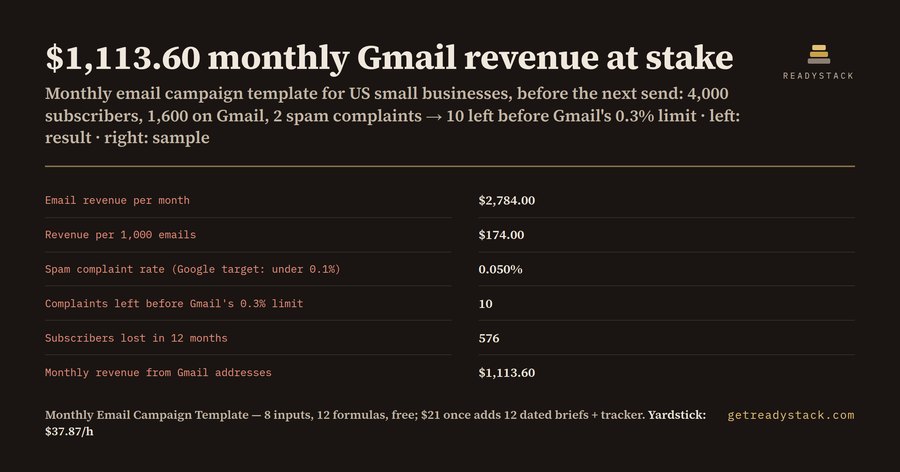
$1,113.60 of monthly Gmail revenue is at stake for a US small business with 4,000 subscribers that sends 4 campaigns a month. That is the sample in this monthly email campaign template, and here is the full result:
| Result | Sample |
|---|---|
| Emails sent per month | 16,000 |
| Revenue per campaign (12 orders × $58) | $696.00 |
| Email revenue per month | $2,784.00 |
| Revenue per 1,000 emails | $174.00 |
| Spam complaint rate (2 of 4,000) | 0.050% |
| Complaints left before Gmail's 0.3% limit | 10 |
| Subscribers lost in 12 months | 576 |
| Monthly revenue from Gmail addresses | $1,113.60 |
Why the Gmail line matters
1,600 of the 4,000 subscribers use Gmail, so 40% of the $2,784.00 runs through one inbox provider. Google's Email sender guidelines tell senders to keep the spam rate in Postmaster Tools below 0.3%, and the FAQ asks for below 0.1%. At 0.3% a sender loses delivery support, and from November 2025 Gmail ramps up enforcement with temporary and permanent rejections of mail that breaks the rules.
For a 4,000-person list, 0.1% is 4 complaints per campaign and 0.3% is 12. The sample sits at 2, so it has 10 left. A salon with 2,500 subscribers and 9 complaints is already past the limit: 0.360%, and the headroom line reads -1.5.
The quiet loss: your list shrinks
Every unsubscribe and every complaint has to leave the list. Gmail wants unsubscribes honored within 48 hours, and CAN-SPAM forbids sending more than 10 business days after an opt-out. At 10 unsubscribes and 2 complaints per send, 4 sends a month, the sample loses 576 people in 12 months unless new sign-ups replace them.
The 5,000-a-day line
From 5,000 messages a day to Gmail, Google also requires SPF, DKIM and DMARC and one-click unsubscribe. A store with 15,000 subscribers and 6,500 on Gmail is 1,500 over that line on every send day. The calculator shows that headroom as a negative number.
What CAN-SPAM adds
Every commercial email needs a valid physical postal address, a clear way to opt out and an honest subject line. The FTC can seek up to $53,088 per email in violation; that 2025 amount stays in force for 2026.
How to use it
Type 8 numbers from your last campaign report: subscribers, Gmail addresses, campaigns per month, orders, average order value, your email tool bill, spam complaints and unsubscribes. The 12 results update as you type. Nothing is uploaded.
Free, and what the workbook adds
The check for one campaign is free in the browser, every time. The $21 workbook is for sending every month: 12 dated campaign briefs from November 2026 to October 2027 (Black Friday on 27 November 2026, Mother's Day on 9 May 2027, Labor Day on 6 September 2027 and more), a 9-point pre-send checklist with the Google and CAN-SPAM source for each line, and a 12-month tracker that flags any month over 0.1%.
For scale: the median US marketing specialist earns $37.87 an hour (BLS, May 2025).
15 seconds — what it actually does
Questions people ask
What does this monthly email campaign template calculate?
You type eight numbers from your last campaign report: list size, Gmail addresses, sends per month, orders, average order, tool bill, spam complaints and unsubscribes. It returns revenue per campaign and per month, revenue per 1,000 emails, your complaint rate against Google's 0.1% target and 0.3% limit, complaints you can still take, subscribers lost in a year and the Gmail share of your monthly revenue.
Who is this for?
US small-business owners and the one person who runs their email: shops, salons, studios, local services and solo founders who send a promo or newsletter every month from Mailchimp, Klaviyo, Kit or a similar tool, and who need to know whether the next send is still safe for Gmail and still worth the bill.
Why not use a free email calendar template?
Free calendars plan dates and track open rates you type in. None of the ones we checked holds Google's sender rules: spam reports must stay below 0.3% (0.1% recommended), and from 5,000 messages a day to Gmail, SPF, DKIM, DMARC and one-click unsubscribe are required. This template puts those limits next to your own numbers.
What is free, and what does the paid workbook add?
Free in the browser: the full check for one campaign, all 12 results, as often as you like. The paid .xlsx adds what you need once you send every month: 12 dated campaign briefs from November 2026 to October 2027 with subject-line and preheader patterns, a pre-send compliance checklist, and a 12-month tracker that flags any month over 0.1% or 0.3%.
How does the price compare with hiring someone?
BLS (May 2025) puts the median US marketing specialist at $37.87 an hour, so one hour of planning and reporting costs more than this workbook. Template packs we found sell for $27 to $37 and contain no deliverability limits. You pay once, it is not a subscription, and you see your own free answer first.
Ask about this tool
One question, answered by the person who built it. Your email only if you want the answer sent.