· ReadyStack
Worked example
Real numbers from this tool, line by line.
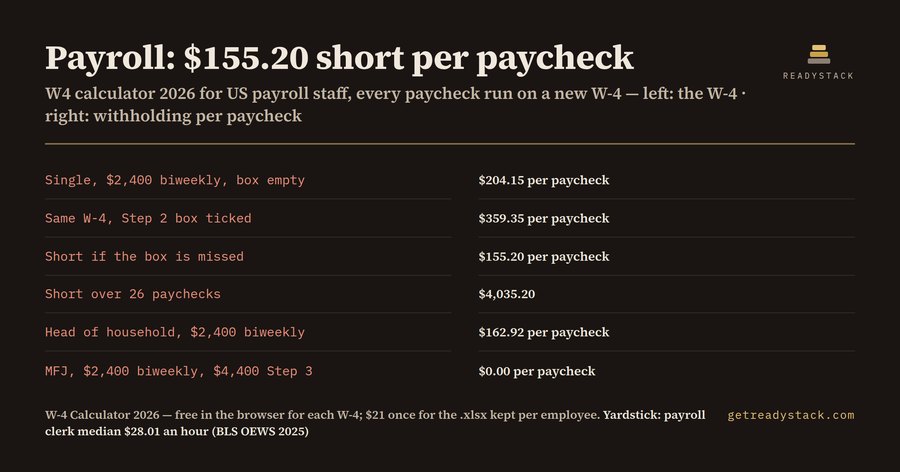
$155.20 short on every paycheck: that is what US payroll staff under-withhold when they miss the Step 2 box on a $2,400 biweekly Single 2026 Form W-4.
Result for one Single employee paid $2,400 biweekly, on the 2026 Pub 15-T tables:
- Step 2 box empty: withhold $204.15 per paycheck
- Step 2 box ticked: withhold $359.35 per paycheck
- Short if the box is missed: $155.20 per paycheck
- Short over 26 paychecks: $4,035.20
- Head of household, same wages: $162.92 per paycheck
- Married filing jointly, same wages, $4,400 in Step 3: $0.00 per paycheck
Those six lines come from IRS Publication 15-T (2026) Worksheet 1A, the method payroll uses to turn a W-4 into the federal income tax to withhold from each paycheck. Here is why each one comes out the way it does.
Why the 2026 tables matter. Pub 15-T (2026) says its withholding tables were updated for P.L. 119-21, the One Big Beautiful Bill Act. The Single STANDARD table now starts at $7,500 of Adjusted Annual Wage Amount; the 2025 table started at $6,400. For the Single employee above, the 2026 table gives $204.15 per paycheck. Last year's table would give $209.60. The gap is small, but a payroll setup copied from 2025 is no longer the IRS method.
The box that moves the most money. Step 2 of the W-4 is for employees with two jobs or a working spouse. When the box is ticked, line 1g of Worksheet 1A becomes zero and you switch to the Step 2 Checkbox schedule, whose bands are half as wide. That is why the same paycheck jumps from $204.15 to $359.35. If payroll misses the tick, each paycheck is $155.20 short, $4,035.20 over 26 paychecks. Section 3403 of the Internal Revenue Code is blunt: the employer is liable for the payment of the tax required to be withheld. Deposits that arrive late carry a 2%, 5% or 10% penalty under section 6656, depending on how many days late they are.
Filing status and Step 3. Married filing jointly uses a table that starts at $19,300, after a $12,900 line 1g amount. Head of household starts at $15,550, which is why the same $2,400 biweekly paycheck gives $162.92. A married employee filing jointly who writes $4,400 in Step 3 has the credits divided by 26 and subtracted per paycheck; the $3,128.00 tentative annual withholding is fully covered, so the result is $0.00.
What the calculator does. You type eight entries: wages this pay period, pay frequency, filing status, the Step 2 checkbox, Step 3, Step 4(a), Step 4(b) and Step 4(c). It shows twelve Worksheet 1A lines, from 1c annual wages to the amount to withhold per paycheck. The bands come straight from the 2026 Annual Percentage Method tables, and the formulas were checked against every row of all six IRS schedules. The IRS rounds three thresholds of the Single Step 2 table to whole dollars, and the calculator keeps that rounding.
What it does not do. This is federal income tax only. Social Security, Medicare and state withholding are separate. It does not replace the employee's W-4; it reads it.
Why not the IRS estimator. The Tax Withholding Estimator helps an employee plan their own refund. It does not show the employer's Worksheet 1A lines, and the employer is the one liable under section 3403.
The free check runs in the browser, with no account. If you want to keep a dated record per employee, the workbook holds the same twelve live formulas and the six official 2026 schedules.
15 seconds — what it actually does
Questions people ask
What does this W4 calculator work out?
You type 8 inputs: filing status, wages from job 1 and job 2, other income, Step 3 credits, tax withheld so far, withholding per paycheck now and paychecks left in 2026. 15 formulas apply the 2026 brackets and standard deduction, project withholding to December 31 and return the Form W-4 Step 4(c) extra amount per paycheck.
Who is this W-4 calculator for?
Married couples where both spouses work and anyone with two W-2 jobs. Each employer's payroll only sees its own wages, so each W-4 applies the whole standard deduction and the low brackets again. Payroll and HR staff can use it to answer an employee asking what to write in Step 4(c).
Why not just use payroll's default withholding?
Payroll withholds as if its job were your only income. With two jobs, both payrolls apply the married standard deduction (32,200 in 2026) and the 10% and 12% bands again, so the combined withholding falls short. Neither pay stub shows that gap; only adding both jobs together against the 2026 brackets does.
What is free and what is in the workbook?
The page is free and complete: 2026 tax, projected withholding, April balance, Step 4(c) per paycheck, the 90% safe-harbor minimum and the cost of waiting until the last 2 paychecks. The .xlsx keeps your numbers to re-run after each raise and splits the Step 4(c) amount between the two W-4s by each job's wages.
What does getting it wrong cost?
If the balance due after withholding is 1,000 or more, IRC 6654 can add an underpayment penalty, unless a safe harbor applies such as paying 90% of this year's tax. Fixing it in October spreads the gap over the paychecks left; waiting until December puts it on two.
Ask about this tool
One question, answered by the person who built it. Your email only if you want the answer sent.