For forums, review sites, directories and comment sections in England and Wales

Defamation notice of complaint form: your 48-hour section 5 deadline

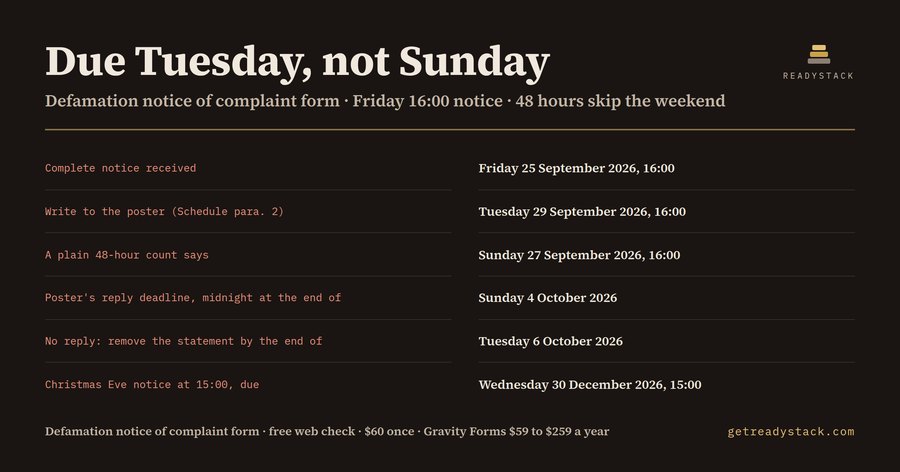
Write to the poster by

Tuesday 29 September 2026, 16:00

A plain 48-hour count says Sunday 27 September 2026, 16:00. Regulation 1(3) skips the weekend.

Full version — $60 once · Get the plugin with alerts, receipts and CSV

One payment, no subscription. The free plugin below already takes and lists every notice.

Your notice

Bank holidays built in: England and Wales, 2026 to 2028, plus Good Friday and Christmas Day as regulation 1(3) names them. The poster's 5th-day reply date counts every calendar day; regulation 1(3) applies only to the 48-hour steps.

What a valid notice must contain (9 items)

  1. The complainant's name — s.5(6)(a)
  2. The statement concerned — s.5(6)(b)
  3. Why it is defamatory of the complainant — s.5(6)(b)
  4. Where on the website it was posted — s.5(6)(c)
  5. An email address for the complainant — reg. 2(a)
  6. The meaning the complainant attributes to it — reg. 2(b)
  7. Which parts are factually inaccurate or opinions not supported by fact — reg. 2(c)
  8. Confirmation they lack enough information about the poster to sue them — reg. 2(d)
  9. Whether they consent to their name and email going to the poster — reg. 2(e)

A notice missing any of these is not a notice of complaint. You still owe a reply within 48 hours saying it does not comply and what it must contain (reg. 4).

Free WordPress plugin: the form itself

One shortcode, [defamation-notice-of-complaint-form], puts all 9 fields on a page, each one required and labelled, with a spam trap and nonce check. Every notice is listed in WordPress admin, 50 per page. Install: Plugins ▸ Add New Plugin ▸ Upload Plugin ▸ choose the .zip ▸ Install Now ▸ Activate. Menu names can differ slightly by WordPress version and admin language; PHP 7.4 or newer is required.

Why not a contact form? It does not ask for the 9 items, so you cannot tell a valid notice from a defective one, and nothing records the hour your 48 hours started.

Paid, $60 once: an email to you the moment a notice arrives, a receipt to the complainant, every notice as CSV with date and time, search by page address to spot a reposted statement (Schedule para. 9), and a separate form per section of your site. Gravity Forms, a general form builder, costs $59 to $259 per year and has no section 5 fields.

Full version — $60 once

Source: Defamation Act 2013 s.5; Defamation (Operators of Websites) Regulations 2013 (SI 2013/3028), regs 1(3), 2, 4 and the Schedule, legislation.gov.uk. This page dates the steps; it is not legal advice on whether a statement is defamatory.
Get the complete version $60

This page is the working piece. The full pack has everything below.

A UK site that hosts what its users post keeps the Defamation Act 2013 section 5 defence only if it acts within 48 business hours of a valid notice of complaint. This form asks for all 9 ite

Gravity Forms, a general WordPress form builder, costs $59 to $259 per year (gravityforms.com/pricing, September 2026) and ships no section 5 notice fields. The 48-hour periods skip Saturdays, Sundays, Good Friday, Christmas Day a

Buy the full version — $60
ENDEJAESPT

Find a tool

· ReadyStack

Worked example

Real numbers from this tool, line by line.

Defamation Notice of Complaint Form – UK Section 5 Defence for Forums, Review and Comment Sites

If your WordPress site in England and Wales publishes what other people write, sooner or later someone will say a post about them is defamatory. Section 5 of the Defamation Act 2013 gives the website operator a defence for statements posted by someone else. The catch is procedural: when the complainant cannot identify the anonymous poster, the defence holds only if you answer their notice of complaint exactly as the Defamation (Operators of Websites) Regulations 2013 set out, and nearly every step has a 48-hour limit.

The first question is whether what arrived is a notice of complaint at all. Section 5(6) and regulation 2 require nine items: the complainant's name; the statement; why it is defamatory of them; where on the site it was posted; an email address; the meaning they attribute to it; which parts they say are factually inaccurate or opinions not supported by fact; confirmation that they do not have enough information about the poster to bring proceedings; and whether they consent to their name and email going to the poster. If any of the nine is missing, regulation 4 still gives you 48 hours to tell the complainant the notice does not comply and what it must contain.

For a complete notice, the Schedule sets the path. If you can contact the poster, you write to them within 48 hours with a copy of the complaint (paragraph 2). They have until midnight at the end of the fifth day after the day you write to reply. If they stay silent, or refuse to give their full name and postal address, you remove the statement within 48 hours (paragraphs 5 and 6). If you have no way to contact the poster, you remove it within 48 hours of the notice (paragraph 3).

Here is the part that trips people. Regulation 1(3) says that when counting those 48 hours you disregard Saturdays, Sundays, Good Friday, Christmas Day and bank holidays in England and Wales. It does not apply to the poster's fifth-day reply date, which runs on calendar days. A complete notice received on Friday 25 September 2026 at 16:00 is due on Tuesday 29 September 2026 at 16:00. A plain 48-hour count would say Sunday 27 September at 16:00. If you write to the poster on the Tuesday, their reply deadline is midnight at the end of Sunday 4 October 2026, and if they say nothing, the removal deadline is the end of Tuesday 6 October 2026. Over Christmas the gap widens: a notice at 15:00 on Thursday 24 December 2026 is due at 15:00 on Wednesday 30 December, because 25 and 28 December are bank holidays and 26 and 27 December are a weekend.

A general contact form does not help with any of this. It will not ask for the nine items, so you cannot tell a valid notice from a defective one, and it does not record the hour your clock started. The free WordPress plugin is the form itself: one shortcode puts all nine fields on a page, each labelled and required, with a spam trap and nonce check, and every notice is listed in your admin, 50 per page.

The paid version is for proof and repeat traffic. It emails you the moment a notice arrives, so it does not sit unread over a weekend. It emails the complainant a copy of what they sent. It exports every notice as CSV with the date and time it arrived. It searches notices by page address, so a reposted statement is easy to spot. It is one payment, not a subscription; Gravity Forms, a general form builder, lists $59 to $259 a year and has no section 5 fields.

The plugin does not decide whether a statement is defamatory or remove anything for you; it makes sure each notice is complete and dated.

15 seconds — what it actually does

Questions people ask

What does this defamation notice of complaint form do?

It adds a notice of complaint form to your WordPress site with one shortcode. Its nine fields cover section 5(6)(a) to (c) of the Defamation Act 2013 and regulation 2(a) to (e) of the 2013 Regulations: name, statement, why it is defamatory, where it was posted, email, meaning, inaccurate parts, no information about the poster and consent to share. Every notice is listed in admin.

Who needs a section 5 notice of complaint form?

Operators of sites in England and Wales that publish what other people write: forums, review sites, local directories, community news and blogs with comments. When the complainant cannot identify an anonymous poster, the section 5 defence holds only if you follow the 2013 Regulations, and each step has a 48-hour limit that skips weekends and bank holidays.

Why not use a free contact form?

A contact form does not ask for the nine items section 5(6) and regulation 2 require, so you cannot tell a valid notice from a defective one. A defective notice needs its own reply within 48 hours under regulation 4. Nothing records the hour your clock started. The paid version alerts you at once, emails a receipt and exports every notice with date and time.

What do I get for free?

The free plugin works on its own: the nine-field notice form, your operator name and 48-hour handling steps above it, spam protection and the full notice list in admin, 50 per page. The free web page dates your deadline for a notice received at a given hour, skipping weekends, Good Friday, Christmas Day and England and Wales bank holidays.

How does the price compare?

It is $60 once, not a subscription. Gravity Forms, a general form builder, lists $59 to $259 every year and ships no section 5 fields. A notice that arrives at 16:00 on a Friday is due by 16:00 on the Tuesday; a plain 48-hour count says Sunday, and a Christmas Eve notice runs to 30 December.

Ask about this tool

One question, answered by the person who built it. Your email only if you want the answer sent.