· ReadyStack
Worked example
Real numbers from this tool, line by line.
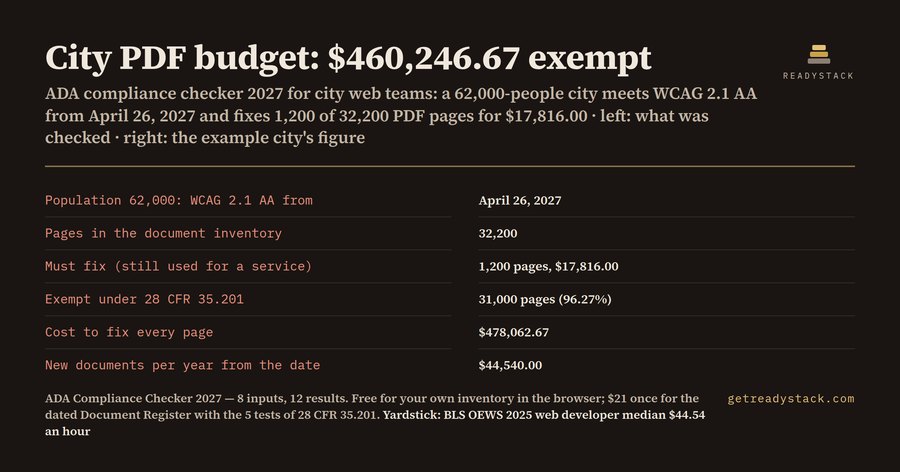
$460,246.67 of this city's PDF budget is exempt under ADA Title II — US city and county web teams, 62,000 people, WCAG 2.1 AA from April 26, 2027. The finished result for its 32,200 pages online:
- WCAG 2.1 AA from: April 26, 2027
- Pages in the document inventory: 32,200
- Must fix (still used for a service): 1,200 pages, $17,816.00
- Exempt under 28 CFR 35.201: 31,000 pages (96.27%)
- Cost to fix every page: $478,062.67
- New documents per year from the date: $44,540.00
A scanner tells you every PDF on your site fails. The ADA Title II rule does not ask you to fix all of them.
Who this is for. You run the website for a city, a county, an independent school district or a special district. The Department of Justice's ADA Title II web rule, 28 CFR 35.200, says your web content and mobile apps must meet WCAG 2.1 Level A and AA. The dates are later than many summaries still say: April 26, 2027 for a public entity with a total population of 50,000 or more, and April 26, 2028 for a smaller one or for any special district government.
What the rule leaves out. Section 35.201 lists five exceptions. (a) Archived web content: made before your date, kept only for reference, research or recordkeeping, never changed after archiving, and stored in an area clearly marked as the archive. (b) Preexisting conventional electronic documents, meaning PDFs, word processor files, presentations and spreadsheets posted before your date, unless people still use them to apply for, get access to or take part in a service, program or activity. (c) Content posted by a third party that is not working for you under a contract or licence. (d) Documents about one person, their property or their account that sit behind a password or are otherwise secured. (e) Social media posts published before your date.
What that does to the budget. Take an example city of 62,000 people with 32,200 pages of documents online. 1,200 pages are forms, applications and permit packets residents still use. 18,000 pages are older reports nobody uses for a service, 9,000 pages sit in a proper archive, and 4,000 pages are tax bills behind a login. At 20 minutes a page and $44.54 an hour, the BLS OEWS 2025 median for web developers, fixing everything costs $478,062.67. The rule requires the 1,200 service pages: 400 hours, $17,816.00, about 10 weeks of one full-time person. The exceptions take $460,246.67 off the bill.
Where people get it wrong. The opposite mistake costs more. A form posted years ago is not exempt if residents still fill it in, so it must meet WCAG 2.1 AA on your date. And from that date every new agenda, minutes file or notice you post has to be accessible too. With 3,000 new pages a year, that is $44,540.00 a year at the same rate.
When the date moves. Change the population to 18,000 and the same inventory gets April 26, 2028; the pages and the cost stay the same, you get one more year. A special district always gets 2028, whatever its size.
What the exceptions do not do. They lift the WCAG 2.1 AA requirement only. Other Title II duties still apply, such as effective communication when a resident asks for a document in a form they can use (28 CFR 35.160).
Check your own inventory. The free calculator on our page takes 8 entries, your population and the page counts from your media library, and returns 12 results, among them your date, the pages you must fix, the pages exempt, hours, cost and the yearly cost of new documents. Nothing is uploaded. The paid workbook adds a Document Register: one row per document with the five 35.201 tests and a Status column that names the paragraph, so you can hand council a dated scope record.
15 seconds — what it actually does
Questions people ask
What does this ADA compliance checker work out?
It applies the DOJ's ADA Title II web rule to your document inventory. From your population it gives your WCAG 2.1 AA date (April 26, 2027 or April 26, 2028, 28 CFR 35.200). From your page counts it applies the 28 CFR 35.201 exceptions and returns 12 results: pages you must fix, pages exempt, hours, cost and the yearly cost of new documents.
Who is it for?
Web managers, clerks, IT and ADA coordinators at cities, counties, independent school districts and special districts covered by ADA Title II. If your site holds thousands of old PDFs and someone asked you to budget the remediation before April 26, 2027 (population 50,000 or more) or April 26, 2028 (smaller or special district), this is the first number you need.
Why not just run a free accessibility checker on the site?
A free scanner tells you which pages fail WCAG. It does not tell you which of them the rule requires you to fix. 28 CFR 35.201 exempts archived web content, preexisting documents not used to apply for or access a service, third-party posts and individual documents behind a login. Scanning every PDF and fixing every failure prices work the rule never asked for.
What is free and what is in the paid file?
Free in the browser: the whole check, 8 inputs and 12 results, as often as you like, no account. The paid .xlsx ($21 once) adds a dated Document Register: one row per document with its URL, pages and the 35.201 tests, a formula that marks each row Must fix or Exempt with the paragraph, page totals per status, and the same 12 live formulas to hand to council or finance.
What does it cost compared with doing it another way?
With the example inventory, 1,200 pages that must be fixed take 400 hours: $17,816.00 at the BLS OEWS 2025 web developer median of $44.54 an hour. Fixing all 32,200 pages would cost $478,062.67. A lawyer's hour on the D.C. Fitzpatrick Matrix for 2026 runs $578 to $998; the workbook is $21 once, not a subscription.
Ask about this tool
One question, answered by the person who built it. Your email only if you want the answer sent.