· ReadyStack
Worked example
Real numbers from this tool, line by line.
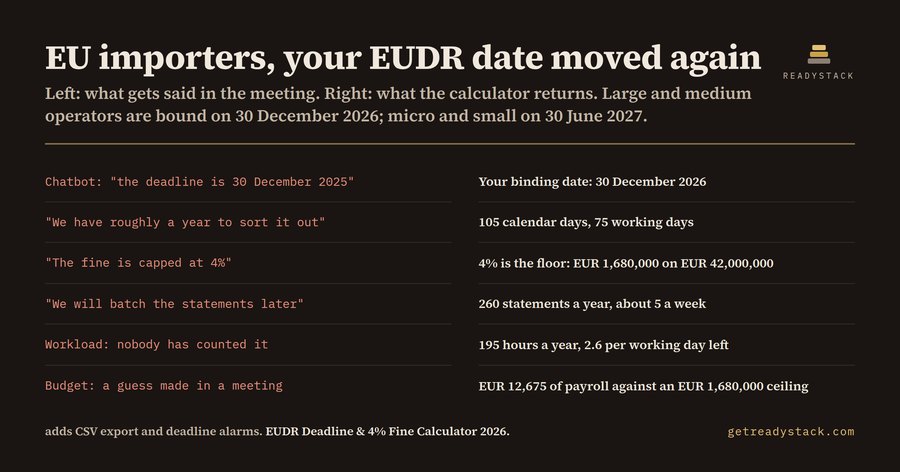
A Dutch coffee importer with EUR 42,000,000 of EU turnover has 105 calendar days - 75 working days - until 30 December 2026, and an Article 25 fine ceiling of EUR 1,680,000 sitting behind that date.
He did not get those numbers from a chatbot, because the chatbot told him the deadline was 30 December 2025.
That answer was true once. The EU Deforestation Regulation, Regulation (EU) 2023/1115, was written to apply from 30 December 2024. It was pushed to 30 December 2025. It was pushed again. The dates that bind anyone now are 30 December 2026 for large and medium operators and traders, and 30 June 2027 for micro and small enterprises and natural persons. A general assistant will hand you one of the dead dates without hesitating, and it has no idea which size class you are in.
The three numbers that decide the budget
The first is the date, and it is a fork, not a fact. Large and medium operators: 30 December 2026. Micro and small enterprises and natural persons: 30 June 2027. Select the wrong branch and every plan built on top of it is out by 182 days.
The second is the ceiling. Article 25 requires Member States to set maximum fines of at least 4% of the operator's total annual Union-wide turnover. The word people miss is 'at least'. Four percent is the floor the Member State ceiling has to clear, not a cap on exposure, and it comes alongside confiscation of the products and of the revenue derived from them, plus exclusion from public procurement and public funding for up to twelve months. On EUR 42,000,000 of turnover, 4% is EUR 1,680,000.
The third is the workload, and it is the one nobody counts until the date is close. A due diligence statement is filed per consignment placed on the market. At 260 consignments a year and 45 minutes each, that is 195 hours a year, five statements a week, and EUR 12,675 of loaded payroll at EUR 65 an hour. Spread across the 75 working days that are left, it is 2.6 hours every single working day, starting now.
What changes when the inputs change
A small cocoa trader in Portugal on EUR 9,500,000 of turnover, 48 consignments a year at 90 minutes each, EUR 58 an hour: 30 June 2027, 287 days left, an EUR 380,000 ceiling, 72 hours a year, EUR 4,176 of payroll. Same regulation, completely different project.
A large German timber importer assessing on 2 November 2026, EUR 310,000,000 of turnover, 1,450 consignments a year at 30 minutes each, EUR 78 an hour: 58 calendar days, 41 working days, an EUR 12,400,000 ceiling, 725 hours a year - 17.68 hours for every working day that remains. That last number is the useful one: it is not a compliance problem any more, it is a headcount problem.
Why a browser extension
Because this gets recalculated in the middle of other work - on a supplier portal, in a mail thread, on the call where finance asks what the exposure actually is. The calculation runs in the popup and on a free web page that uses the same code. Nothing typed into it leaves the browser; the only outbound request is licence validation, and only if a key is entered.
Every number described here is free, with no key, no watermark and no limit on how many times it runs. The paid layer is a different axis, not a crippled version of the same one: a .csv export of every scenario, so the working stays in the audit file, and browser alarms at 180, 90, 30 and 7 days before whichever date binds you.
The date moved three times. The next person who asks an assistant for it will get an old answer, delivered with total confidence. Ask something that knows your size class instead.
Questions people ask
What does this extension actually do?
You enter company size, assessment date, EU-wide turnover, consignments per year, minutes per statement and your hourly cost. A medium coffee importer on EUR 42,000,000 turnover with 260 consignments gets 30 December 2026, 105 calendar days and 75 working days left, an EUR 1,680,000 fine ceiling, 195 hours a year and EUR 12,675 of payroll.
Who is it for?
EU importers and their compliance managers placing coffee, cocoa, soy, palm oil, rubber, cattle or wood products on the Union market. It is built for the person who has to defend a readiness budget to a finance director and needs the date, the exposure and the workload on one screen.
Why not just ask a chatbot for the EUDR date?
Because the date moved three times. A general assistant will confidently repeat 30 December 2024 or 30 December 2025, both of which were superseded. It also will not know your size class, so it cannot tell you whether 30 December 2026 or 30 June 2027 binds you, and it cannot price your own consignment volume.
What is free and what needs the key?
Every number on the screen is free forever, with no key, no watermark and no usage limit. The key unlocks two different things: CSV export of every scenario you calculated, so it lives in your audit file, and browser alarms at 180, 90, 30 and 7 days before your application date.
What would this cost if a person did it?
At the default volume the tool prices 195 compliance hours a year at EUR 65 an hour, which is EUR 12,675 of payroll. A small trader with 48 consignments sees 72 hours and EUR 4,176 instead. The calculator does not remove that work, it plans it in one screen instead of a spreadsheet rebuilt every time the deadline moves.
Ask about this tool
One question, answered by the person who built it. Your email only if you want the answer sent.