· ReadyStack
Worked example
Real numbers from this tool, line by line.
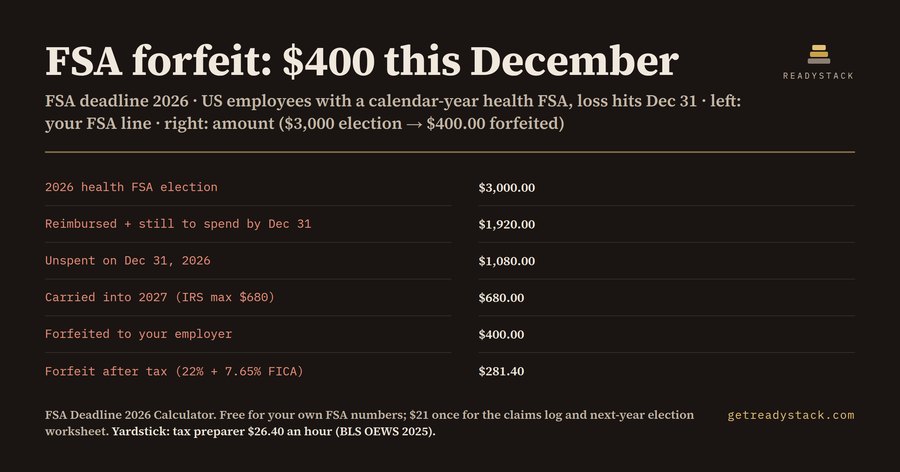
If your health FSA runs on the calendar year, December 31, 2026 is the day unspent money stops being yours. IRS Publication 969 calls FSAs "use-it-or-lose-it": whatever is left at the end of the plan year is forfeited unless your plan offers one of two kinds of relief. It can offer a carryover or a grace period of up to 2½ months, but never both.
For 2026 the IRS set the numbers in Rev. Proc. 2025-32. The most you can put into a health FSA through salary reduction is $3,400. If your plan allows a carryover, the most it can carry into 2027 is $680. Your plan can choose a lower figure, so read the plan summary before you trust that number.
Here is a worked example with numbers I ran through the calculator. You elected $3,000 for 2026. You have been reimbursed $1,640 so far, and you have another $280 of eligible expenses booked before December 31: a dental filling and a prescription refill. That leaves $1,080 unspent at year end. Your plan carries over up to $680, so $680 moves into 2027 and $400 is forfeited to your employer.
Four hundred dollars sounds bad, and it is, but it is not the whole story. FSA money comes out of your pay before federal income tax and before the 7.65% employee FICA. At a 22% bracket you skip 29.65% on every FSA dollar. So the $400 forfeit really costs you $281.40 of take-home pay. On the $1,920 you did use, you saved $569.28 in tax. The FSA still came out $169.28 ahead for 2026. The calculator shows all three numbers side by side, because "I lost money on my FSA" and "my FSA was a mistake" are not the same thing.
Plan design changes the answer more than most people expect. Take the same election and spending, but put it on a grace-period plan instead of a carryover plan, at a 24% bracket. If you will incur $500 of eligible expenses between January 1 and March 15, 2027, those come out of the 2026 money. You forfeit $580 when the grace period ends, which costs you $396.43 after tax. If your plan has neither relief, the full $1,080 is gone on December 31, which costs $738.18 at the same bracket. Same person, same receipts, three different losses.
There is a second deadline hiding inside the first one. Open enrollment for 2027 happens this autumn, often before you know how 2026 ends. The calculator answers that too. In the carryover example you actually used $1,920. With $680 arriving from 2026, an election of $1,240 for 2027 covers the same spending. Electing $3,000 again would set up the same forfeit next December.
What to do this week: type your election, what you have been reimbursed, and the eligible expenses you can still schedule before December 31. Pick your plan's rule, carryover, grace period or neither, and your bracket. If the verdict shows a forfeit, you have a dollar target. Book the eye exam, refill the glasses prescription, or submit that receipt from March you forgot about. Expenses must be incurred by December 31, or by the end of the grace period. Claims can usually be submitted later, up to your plan's own run-out date, so check yours.
The check is free in the browser and complete. If you want to keep track for the rest of the year, there is an Excel file. Its claims log has 100 rows and recounts your balance and forfeit after every receipt you add. Its 2027 election worksheet has 12 expense lines for open enrollment.
15 seconds — what it actually does
Questions people ask
What does the FSA deadline 2026 calculator work out?
It takes your 2026 health FSA election, what you have been reimbursed, what you will still spend by December 31, 2026 and your plan type, then shows the dollars you forfeit after the carryover (IRS maximum $680) or grace period. It also shows what that forfeit really costs after tax and a 2027 election that covers the same spending.
Who is this FSA planner for?
US employees with a health flexible spending account on a calendar-year plan who still have a balance this autumn, and the HR or benefits staff who answer their questions during open enrollment. If your plan year ends December 31, 2026, your unspent money is at stake now and your 2027 election is due in the same weeks.
Why not just check the balance in my FSA app?
Your FSA app shows a balance. It does not subtract the expenses you still plan to incur, apply your plan's $680 carryover or grace-period rule, or tell you what the forfeit costs after the 22% or 24% tax you skipped. It also does not turn this year's real spending into a 2027 election figure.
What is free and what is in the paid file?
The full check runs free in your browser with your own numbers: forfeit, after-tax cost, tax saved and a 2027 election figure, with no account. The one-time paid Excel file adds a 2026 claims log with 100 rows that recounts your balance after every receipt, plus a 2027 election worksheet with 12 expense lines.
What does it cost compared with asking a professional?
BLS OEWS 2025 puts the median hourly wage of a tax preparer at $26.40 and of a benefits specialist at $37.60, before any firm's markup. The file is a single payment, not a subscription. Most people only see the result after the plan year has closed, when nothing can be changed.
Ask about this tool
One question, answered by the person who built it. Your email only if you want the answer sent.