· ReadyStack
Worked example
Real numbers from this tool, line by line.
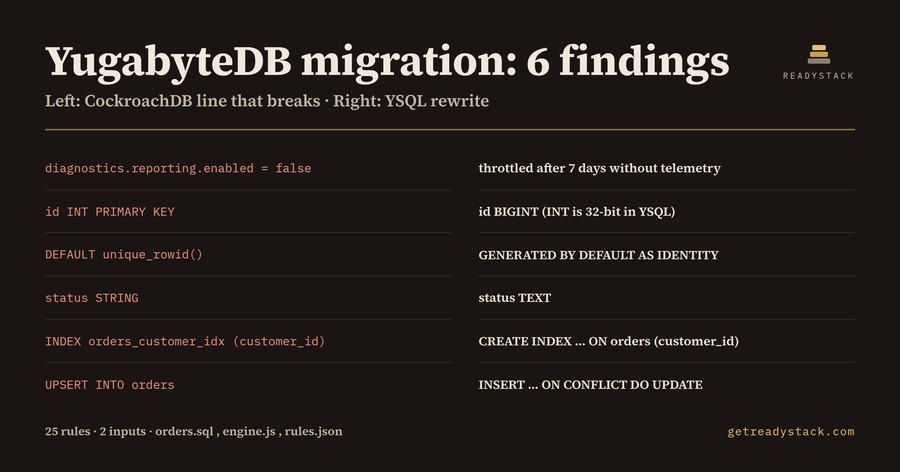
6 findings in one CockroachDB orders.sql: that is what a YugabyteDB migration check returned for the schema a platform team exports first when it leaves self-hosted CockroachDB.
What Cockroach Labs changed, and when
Cockroach Labs retired the free CockroachDB Core edition with version 24.3.0 on 2024-11-18. Its Licensing FAQ says the CockroachDB Software License covers all versions from the 24.3.0 release date on, including patch fixes for 23.1 to 24.2 from that date. A cluster without a licence key gets a 7-day grace period, then is throttled to 5 concurrent open SQL transactions. Enterprise Free is for businesses with less than 10 million dollars in annual revenue, and Enterprise Free and Trial clusters are throttled after 7 days without sending telemetry. The Enterprise Trial lasts 30 days.
YugabyteDB is Apache-2.0 and speaks the PostgreSQL dialect, YSQL. CockroachDB also calls itself PostgreSQL-compatible, so the schema looks portable until the first CREATE TABLE runs.
The file
SET CLUSTER SETTING diagnostics.reporting.enabled = false;

CREATE TABLE orders (
  id INT PRIMARY KEY DEFAULT unique_rowid(),
  customer_id UUID NOT NULL,
  status STRING NOT NULL DEFAULT 'new',
  total DECIMAL(12,2) NOT NULL,
  created_at TIMESTAMPTZ NOT NULL DEFAULT now(),
  INDEX orders_customer_idx (customer_id)
);

UPSERT INTO orders (id, customer_id, status, total) VALUES (...);
The 6 findings
diagnostics.reporting.enabled = false(licence-telemetry-off). On Enterprise Free this is the setting that gets a cluster throttled after 7 days. On YugabyteDB, delete it.INT(int-width). CockroachDB INT is 64-bit. YSQL INT is 32-bit, so ids above 2,147,483,647 overflow after the move. Write BIGINT.unique_rowid()(unique-rowid). A CockroachDB built-in with no YSQL equivalent. UseBIGINT GENERATED BY DEFAULT AS IDENTITY.STRING(string-type). A CockroachDB alias. Write TEXT.INDEX orders_customer_idx (customer_id)insideCREATE TABLE(inline-index). YSQL rejects it. Move it toCREATE INDEX ... ON orders (customer_id).UPSERT INTO(upsert). Not in YSQL. WriteINSERT ... ON CONFLICT (id) DO UPDATE SET ....
The rewritten file, with PRIMARY KEY (id HASH) and INCLUDE (status) on the index, returns 0 findings.
Why a PostgreSQL linter does not catch it
Finding 2 is the dangerous one. INT is perfectly valid PostgreSQL, so a generic linter passes it. It fails later, when an id crosses the 32-bit limit. Findings 3 to 6 fail loudly, but without the rewrite.
What the 25 rules cover
The extension groups its 25 rules into licence and settings (4), types and keys (5), DDL (10) and DML and operations (6). Beyond the six above it flags hash-sharded indexes with bucket_count, column families, INVERTED INDEX (use GIN), STORING (use INCLUDE), CONFIGURE ZONE and multi-region LOCALITY (use tablespaces with replica placement), AS OF SYSTEM TIME, CREATE CHANGEFEED, crdb_internal and BACKUP/RESTORE.
Try it on your own file
Open any .sql file in VS Code and the findings land in the Problems panel, each ending with the YSQL rewrite. The same engine runs on the web page at getreadystack.com/tools/yugabytedb-migration-check, in the browser, with nothing uploaded. Checking one file is free and complete. The full version scans every migration in the workspace at once and exports a Markdown report for the change ticket.
15 seconds — what it actually does
Questions people ask
What does YugabyteDB Migration Check do?
It reads a CockroachDB .sql schema or migration file and marks every line YugabyteDB YSQL rejects or reads differently, with the rewrite. It has 25 rules and 2 inputs: the .sql file text and today's date. On the sample orders.sql it returns 6 findings, including UPSERT INTO, unique_rowid(), STRING and 64-bit INT; the rewritten file returns 0.
Who is this migration check for?
Platform, backend and database engineers who self-host CockroachDB and are moving to YugabyteDB after CockroachDB 24.3.0 (2024-11-18) retired the free Core edition. It fits companies above the $10M annual revenue limit of Enterprise Free, and teams whose clusters would be throttled to 5 concurrent open SQL transactions without a licence key.
Why not use a free PostgreSQL linter to check CockroachDB SQL?
A PostgreSQL linter accepts INT as valid SQL, but CockroachDB INT is 64-bit and YugabyteDB YSQL INT is 32-bit, so values above 2,147,483,647 overflow after the move without any warning. CockroachDB extensions like STRING, UPSERT INTO, unique_rowid(), STORING and inline INDEX are also not in a PostgreSQL rule set.
What is free and what does the full version add?
Free: check one CockroachDB .sql file, completely, with all 25 rules in 4 groups: licence and settings (4), types and keys (5), DDL (10), DML and operations (6). No key is needed. Full version, $29 once with one licence key per person or team seat: scan every .sql migration in the workspace in one pass and export a Markdown migration report.
What does staying on CockroachDB self-hosted cost instead?
Under the CockroachDB Software License, businesses at or above $10M annual revenue need a paid Enterprise licence, priced per vCPU. A cluster without a key gets a 7-day grace and is then throttled to 5 concurrent open SQL transactions. Enterprise Free clusters are also throttled after 7 days without telemetry. YugabyteDB is Apache-2.0.
Ask about this tool
One question, answered by the person who built it. Your email only if you want the answer sent.