· ReadyStack
Worked example
Real numbers from this tool, line by line.
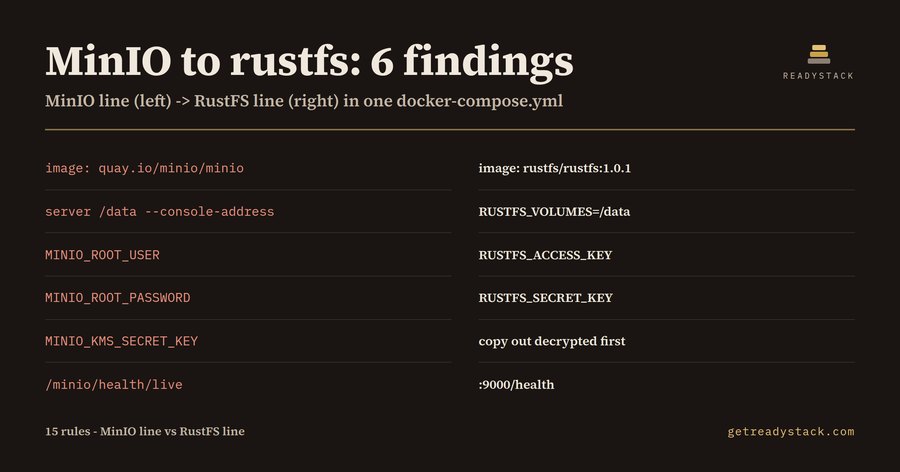
MinIO to rustfs: 6 findings. That is what a platform engineer moving self-hosted S3 storage off MinIO gets from one 16-line docker-compose.yml, and every finding comes with the line that replaces it.
| Line | MinIO line | RustFS line |
|---|---|---|
| 3 | image: quay.io/minio/minio:RELEASE.2025-04-22T22-12-26Z | image: rustfs/rustfs:1.0.1 |
| 4 | command: server /data --console-address ":9001" | RUSTFS_VOLUMES=/data, RUSTFS_ADDRESS=0.0.0.0:9000, RUSTFS_CONSOLE_ADDRESS=0.0.0.0:9001, RUSTFS_CONSOLE_ENABLE=true |
| 9 | MINIO_ROOT_USER | RUSTFS_ACCESS_KEY |
| 10 | MINIO_ROOT_PASSWORD | RUSTFS_SECRET_KEY |
| 11 | MINIO_KMS_SECRET_KEY | copy objects out decrypted over the S3 API first |
| 15 | /minio/health/live | http://localhost:9000/health |
What MinIO changed
The minio/minio GitHub repository was archived in April 2026. Its README now opens with "THIS REPOSITORY IS NO LONGER MAINTAINED." The community edition is AGPLv3 and distributed as source code only, and the legacy pre-compiled binaries "will not receive updates." Commercial or proprietary use goes to AIStor, MinIO's commercial edition, which is priced by quote.
A team pulling quay.io/minio/minio today runs an image that will not get another fix, so teams are moving to RustFS, an Apache-2.0, S3-compatible server that keeps the same ports: S3 on 9000 and the console on 9001.
Why changing the image is not the migration
Swapping the image tag is the edit a chatbot makes first. The other five lines are where the move breaks:
- RustFS ignores MINIO_ROOT_USER and MINIO_ROOT_PASSWORD. It reads RUSTFS_ACCESS_KEY and RUSTFS_SECRET_KEY. If you leave the old names in place, the server starts with the public sample credential rustfsadmin.
- The server /data --console-address command is MinIO syntax. RustFS takes its volumes and addresses from RUSTFS_VOLUMES, RUSTFS_ADDRESS and RUSTFS_CONSOLE_ADDRESS.
- The health probe /minio/health/live does not exist on RustFS. The RustFS sample compose probes :9000/health and :9001/rustfs/console/health.
- MINIO_KMS_SECRET_KEY is the dangerous one. The RustFS README says objects MinIO encrypted are not readable by RustFS. Copy them out over the S3 API, which returns decrypted bytes, before the cutover. Then configure a RustFS KMS backend: Vault KV2/Transit or AWS KMS.
Two things that are not in your file
The RustFS container runs as UID/GID 10001:10001, so bind-mounted data, log and TLS directories have to be writable by that user. MinIO on-disk compatibility is a preview feature behind the rio-v2 build flag and is not in the default build. Do not remount the old data directory; copy objects with rclone or any S3 client.
Helm, Dockerfile and Terraform
The same 15 rules read Helm values.yaml and Chart.yaml: quay.io/minio/minio and quay.io/minio/mc repositories, bitnami/minio, minio/operator, and the charts.min.io repository, which maps to https://charts.rustfs.com, chart rustfs 1.0.1. In a Dockerfile they flag dl.min.io binary downloads, the CMD ["minio", "server", ...] form, MINIO_ACCESS_KEY and MINIO_VOLUMES. In Terraform they flag the aminueza/minio provider.
Run it on your own file
Open the free page or install the VS Code extension and paste one compose file, Dockerfile, values.yaml, Chart.yaml or .tf file. You get every MinIO line with its replacement; nothing is uploaded. The check for one file is complete and free. A licence key adds the whole-workspace migration plan and a CI gate that fails a build adding new MinIO use.
15 seconds — what it actually does
Questions people ask
What does RustFS Migration Map do?
It reads a docker-compose.yml, Dockerfile, Helm values.yaml, Chart.yaml or Terraform file and lists every MinIO line with its line number and the exact RustFS replacement line. The sample compose file gives 6 findings: the minio/minio image, the server command, MINIO_ROOT_USER, MINIO_ROOT_PASSWORD, MINIO_KMS_SECRET_KEY and the /minio/health/live probe. It uses 15 rules.
Who is it for?
It is for platform, DevOps and backend engineers who self-host S3-compatible storage with MinIO in docker-compose, Kubernetes Helm charts or Terraform. The minio/minio repository was archived in April 2026 and its community binaries get no updates, so these engineers are moving to RustFS, the Apache-2.0 alternative, and need every config line changed correctly.
Why not just ask a chatbot or use find-and-replace?
Find-and-replace changes the image tag but leaves MINIO_ROOT_USER, the /minio/health/live probe and MINIO_KMS keys behind. RustFS ignores those names, so the container starts with the public default credential rustfsadmin or fails its health check. Objects MinIO encrypted are not readable by RustFS at all, and a chatbot rarely warns about that.
What is free and what does the licence key add?
Free: any single file, checked completely, with all 15 rules and every replacement line, in VS Code or the web page, with no account. The licence key adds the whole workspace: a dated migration plan across all files and a CI gate that fails a build adding new MinIO use. The team key adds the company exposure report.
What does staying on MinIO cost compared with moving?
Staying on a supported MinIO build means AIStor, MinIO's commercial edition, which is priced by quote. The archived community edition is AGPLv3 and source-only. RustFS is Apache-2.0 and free to run. The remaining cost is the engineering time to change every MinIO line, and this map lists those lines for you.
What changes next?
RustFS lists MinIO on-disk compatibility as a preview feature behind the rio-v2 build flag, not in the default build, so data still has to be copied over the S3 API. When the RustFS README or chart index changes (current chart rustfs 1.0.1), the rules and their source links are updated.
Ask about this tool
One question, answered by the person who built it. Your email only if you want the answer sent.