Prices the 2026 paid-family-leave payroll premium for Delaware, Maine, Minnesota and Maryland, applying the size tier and the wage test that decide your rate.

What you get: Export the rate table and your own figures to CSV, and get reminders 30, 14 and 1 day before each quarterly premium due date. Full version · $60 →
Updated 2026-09-20 · ReadyStack
Prices the 2026 paid-family-leave payroll premium for Delaware, Maine, Minnesota and Maryland, applying the size tier and the wage test that decide your rate.
| Rate that actually applies | — | % |
|---|---|---|
| Wages the premium is charged on | — | USD |
| Total 2026 premium | — | USD |
| Employer's own share | — | USD |
| Withheld from wages | — | USD |
| Back premium for months already run | — | USD |
| Why that rate | — |
$60 once · one licence key per person or team seat · Every calculation above stays free and unlimited without a key. A payroll-compliance consultant bills $150 to $300 an hour for one state.
Export the rate table and your own figures to CSV, and get reminders 30, 14 and 1 day before each quarterly premium due date.
One payment, one licence key for this tool. The key is shown right after payment.
A payroll-compliance consultant bills $150 to $300 an hour for one state.
Buy the full version — $60I have a keyThis tool is 1 of 262 paid tools in English. All 262 with one key: Freelancer & Small Business Pass — $9.99/month · $79/year · Deadline reminders by email (free)
Need more than this one? ReadyStack Pass opens all 676 files and 556 full versions — $29/month or $199/year. See the Pass →
· ReadyStack
Real numbers from this tool, line by line.
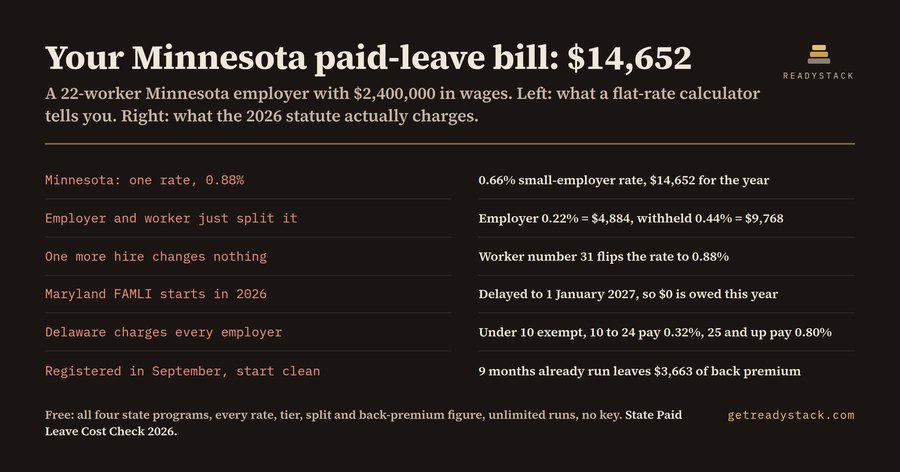
A Minnesota payroll administrator running 22 people on $2,400,000 of in-state wages owes $14,652 in Paid Leave premium for 2026, and $4,884 of that is the company's own money rather than a deduction from wages.
That figure is easy to get wrong this year, because four US states now charge an employer paid-family-and-medical-leave premium and in 2026 none of them charge it the same way.
Minnesota Paid Leave switched on 1 January 2026. The headline rate is 0.88% of covered wages, but there is a reduced small-employer rate of 0.66% and it has two conditions, not one. You need 30 or fewer workers in each quarter, and you need an average quarterly wage at or under $27,745.88.
Work the example. Twenty-two workers, $2,400,000 of in-state wages, of which $180,000 sits above the $185,000 per-worker cap, so the premium is charged on $2,220,000. Average quarterly wage is $27,273, just under the $27,745.88 line. The small-employer rate holds: 0.66%, or $14,652 for the year. Of that, 0.44% may be withheld from wages, which is $9,768, and the employer's own share is the remaining 0.22%, or $4,884.
Now hire one more person. At worker number 31 the headcount condition fails on its own, no matter what the wages do. The rate becomes 0.88%, the employer's own share becomes 0.44% instead of 0.22%, and on the same $2,220,000 of covered wages that share doubles from $4,884 to $9,768. One hire, $4,884 of new employer cost that nothing on your payroll run tells you about.
Delaware is a different shape entirely. It is not a single rate but a headcount ladder. Under 10 Delaware workers the program does not apply and you owe nothing unless you opt in. At 10 to 24 workers you owe parental leave only, 0.32% of covered wages. At 25 and up you owe the full 0.80%, split 50/50 with employees by default, capped at the 2026 Social Security taxable wage base of $184,500.
Maine runs a third shape. The rate is 1.0% of wages for employers with 15 or more employees, of which no more than 0.5% may come out of wages. Below 15 employees the employer's half is waived entirely, but the 0.5% employee deduction still has to be withheld and remitted.
Maryland is where most reference material is stale. Maryland FAMLI has been delayed again, to contributions beginning 1 January 2027. The correct 2026 amount for Maryland is $0. An employer that starts withholding this year is taking money out of wages for a program that is not in force.
The fourth number that matters is the one nobody calculates: what you owe for the months you have already run. Minnesota premiums began in January. An employer that registered late in September has nine months of payroll behind it, and on a $4,884 annual employer share that is $3,663 of back premium already accrued before the next quarterly payment is even due.
State Paid Leave Cost Check 2026 is a browser extension that takes state, in-state headcount, annual in-state wages, the part above the per-worker cap, your withholding choice and the months already run, and returns the applied rate with a one-sentence reason, the covered wages, the total premium, the employer share, the withheld amount, and the back premium. Every one of those calculations is free and unlimited with no licence key. The $60 full version adds a different axis rather than more answers: CSV export of your figures, and reminders 30, 14 and 1 day before each quarterly due date. For comparison, an independent payroll-compliance consultant bills $150 to $300 an hour to re-check a single state's rate and tier.
You enter a state, your headcount there, your annual wages and the part of those wages above the per-worker cap. It returns the 2026 premium rate that applies to you, the total premium, the employer's own share, the amount you may withhold from wages, and the back premium owed for months of 2026 payroll you already ran.
Payroll and HR admins at 10-to-60-person US employers with staff in Delaware, Maine, Minnesota or Maryland. That headcount band is exactly where the size tiers bite: Delaware changes rate at 10 and again at 25 workers, Maine waives the employer share under 15, and Minnesota's reduced rate stops at 30.
A single-rate calculator gives you one percentage. It does not run Minnesota's average-quarterly-wage test, does not switch Delaware between 0%, 0.32% and 0.80% on headcount, does not know Maryland FAMLI moved to 1 January 2027, and does not price the months of 2026 you have already run payroll without remitting.
Every calculation is free and unlimited with no licence key: all four states, every rate, the size tiers, the employer and employee split, and the back-premium figure. The $60 full version adds a different axis, ownership and repetition: CSV export of your figures and reminders 30, 14 and 1 day before each quarterly premium due date.
An independent payroll-compliance consultant bills $150 to $300 an hour. Re-checking one state's 2026 rate, its size tier and your split is comfortably an hour of that, and you need it again each time headcount crosses a tier or a new state program switches on.
One question, answered by the person who built it. Your email only if you want the answer sent.
Paste this code into your page. It runs in your visitor’s browser and stays up to date. Nothing your visitors type is stored.
For businesses: your name and logo instead of ours, and each visitor’s result + e-mail in your inbox (only when they tick consent) — Pro from $19/month. See Pro →
For a team or company: for an invoice with your company details, a quote or several licences, write to [email protected].
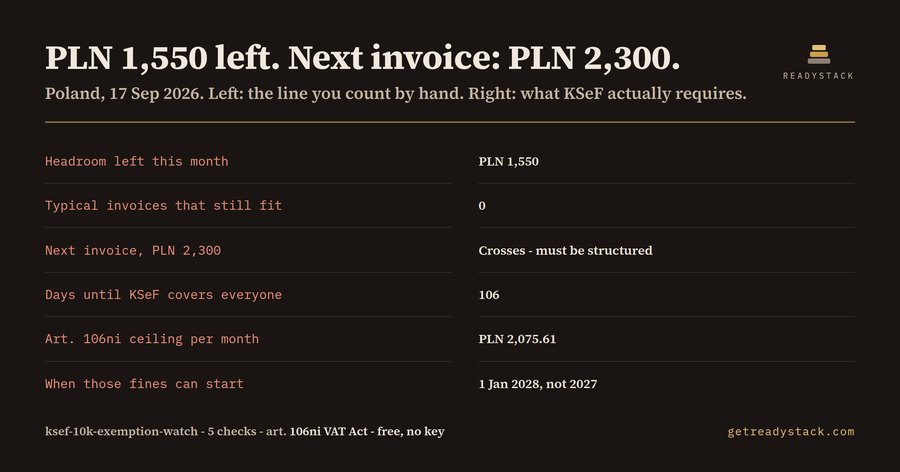
Your PLN 10,000 headroom this monthPoland, 2026: find the exact invoice that kills your PLN 10,000/month KSeF exemption, and the date it stops mattering.FreeFull version $60
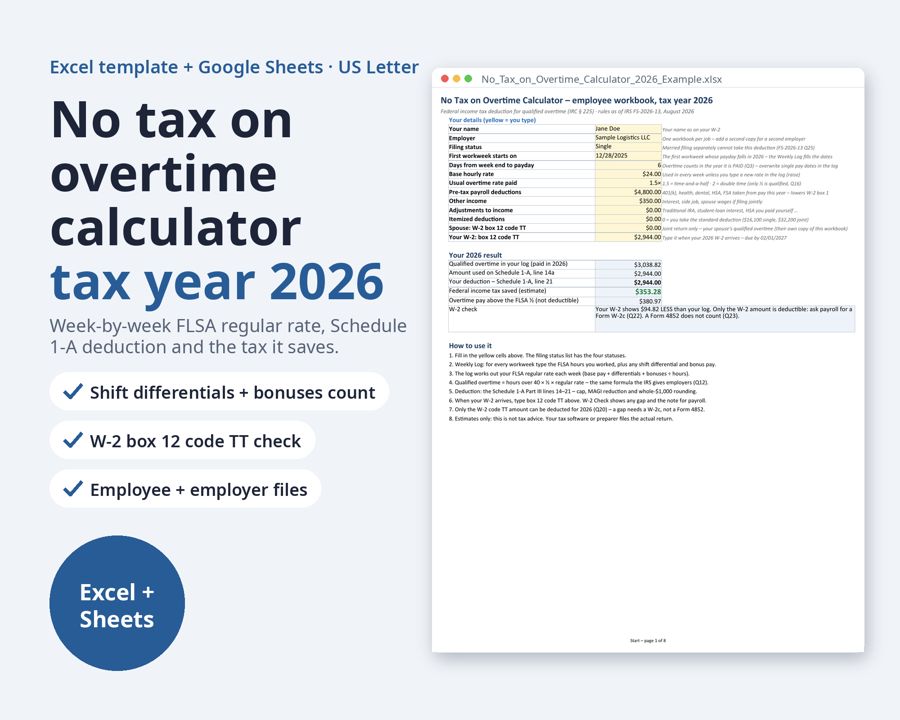
No Tax on Overtime Calculator 2026A no tax on overtime calculator for the 2026 tax year: log your hours week by week and the spreadsheet works out your qualified overtime…FreeFull version $11.99
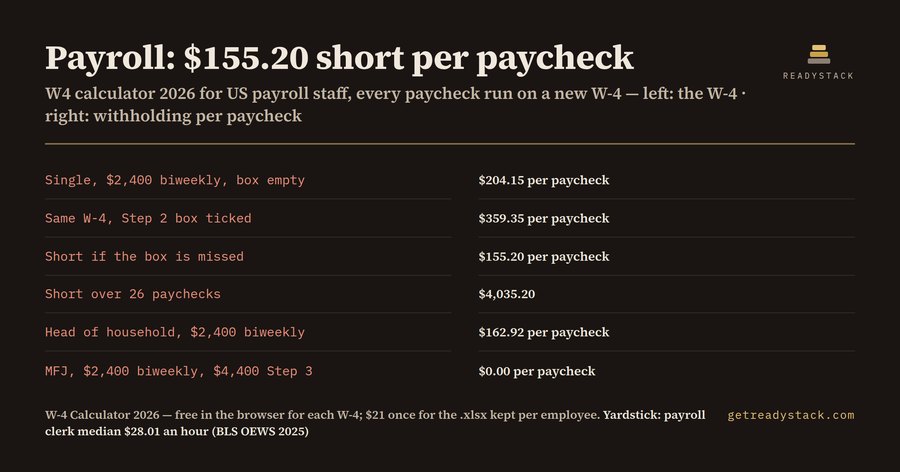
W4 Calculator 2026: Step 4(c) Extra Withholding Per Paycheck for Two-Job CouplesTwo jobs, two payrolls, each applying the married standard deduction (32,200 in 2026) and the 10% and 12% bands again. Owing 1,000 or more…FreeFull version $21
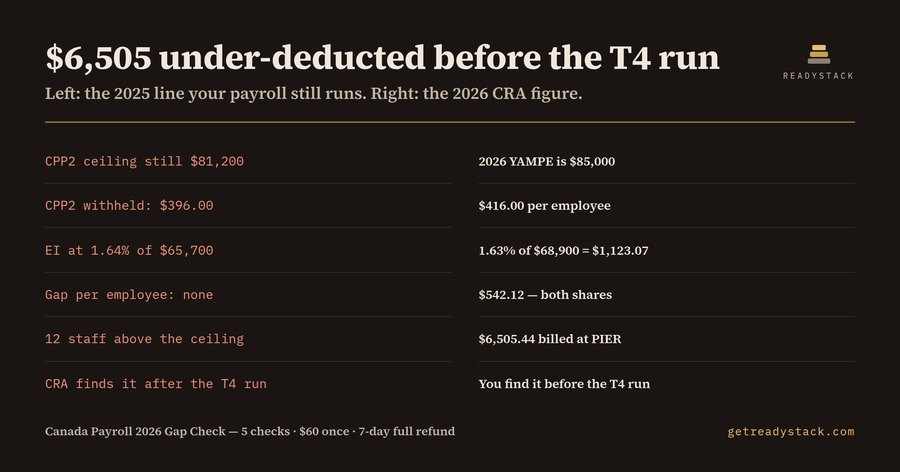
2026 CPP / CPP2 / EI deduction and under-deduction gapReads a salary against the 2026 CRA ceilings and shows what a payroll still on 2025 tables under-deducts for CPP, CPP2 and EI before a PIER…FreeFull version $60
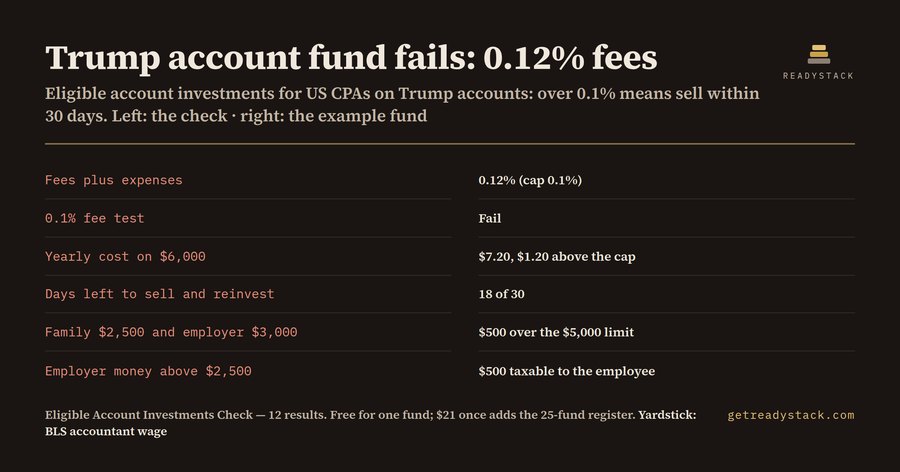
Eligible Account Investments Check (Trump Account, 2026)Eligible account investments check for Trump accounts: fees plus expenses vs the 0.1% cap, the 30-day sell rule, the $5,000 limit, $2,500…FreeFull version $21ReadyStack
Calculators, templates and deadlines for the rules that change every year — free in your browser.