· ReadyStack
Worked example
Real numbers from this tool, line by line.
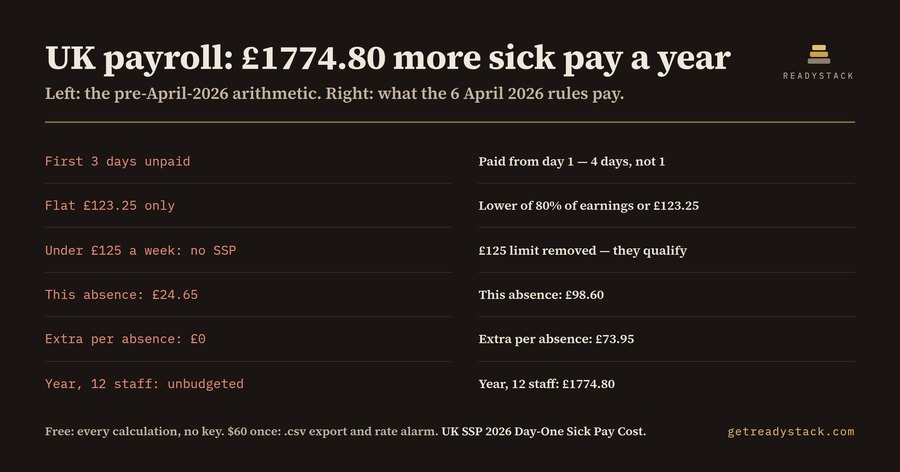
£1774.80 a year is what the 6 April 2026 statutory sick pay rules add to the wage bill of a UK employer with 12 part-time staff, and a spreadsheet built on the old rule shows none of it.
Three things changed on the same morning. The Employment Rights Act 2025 abolished the three unpaid waiting days, so statutory sick pay is payable from the first qualifying day of the absence. It removed the lower earnings limit, which was £125 a week in 2025/26 and used to be the gate you had to clear to qualify at all; around 1.3 million lower-paid workers became eligible. And it changed the amount: an employee is now paid the lower of 80% of their average weekly earnings, measured over the 8-week reference period before the absence, or the flat rate of £123.25 a week, for up to the statutory maximum of 28 weeks.
Each change is small. Together they move the number most for exactly the staff a small employer has most of.
Take a shop with 12 people on £260 a week over a 5-day qualifying week. Someone is off for 4 days. Under the old rule the first 3 days were waiting days, so the employer paid 1 day at the flat rate: £24.65. Under the rule in force now, all 4 qualifying days are paid at £24.65 a day, which is £98.60 for the same absence. That is £73.95 more per absence. At 2 absences per person per year across those 12 people, it is £1774.80 a year that was not in last year's budget.
Now take the case the old rule made invisible. Someone earns £110 a week over a 4-day week. In 2025/26 they were below the £125 lower earnings limit, so a 4-day absence cost the employer £0 in statutory sick pay. Today the weekly rate is 80% of £110, which is £88, the daily rate is £22, and the same absence costs £88. Across 12 people at 2 absences each that is £2112 a year appearing from nothing. This is the line that catches employers with hourly and zero-hours staff: the people who used to fall through the gate are the ones they employ.
The third pattern is the long absence. A full-time employee on £600 a week is off for 10 qualifying days. The 80% figure is £480, so the £123.25 flat rate is the lower of the two and applies: £24.65 a day, £246.50 for the absence. The old rule would have paid 7 of those days, so the gap is still £73.95, and across 30 staff with 1 absence each it is £2218.50 a year.
The reason this is worth checking rather than assuming is that most of the arithmetic you can reach for free is arithmetic for the old rule. A calculator or a chat answer that still counts 3 waiting days pays 1 day where 4 are owed, and a calculator that still asks whether the worker clears £125 a week pays nothing to a worker who now qualifies. The rule changed in April 2026; the arithmetic that surrounds you mostly did not.
So this is a browser extension and a free web page that share one calculation. You type the average weekly earnings, the qualifying days in the week, the length of the absence, the absences per year and the headcount on that pattern. It prints the weekly rate now payable, the daily rate, the days paid under the old rule against the days paid now, the cost of that absence, the extra per absence and the extra per year. Nothing you type leaves the browser.
Every one of those numbers is free, with no key, no usage limit and no watermark. The paid tier, $60 once, is a different job on a different axis: exporting the priced pay patterns as a .csv you keep in the payroll file, and setting an alarm for the next rate change. For scale, a UK payroll bureau charges £4 to £15 per payslip per month on a £25 to £50 minimum monthly fee at 2026 market rates.
Questions people ask
What does this actually work out?
It works out what one sick absence costs an employer under the statutory sick pay rules that took effect on 6 April 2026, and what a year of absences costs across your headcount. It pays from day one, applies the lower of 80% of average weekly earnings or the £123.25 flat rate, and prints the gap against the old three-waiting-day rule.
Who is it for?
UK small-business owners, payroll clerks and bookkeepers who run PAYE themselves and need a sick pay budget line for hourly, part-time and zero-hours staff. It is aimed at the employers who now owe statutory sick pay to people who earned under the old £125 a week lower earnings limit and were paid nothing before.
Why will a free calculator not do?
Most free sick pay calculators and chat answers still assume three unpaid waiting days and the £125 a week lower earnings limit, both of which were removed on 6 April 2026. On a four-day absence that arithmetic pays one day instead of four, and pays nothing at all to a low earner who now qualifies.
What is free and what costs money?
Every calculation is free, with no key and no limit: on £260 a week, a 5-day week and a 4-day absence it prints £24.65 a day, £98.60 for the absence, £73.95 above the old rule and £1774.80 a year across 12 staff. The paid tier is a different job: .csv export and a rate-change alarm.
What would it cost to have someone else do this?
A UK payroll bureau charges £4 to £15 per payslip per month on a £25 to £50 minimum monthly fee at 2026 market rates, and sick pay recalculations usually sit inside that engagement. The full version of this extension is $60 once, with one licence key per person or team seat.
Ask about this tool
One question, answered by the person who built it. Your email only if you want the answer sent.