· ReadyStack
Worked example
Real numbers from this tool, line by line.
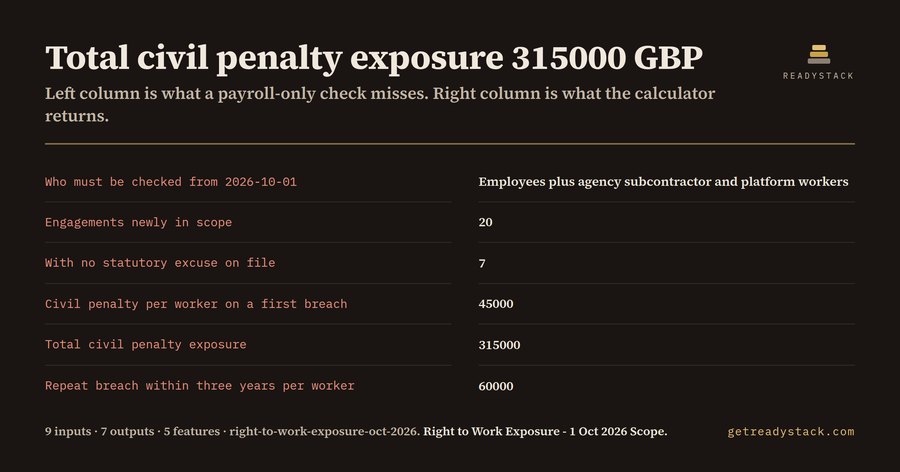
A UK delivery platform that engages 20 agency and platform workers, with 35 percent of them missing a compliant right to work check, is carrying 315000 GBP of illegal working civil penalty exposure on 1 October 2026. That is the number this calculator returns on its default settings, and most operations managers in logistics, construction and hospitality have never seen it, because the right to work duty used to belong to payroll.
That changes on 2026-10-01. From that date the definition of employer for right to work purposes widens past the contract of employment. Agency workers supplied to work under your name, individual subcontractors providing services under your name, and gig or platform workers matched through an online service all fall inside the duty, regardless of how the engagement is labelled. The updated statutory codes of practice and the digital identity verification requirement take effect at the same time.
The price of getting it wrong has not moved since 13 February 2024, but almost every free source still has the old number. The Home Office starting point is 45000 per illegal worker on a first breach and 60000 per illegal worker on a repeat breach within three years. Before 13 February 2024 the cap was 20000 per worker. Ask a general chatbot what an illegal working penalty costs and you will very often get that superseded figure, applied to payroll staff only.
Inside those caps the Home Office runs a sliding scale. If you reported the suspected illegal working to the Home Office, the penalty comes down by 5000. If you co-operated with the Home Office on the matter, it comes down by another 5000. On a first breach only, if both of those are evidenced alongside an effective right to work checking system, the outcome can be a warning notice instead of a financial penalty. And on a first breach, paying in full within 21 days of the notice carries a 30 percent reduction under the fast payment option. None of these apply the same way to a repeat breach.
Run the default case and the extension returns seven figures: 20 engagements newly in scope, 7 with no statutory excuse on file, 45000 civil penalty per worker, 315000 total exposure, 0 fast payment saving, 10 days until the duty starts, and a plain sentence naming which breach scale you are on. Switch the history field to a repeat breach and the same 7 engagements become 420000. Tick the fast payment box on the first breach and the per-worker figure drops to 31500, with 94500 saved across the seven.
Three shapes show how far apart the answers sit. A delivery platform with 40 couriers and 60 percent unchecked gets 24 exposed engagements and 1080000. A recruitment agency supplying 60 workers under client names, with a penalty already on file but having reported and co-operated, lands at 50000 per worker and 650000. A construction firm with 35 subcontractors that already did the checks returns 0.
The extension is 9 inputs, 7 outputs and 5 features, and every calculation is free and unlimited, in the popup and on the web page, with no key, no watermark and no run limit. The licence key adds two things on a different axis: ownership and repetition. You export the finished audit as a dated .csv to hand to your board, your client or your solicitor, and you set alarms for 1 October 2026 and for the 28-day window to object to a civil penalty notice.
Figures are from the Home Office code of practice on preventing illegal working in force since 13 February 2024, and from the commencement of the widened right to work duty on 1 October 2026.
15 seconds — what it actually does
Full walk-through
Questions people ask
What does this actually work out for me?
It takes the number of individual subcontractors, gig or platform workers and agency workers you engage, the share with no compliant right to work check on file, and your penalty history, then returns the illegal working civil penalty per worker after mitigation, your total exposure in pounds, and the days left before 1 October 2026.
Who is this for?
UK hiring managers, gig and delivery platform operators, recruitment agencies that supply workers under a client's name, and construction or facilities firms that engage individual subcontractors. From 1 October 2026 all of these sit inside the right to work duty, not only businesses with payroll employees.
Why will a free chatbot or penalty table not do?
Most free sources still quote the pre-2024 cap of 20000 per illegal worker, and almost all of them treat employer as meaning payroll staff. Neither is true from 1 October 2026. They also skip the sliding scale, so they cannot tell you whether the warning notice route is still open to you.
What is free and what needs the key?
Every calculation is free and unlimited, in the popup and on the web page, with no key and no watermark. The key adds ownership and repetition: a dated .csv export of the finished audit for your board or solicitor, and alarms for 1 October 2026 and the 28-day objection window.
What does the alternative cost?
The comparison is the statutory scale itself. Since 13 February 2024 the Home Office starting point is 45000 per illegal worker on a first breach and 60000 on a repeat breach within three years. A single missed check on one agency worker is worth more than any audit you would commission.
Ask about this tool
One question, answered by the person who built it. Your email only if you want the answer sent.