· ReadyStack
Worked example
Real numbers from this tool, line by line.
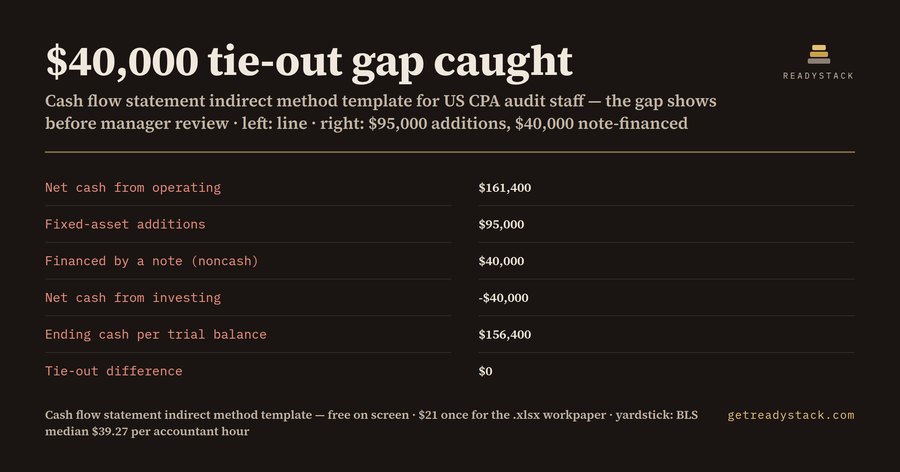
A US CPA-firm staff accountant drafting a client's cash flow statement in Excel can miss trial-balance cash by $40,000 from one equipment note, and this template shows the gap before the manager does. Here is the worked example, computed by the template's own formulas:
| Line | Correct (ASC 230) | Financed part left in investing |
|---|---|---|
| Net cash from operating activities | $161,400 | $161,400 |
| Purchases of fixed assets paid in cash | $55,000 | $95,000 |
| Net cash from investing activities | -$40,000 | -$80,000 |
| Net cash from financing activities | -$50,000 | -$50,000 |
| Net change in cash | $71,400 | $31,400 |
| Ending cash per statement | $156,400 | $116,400 |
| Ending cash per trial balance | $156,400 | $156,400 |
| Tie-out difference | $0 | $40,000 |
The inputs are the client's own figures: beginning cash $85,000, ending cash per trial balance $156,400, net income $142,000, depreciation $38,500, a $6,000 gain on a disposal, a $24,300 increase in receivables, inventory and prepaids, an $11,200 increase in payables and accruals, $95,000 of fixed-asset additions of which $40,000 was financed by a note, $15,000 of sale proceeds, net borrowings of -$20,000 and $30,000 of owner distributions.
Why the right column misses
The fixed-asset rollforward says additions were $95,000. It is tempting to type that straight into investing. But $40,000 of that equipment came with a note payable, and no cash left the bank for it. ASC 230-10-50-3 says investing and financing activities that change recognized assets or liabilities without a cash receipt or payment are disclosed, not run through the statement. Leave the $40,000 inside investing and the statement ends at $116,400 while the trial balance says $156,400. The difference is exactly the financed amount.
The second trap: the gain on disposal
The $6,000 gain is already inside net income, and the $15,000 proceeds belong in investing. If the gain is not backed out of operating, operating cash reads $167,400 instead of $161,400 and the statement overshoots trial-balance cash by $6,000. The template subtracts the gain in operating (enter a loss as a negative number and it is added back) and puts the proceeds in investing.
What the template does
You type twelve figures from the trial balance, prior-year balance sheet and fixed-asset rollforward. The page returns operating cash (indirect method), cash capex with financed additions removed, investing and financing totals, ending cash, and the tie-out difference to trial-balance cash. Nothing is uploaded.
Free and paid
The statement and the tie-out line are free on the page, from your own numbers, with nothing held back. The paid file is the .xlsx workpaper: the same live formulas in a file you can tick-mark, keep in the engagement binder and roll forward next year, plus an Error checks tab that shows the noncash disclosure figure ($40,000 in the example), the investing total if the financed part stayed in (-$80,000), the operating total if the gain were left in ($167,400) and free cash flow ($106,400). It is a one-time payment, not a subscription.
The yardstick
The BLS Occupational Outlook Handbook gives the May 2024 median pay of accountants and auditors as $39.27 per hour. A returned draft costs that hour twice: preparer and reviewer.
Type your own trial balance figures into the free page and read the tie-out line before the draft goes to review.
15 seconds — what it actually does
Questions people ask
What does this cash flow statement template do?
It turns twelve figures from a client's trial balance, prior-year balance sheet and fixed-asset rollforward into a US GAAP statement of cash flows using the indirect method. It shows operating, investing and financing totals, computes ending cash, and prints the difference to trial-balance cash so you know at once whether the statement ties.
Who is it for?
Audit, review and compilation staff at US CPA firms who draft a private client's statement of cash flows in a spreadsheet because their audit software does not build one. It also suits controllers preparing year-end statements for a lender or an outside accountant who will check the cash tie-out.
Why not use a free template or ask a chatbot?
Free templates give the indirect-method layout, but they leave financed equipment inside investing. ASC 230-10-50-3 says equipment bought with a note or lease is a noncash activity to disclose, not a cash outflow. Leave it in and the statement misses trial-balance cash by exactly that amount. This template removes it and shows the tie-out line.
What is free and what is paid?
The whole statement is free on the page: type your own twelve figures and read operating, investing and financing totals, ending cash and the tie-out difference. The paid file is the .xlsx workpaper with live formulas to tick-mark, file in the binder and roll forward next year, plus an Error checks tab. You pay once; it is not a subscription.
How does the cost compare with doing it by hand?
The BLS Occupational Outlook Handbook puts the May 2024 median pay for accountants and auditors at $39.27 per hour. One hour spent hunting an unexplained cash difference costs more than this workpaper, and a statement that does not tie usually costs that hour twice: once for the preparer and once for the reviewer.
Ask about this tool
One question, answered by the person who built it. Your email only if you want the answer sent.