· ReadyStack
Worked example
Real numbers from this tool, line by line.
A UK recruitment agency paying 40 workers £600.00 gross a week through an umbrella company, on a quote of £660.00 a week all-in, is £33.00 a week below the statutory floor per worker, £68,640.00 a year across the team. These are the lines the check prints for that case:
| Line | Value |
|---|---|
| Employer NI above £96 a week (15%) | £75.60 |
| Employer pension on £120 to £967 a week (3%) | £14.40 |
| Apprenticeship Levy (0.5%) | £3.00 |
| Statutory floor per worker per week | £693.00 |
| Quote below statutory floor | £33.00 |
| Shortfall as share of the floor | 4.76% |
| Shortfall a year, all workers | £68,640.00 |
The floor is not a guess about margins. It is the gross pay plus three costs a lawful employer cannot skip in the 2026-27 tax year: employer Class 1 National Insurance at 15% on every pound above the £96 a week secondary threshold, the employer's minimum 3% auto-enrolment contribution on qualifying earnings between £120 and £967 a week, and the 0.5% Apprenticeship Levy that a payroll company with a large pay bill pays. Before the umbrella company takes a penny of its own margin, £600.00 of pay already costs £693.00.
Why the gap matters from 6 April 2026
HMRC's guidance on payroll company fraud lists "labour or payroll savings that seem too good to be true" among the signs an employer or agency should look for. Since 6 April 2026 the gap also has an owner. Under ITEPA 2003 Part 2 Chapter 11, described in HMRC's manual at ESM2405, the agency that supplies the worker, or the end client where there is no agency, is jointly and severally liable for PAYE and Class 1 NIC the umbrella company does not pay.
The workbook's payslip sheet shows what is at stake in the example. A lawful payslip at £600.00 gross on tax code 1257L shows employee NI of £28.64 and income tax of £71.65, net pay of £499.71 before pension. Add the employer NI and the PAYE and NIC the chain must hand to HMRC is £365,851.20 a year for 40 workers. That is the sum HMRC can collect from your business if the supplier keeps the money.
Three quotes, three answers
The same 40 workers on £600.00 a week give different results as the quote moves:
- Quote £660.00: £33.00 below the floor, flagged, £68,640.00 a year short.
- Quote £720.00: £27.00 above the floor, not flagged. The supplier has room to pay every cost and keep a margin.
- A higher-paid team, 10 workers on £1,200.00 gross quoted £1,300.00: the floor is £1,397.01 because pension stops at £967 a week, and the quote is £97.01 short, £50,445.20 a year.
What the check does not do
It does not prove fraud. A supplier can lawfully lower the employer cost through salary sacrifice, or a worker may have opted out of the pension, and you can set pension or levy to 0 for that case. What the check gives you is a number to put in front of the supplier: show me how employer NI, pension and levy are paid out of this charge.
Use it
Type your workers, their weekly gross pay and the weekly charge you were quoted. The answer appears in your browser, as often as you like. If the quote is below the floor, ask the supplier in writing for a breakdown, keep the reply with a dated copy of the workbook, and report a supplier that cannot explain it through HMRC's fraud reporting service.
15 seconds — what it actually does
Full walk-through
Questions people ask
What does the payroll company fraud check work out?
It takes your worker count, each worker's weekly gross pay and the supplier's weekly charge per worker, then works out the lowest legal cost for 2026/27: gross pay plus 15% employer NI above £96 a week, plus 3% pension above £120 a week, minus the £10,500 Employment Allowance spread across your workers. A quote under that floor is the HMRC 'too good to be true' sign.
Who should run this check before signing with a payroll supplier?
UK employers, recruitment agencies and labour users who move workers or payroll to an umbrella, payroll or labour supply company. HMRC names agencies, businesses outsourcing their workforce or payroll, and workers paid by a different company from the one they work for as the people most likely to be affected by outsourced labour payroll fraud.
Why not ask a chatbot or use a free take-home pay calculator?
Those tools answer what one worker takes home. They do not start from a supplier's per-worker charge, and they do not test it against the 2026/27 employer floor: 15% employer NI over £96 a week, 3% auto-enrolment pension over £120 a week and the £10,500 Employment Allowance cap, which one supplier cannot claim again and again. They also keep no dated record of your checks.
What is free on the page and what is in the paid file?
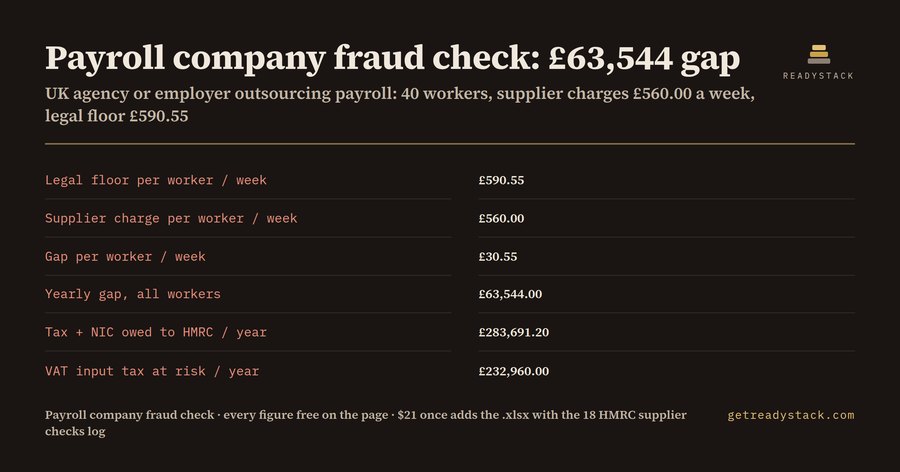
The page gives the complete answer for one supplier quote: legal floor per worker, gap per week and per year, tax and NIC the supplier owes HMRC for your workers, and VAT at risk. The paid .xlsx is the record you keep: the same calculator offline plus a log of 18 checks from the HMRC guidance, with date, evidence, result and who checked.
What does getting this wrong cost compared with the file?
HMRC says that if you knew or should have known about fraud in the chain, it may deny your VAT input tax, hold you responsible for unpaid Income Tax and NICs plus interest, and charge VAT penalties to the business and its directors. With 40 workers on a £560 weekly charge, the 20% VAT on a year of invoices is £232,960. The file costs $21 once.
Ask about this tool
One question, answered by the person who built it. Your email only if you want the answer sent.