· ReadyStack
Worked example
Real numbers from this tool, line by line.
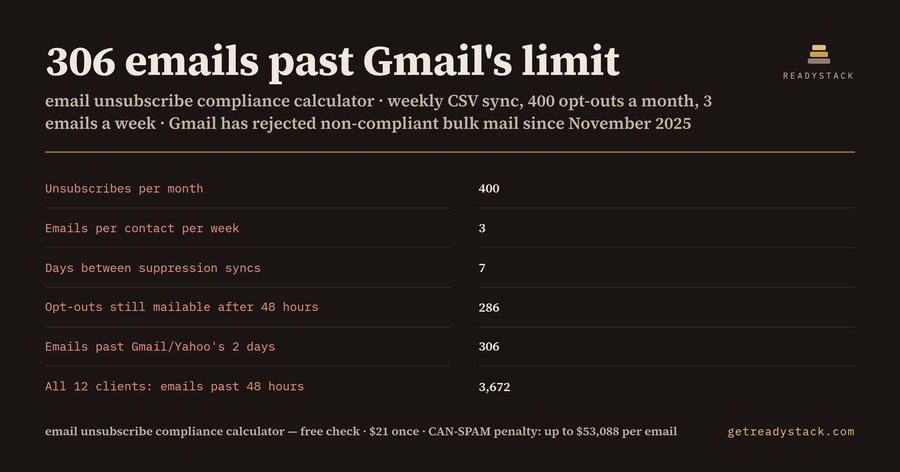
With a weekly suppression sync, an agency client with 400 unsubscribes a month and 3 emails a week sends 306 emails a month to people who opted out more than 48 hours earlier. Across 12 clients on the same routine, that is 3,672 emails a month past the limit Gmail and Yahoo set for bulk senders.
| Weekly CSV sync, 400 opt-outs a month, 3 emails a week | Per client | 12 clients |
|---|---|---|
| Emails to opted-out contacts | 600 | 7,200 |
| Opt-outs still mailable after 48 hours | 286 | 3,432 |
| Emails past Gmail and Yahoo's 2 days | 306 | 3,672 |
| Emails past CAN-SPAM's 10 business days | 0 | 0 |
Most agencies check unsubscribes against CAN-SPAM's 10 business days. A weekly sync passes that test, so nobody notices. The inbox providers set a shorter clock. Google's sender FAQ asks senders to fulfill unsubscribe requests within 48 hours and lists missing that window as a compliance failure. Yahoo's bulk sender requirements say to honor unsubscribes within 2 days. Google also says that since November 2025 it has been ramping up enforcement on non-compliant traffic, with temporary and permanent rejections.
An unsubscribe in the tool you send from is suppressed at once. The gap starts when opt-outs are captured elsewhere (the client's CRM, a preference center, a second ESP) and reach your sending account by CSV import or scheduled sync. An opt-out lands at a random point in that cycle and waits half the interval on average. With a 7-day sync, it waits 3.5 days on average, and 5 of every 7 opt-outs are still mailable after 48 hours.
The calculator turns that into counts. Emails past a limit equal monthly unsubscribes times emails per contact per day times the average days past the limit. For a sync interval longer than the limit, that average is the square of the days over the limit divided by twice the interval. For the weekly example it is 1.79 days, so 400 opt-outs at 3 emails a week give 306 emails past 48 hours.
Stretch the interval and CAN-SPAM comes into play. With a 21-day sync, the same client sends 1,473 emails a month past 48 hours and 200 past 14 calendar days, which is 10 business days when no federal holiday falls in the window. The FTC's compliance guide says each separate email in violation is subject to penalties of up to $53,088, so the calculator shows an exposure of up to $10,617,600 for that client. That is a statutory maximum, not a forecast. With a monthly re-import (30 days), the counts rise to 2,240 and 731. With a daily sync, both are 0.
The FTC kept its 2025 penalty amounts unchanged for 2026. Its guide also says a business cannot contract away its responsibility: both the company whose product is promoted and the company that sends the email can be held responsible.
Gmail adds a second risk at scale. A domain that sends more than 5,000 messages to Gmail accounts in one day, even once, is permanently a bulk sender under Google's rules. One large promotion is enough, and from then on the 48-hour clock applies to that domain for good.
The free calculator on this page runs one sync routine in your browser and gives 12 results, including the totals for all clients on that routine. The paid spreadsheet adds a 25-row client roster. Each client gets its own unsubscribes, send frequency, sync interval and peak daily Gmail volume, a permanent bulk-sender flag, and a rank by emails past 48 hours, so you know which client to move to a sync of 2 days or less first.
Limits: US CAN-SPAM plus the Gmail and Yahoo rules only, opt-outs spread evenly, not legal advice. Check one client before the next send.
15 seconds — what it actually does
Questions people ask
What does the unsubscribe compliance calculator work out?
It takes one client's monthly unsubscribes, how many emails a contact gets per week and how often your agency syncs suppression lists, then counts the emails that still reach people after they opted out: past Gmail's 48 hours, past Yahoo's 2 days and past CAN-SPAM's 10 business days, with the CAN-SPAM penalty exposure and the total for all your clients.
Who is this calculator for?
Marketing agency operators and email or CRM managers who send campaigns for several US clients from tools that do not share one suppression list, for example a client CRM plus Klaviyo or Mailchimp synced by CSV. The client is liable too, so their marketing lead can use the same numbers to check the agency.
Why not just ask a chatbot or read the Gmail rules?
The rules give a deadline, not your exposure. A chatbot will usually quote only CAN-SPAM's 10 business days and miss Gmail's 48 hours and Yahoo's 2 days. Neither turns your sync interval and send frequency into a count of emails that reach opted-out contacts after each limit.
What do I get free, and what does the paid file add?
Free in the browser, with no limit: all 12 results for one sync routine, multiplied across your client count. The $21 one-time .xlsx adds a 25-row client roster where each client has its own unsubscribes, frequency, sync interval and daily Gmail volume, ranked by emails past each limit, plus a dated sources sheet.
How does the cost compare with getting it wrong?
The FTC guide says each separate email that violates CAN-SPAM is subject to penalties of up to $53,088, and the 2025 amount stays unchanged for 2026. Gmail has been rejecting non-compliant bulk mail since November 2025. The file costs $21 once, not a subscription, and you can see your own free result first.
Ask about this tool
One question, answered by the person who built it. Your email only if you want the answer sent.