· ReadyStack
Worked example
Real numbers from this tool, line by line.
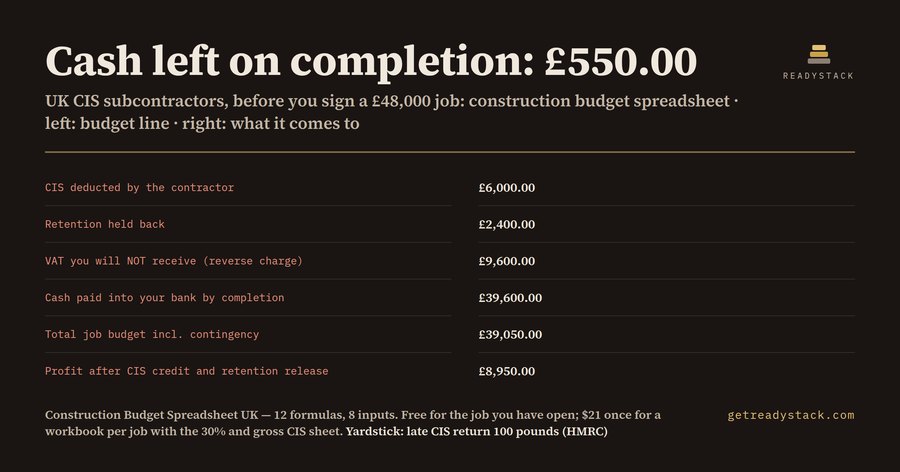
You priced the job at 48,000 pounds plus VAT. The contractor accepted. Here is what actually reaches your bank by completion: 39,600 pounds, and none of the 9,600 pounds of VAT. Against a job budget of 39,050 pounds, that leaves 550 pounds of cash. The profit is 8,950 pounds, but most of it is still sitting with the contractor or with HMRC.
Why the cash and the profit split apart Three UK rules sit between the price on your quote and the money in your account.
- The Construction Industry Scheme. A contractor paying a subcontractor deducts CIS from every payment: 20% if you are registered for CIS, 30% if you are not, and 0% if you have gross payment status. The deduction is charged on the payment minus VAT and minus the materials you show on your invoice. In the example, materials are 18,000 pounds, so the labour part is 30,000 pounds and CIS takes 6,000 pounds.
- Retention. Most main contracts hold back a percentage until practical completion or the end of the defects period. At 5%, that is 2,400 pounds on a 48,000 pound job. Retention is a contract term, not a law, so the spreadsheet leaves it as an input you set from your own contract.
- The VAT domestic reverse charge. Since 1 March 2021, when you supply building and construction services to a contractor that is VAT- and CIS-registered and is not the end user, the contractor accounts for the VAT to HMRC. Your invoice still shows the VAT, but you are not paid it. At 20%, that is 9,600 pounds you would have had in the bank under the old rules.
Add the three together and the cash gap against a budget built on price plus VAT is 18,000 pounds.
What it looks like at the other CIS rates The same job at 30%, because you never registered for CIS, means 9,000 pounds deducted instead of 6,000 pounds. The cash left on completion goes to minus 2,450 pounds. You are funding the job yourself. With gross payment status at 0%, the cash left is 6,550 pounds. The paid workbook carries this comparison as its own sheet, so you can show a bank or a partner what registration or gross status is worth on a real job.
CIS is a credit, not a cost The 6,000 pounds is not lost. A limited company offsets CIS suffered against its PAYE bill. A sole trader claims it through Self Assessment after the tax year. That is why the spreadsheet shows two lines: profit after the CIS credit and retention release (8,950 pounds), and cash left on completion (550 pounds). Materials, wages and plant hire are paid during the job. The CIS credit and the retention arrive months later.
What you type 8 inputs: contract price excluding VAT, materials, labour cost, plant hire and overheads, contingency, retention, CIS rate and VAT rate. The rates start at the HMRC defaults of 20% CIS and 20% VAT. Change the CIS rate to match your last payment and deduction statement.
What you get back Labour part of the price, CIS deducted, retention held back, cash paid by completion, contingency, total job budget, cash left on completion, profit, VAT not received and the cash shortfall. A second sheet shows cash left at 30% and at 0%.
Free on the page, workbook to keep The web calculator does the whole job budget for one job, free, in your browser. Nothing is uploaded. The workbook is for keeping one dated copy per job and sending it to your accountant. It opens in Excel or LibreOffice. In Google Sheets, use File > Import > Upload.
Before you sign the next price, put the job in and read the cash line, not the profit line.
15 seconds — what it actually does
Questions people ask
What does this construction budget spreadsheet work out?
You type 8 inputs: contract price, materials, labour cost, plant and overheads, contingency, retention, CIS rate and VAT rate. 12 formulas work out the labour part CIS applies to, the CIS deducted, retention, cash paid by completion, contingency, total budget, cash left, profit, VAT not received under the reverse charge, the cash shortfall, and the same job at 30% and 0% CIS.
Who is it for?
UK builders, plumbers, electricians, roofers and other trade subcontractors, sole traders or limited companies, who are paid by a main contractor under the Construction Industry Scheme. It is for the moment before you sign a price, when you need to know the cash you will actually see, not the figure on the quote.
Why not use a free construction budget template?
Free templates compare your costs with the contract price, often plus VAT. Under CIS the contractor keeps 20% of the labour part (30% if you are not registered), and under the domestic reverse charge since 1 March 2021 they pay your VAT to HMRC. On a 48,000 pound job that is 18,000 pounds less cash than such a template shows.
What can I do free on the page?
Everything for one job: type your own price and costs and read CIS deducted, retention held, VAT not received, cash left on completion and profit. Nothing is locked or blurred. The paid workbook is for keeping one copy per job, sending it to your accountant and comparing 30% and gross payment status.
What does getting it wrong cost?
With the example figures, a 48,000 pound job leaves only 550 pounds of cash on completion although profit is 8,950 pounds, because 6,000 pounds of CIS and 2,400 pounds of retention are held back. At 30% unregistered the cash goes negative. The CIS is credited back later, but the bills come first.
Ask about this tool
One question, answered by the person who built it. Your email only if you want the answer sent.