· ReadyStack
Worked example
Real numbers from this tool, line by line.
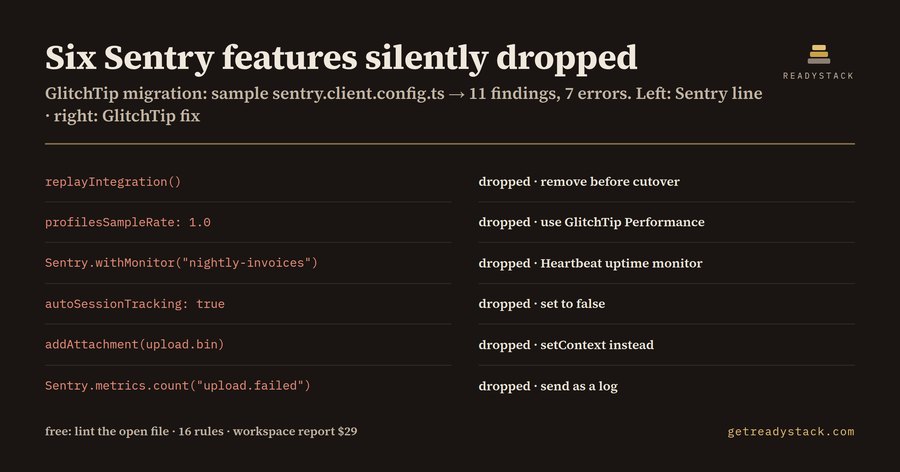
Six Sentry features stopped arriving when our sample Next.js app pointed its DSN at GlitchTip: one lint pass over sentry.client.config.ts returned 11 findings, 7 errors. If you are an engineering team or agency moving from Sentry to GlitchTip, this is the part the migration guides skip.
Why teams move. Sentry's web app is licensed FSL-1.1-Apache-2.0 (open.sentry.io/licensing): you may run it for your own business, but not as a commercial Sentry-like offering until each release converts to Apache-2.0 after two years. Sentry Team costs $26/mo billed annually and Business $80/mo. GlitchTip is MIT-licensed, speaks the Sentry SDK protocol, and hosted plans start free at 1,000 events/mo, with Small at $15/mo for 100k events.
What breaks without a sound. Because GlitchTip accepts the same SDKs, the swap looks like a one-line DSN change. It is not. GlitchTip's ingest code (apps/event_ingest/schema.py in glitchtip-backend) accepts six envelope item types: event, transaction, user_report, feedback, log and otel_log. It lists session, attachment, check_in, profile, replay_event, replay_recording, span and trace_metric as ignored. The SDK keeps sending them, and the data is simply not stored.
In our sample file that meant:
- replayIntegration() plus two replay sample rates: Session Replay still records in every browser, then gets dropped.
- profilesSampleRate: 1.0 and browserProfilingIntegration(): no profile ever appears.
- Sentry.withMonitor("nightly-invoices"): the cron check-in is dropped, so a nightly job that stops running raises no alert. This is the expensive one.
- autoSessionTracking: true: GlitchTip's own SDK pages set it to false with the note "GlitchTip does not support sessions".
- addAttachment(upload.bin): the file never reaches the issue.
- Sentry.metrics.count("upload.failed"): the counter stays at zero.
Two more findings are not about dropped data. The DSN still pointed at o451234.ingest.us.sentry.io, so events would keep flowing to Sentry. And tracesSampleRate: 1.0 sends every transaction; hosted GlitchTip counts each one as an event, throttles past the quota and blocks fully at 2x the quota, errors included. GlitchTip's FAQ suggests 0.01.
The fixes. Remove the replay and profiling integrations and rates. Replace cron monitors with a GlitchTip uptime monitor of type Heartbeat, or wrap the job with glitchtip-cli monitors run. Set autoSessionTracking to false. Move attachment facts into setContext. Send metric values as logs with enableLogs: true, which GlitchTip ingests. The fixed file returns 0 findings.
How the lint works. GlitchTip Migration Lint is a VS Code extension with 16 rules. Open a file and every finding appears in the Problems panel with its line, the envelope item it produces and the GlitchTip-side fix. The same engine runs on a free web page where you paste a file. It reads JS/TS, Python, Dart, Swift, Kotlin, Java, C#, YAML, .env, .properties and .sentryclirc, and it also flags sentry-cli steps with no url (they upload to https://sentry.io/ by default) and self-hosted getsentry images.
Why not a chatbot. A chatbot will happily rewrite your Sentry.init, but it does not know GlitchTip's ignore list, and it only sees the snippet you paste, not the CI step or compose file next to it.
Free and paid. Linting the open file is free, with no key, and finishes the job for a single-app repo. The workspace migration report covers every app, CI file and compose file and exports a Markdown or CSV checklist for the cutover pull request.
15 seconds — what it actually does
Questions people ask
What does GlitchTip Migration Lint do?
It scans Sentry SDK setup code, .sentryclirc, CI and docker-compose files for settings GlitchTip will not ingest: Session Replay, profiling, cron check-ins, sessions, attachments and metrics. It also flags DSNs and upload URLs still pointing at sentry.io and self-hosted Sentry images under the FSL licence. It has 16 rules, and each finding names the line, the envelope item and the GlitchTip-side fix.
Who is this Sentry to GlitchTip lint for?
Engineering teams, agencies and self-hosters moving from Sentry SaaS or self-hosted Sentry to GlitchTip, in the US, the EU or anywhere else. It suits the person who owns the cutover pull request: a Next.js, Node, Django or mobile app whose Sentry.init was written for Sentry features and is about to point its DSN at a GlitchTip host.
Why not just change the DSN or ask a chatbot?
Changing the DSN works for errors, and GlitchTip returns success for everything else too. Its ingest code ignores session, attachment, check_in, profile, replay and trace_metric items, so Session Replay, profiles, cron check-ins and metrics vanish without an error. A chatbot does not know that list and only sees the snippet you paste.
What is free and what needs a licence key?
Linting one open or pasted file is free, with no key and no limit: every finding shows its line, the dropped envelope item and the fix, from all 16 rules. The paid workspace report ($29 once, one licence key per person or team seat) scans every app, CI file and compose file in the repo and exports a Markdown or CSV checklist.
How does the cost compare with staying on Sentry?
Sentry Team is $26/mo billed annually and Business is $80/mo. Hosted GlitchTip is free up to 1,000 events/mo, Small is $15/mo for 100k events and Medium $50/mo for 500k. The lint itself is free per file; the $29 workspace report is a one-time payment, not a subscription, for the whole repo checklist.
Ask about this tool
One question, answered by the person who built it. Your email only if you want the answer sent.