· ReadyStack
Worked example
Real numbers from this tool, line by line.
If your WordPress site lets people upload or post anything, copyright holders will eventually send you takedown notices. US law gives you a shield for that situation: the Section 512(c) safe harbor of the Digital Millennium Copyright Act. It protects a host from money damages for what its users post, but only if the host has a designated agent registered with the U.S. Copyright Office and removes the material expeditiously once it receives a valid notice.
What makes a notice valid is written into 17 U.S.C. 512(c)(3)(A). It has six elements: (i) a physical or electronic signature of the owner or an authorized agent, (ii) identification of the copyrighted work, (iii) identification of the infringing material with enough information to find it, in practice the URL, (iv) the complainant's contact details, (v) a statement of good-faith belief that the use is not authorized, and (vi) a statement that the notice is accurate and, under penalty of perjury, that the sender is authorized to act for the owner.
The statute also says what happens when a notice is not complete. Under 512(c)(3)(B)(i), a notice that does not substantially comply does not count toward your knowledge of infringement. But 512(c)(3)(B)(ii) adds a catch: if the notice still names the work, the URL and a contact, you must promptly contact the sender or help them send a complete notice.
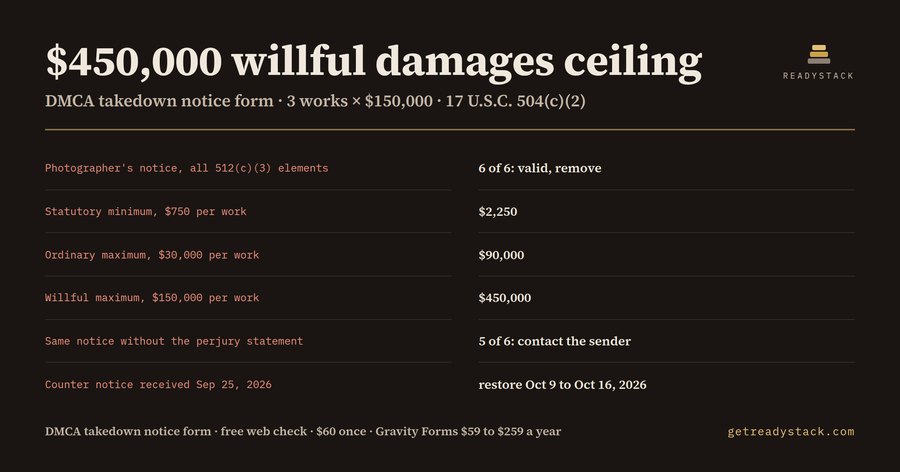
A photographer finds three of their photos in a member gallery and sends a notice with a signature, the three works, the URLs, their contact details, the good-faith statement and the perjury statement. Result: 6 of 6 elements, a valid notice.
Now change one thing. Drop the perjury statement and the same notice scores 5 of 6. It still names the works, the URL and a contact, so the check tells you to contact the sender promptly. Drop the URL instead and it no longer counts toward your knowledge at all.
What does getting it wrong cost? Statutory damages under 17 U.S.C. 504(c) run from $750 to $30,000 per work, and up to $150,000 per work for willful infringement. For the three photos in the example, that is $2,250 at the minimum, $90,000 at the ordinary maximum and $450,000 at the willful maximum. Those are ceilings set by statute, not the fine you will pay.
The last clock is the counter notice. If the member says the removal was a mistake and sends a counter notice, 512(g)(2)(C) says you put the material back not less than 10 and not more than 14 business days after receiving it, unless the complainant tells you they filed suit. The statute does not define a business day; with a counter notice received on Friday 25 September 2026 and US federal holidays skipped, the window runs from Friday 9 October to Friday 16 October 2026, because Columbus Day falls on 12 October. Counting weekends only, the window closes a day earlier, on Thursday 15 October.
Your agent designation at dmca.copyright.gov costs $6 and expires after three years unless renewed (37 CFR 201.38). And 512(f) makes anyone who knowingly misrepresents that material is infringing liable for damages, costs and attorneys' fees.
The plugin puts a nine-field notice form covering all six elements on your site with one shortcode, with your agent, registration number and the 512(f) warning above it. Every notice is listed in WordPress admin. The free plugin does that whole job. The paid version emails each complainant a receipt, alerts your agent, exports every notice with its date and time to CSV, and searches notices by URL so repeat infringers stand out. Try the free web check first with a notice you actually received.
15 seconds — what it actually does
Questions people ask
What does this DMCA takedown notice form do?
It adds a copyright complaint form to your WordPress site with one shortcode. The nine fields cover all six elements of 17 U.S.C. 512(c)(3): signature, the work, the exact URL, contact details, the good-faith statement and the perjury statement. Your designated agent is shown above it, and every notice is listed in admin, 50 per page.
Who needs a DMCA notice form?
Any site serving US visitors that stores material its users upload or post: forums, photo communities, directories, classifieds, membership sites and blogs with comments. The 512(c) safe harbor needs a designated agent registered with the Copyright Office and quick removal once a valid notice arrives. A clear form makes valid notices easy to send and recognise.
Why not use a free contact form?
A contact form does not ask for the six 512(c)(3) elements or the statement under penalty of perjury, so you cannot tell whether a notice is valid or only nearly valid. Nothing records when it arrived. The paid version emails the sender a receipt, alerts your agent and exports every notice with its date and time.
What do I get for free?
The free plugin works on its own: the nine-field notice form, your designated agent and registration number above it, the 512(f) warning on false claims, spam protection and the full notice list in admin. The free web page checks a notice against the six elements, shows the damages range and dates the counter-notice window.
How does the price compare?
It is $60 once, not a subscription. Gravity Forms, a general form builder, lists $59 to $259 every year and ships no DMCA fields. On the other side, statutory damages for willful infringement reach $150,000 per work under 17 U.S.C. 504(c)(2): for 3 works named in one notice, that ceiling is $450,000.
Ask about this tool
One question, answered by the person who built it. Your email only if you want the answer sent.