· ReadyStack
Worked example
Real numbers from this tool, line by line.
If you run the website for a housing association, an almshouse charity, a co-operative or a council housing team in England, one law changed what your repairs page has to do. Awaab's Law, set out in the Hazards in Social Housing (Prescribed Requirements) (England) Regulations 2025, has applied since 27 October 2025. It is named after Awaab Ishak, a two-year-old who died in 2020 after long exposure to mould in his family's social housing flat.
The first phase covers two things: damp and mould hazards, and emergency hazards of any kind. The timescales run from the moment the landlord becomes aware of the hazard, and they are short.
For damp and mould, the landlord investigates within 10 working days. A written summary of the findings goes to the tenant within 3 working days of the investigation ending. If the investigation finds a significant hazard, safety work begins within 5 working days. For an emergency hazard, the landlord investigates and makes the home safe within 24 hours. If the home cannot be made safe within these timescales, the landlord must offer the household suitable alternative accommodation.
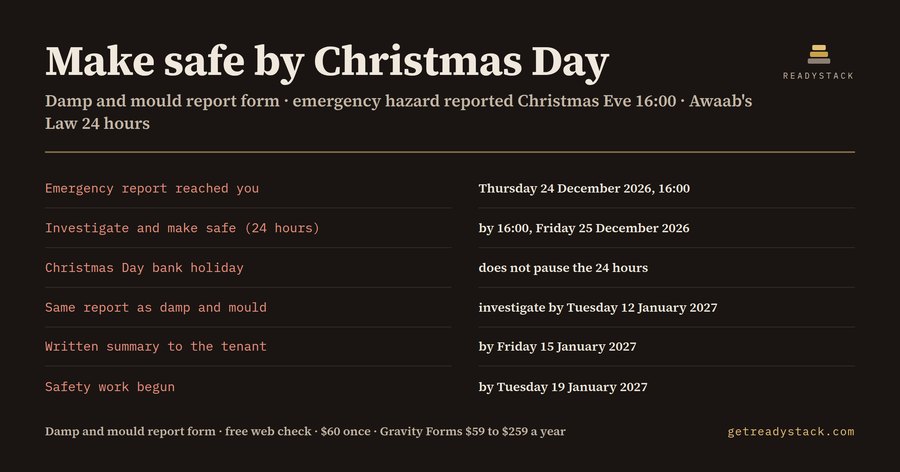
Working days and hours behave differently, and the calendar is where teams slip. Here is what the free check on this page returns for one real date. A tenant reports an emergency hazard at 16:00 on Thursday 24 December 2026, Christmas Eve. The deadline to investigate and make safe is 16:00 on Friday 25 December 2026, Christmas Day. The 24 hours do not pause for a bank holiday or a weekend.
Treat the same report as damp and mould instead, and the working-day count skips 25 December, 28 December (the Boxing Day substitute, because 26 December 2026 is a Saturday) and 1 January 2027. The investigation is due by Tuesday 12 January 2027. If it ends that day, the written summary is due by Friday 15 January 2027 and safety work must begin by Tuesday 19 January 2027. A report that arrives on Wednesday 16 December 2026 must be investigated by Monday 4 January 2027.
None of those clocks can start well if the report arrives as a vague email or a phone note. That is the job of the plugin. One shortcode puts a damp and mould report form on your repairs page. It has 9 fields: the address and postcode; the problem, from 8 choices running from damp or mould and condensation that keeps coming back to a gas smell, electrical danger and a home that is not secure; which rooms are affected; whether anyone in the home has a higher health risk, from 5 choices including a baby or young child, someone aged 65 or over and someone with asthma; when it was first noticed; the details; a name; a phone number; and an optional email. Seven fields are required, every field has a label, and every report is listed in WordPress admin, 50 per page. The gas emergency number, 0800 111 999, and your own timescales sit above the form.
The free plugin is complete on its own. The full version, $60 once, handles the part that decides whether a clock is met: each report is emailed to your repairs inbox the moment it arrives, the tenant gets a copy, every report exports to CSV with its arrival date and time, reports can be filtered by address so repeat damp at one home shows up, and each scheme or area can have its own tagged form. For comparison, Gravity Forms, a general form builder, costs $59 to $259 every year and ships no damp and mould fields.
Enter the date your last report reached you in the free check and see the dates it gives you.
15 seconds — what it actually does
Questions people ask
What does this damp and mould report form do?
It adds a damp and mould report form to your WordPress site with one shortcode. Nine fields ask for the address, the problem from eight choices, the rooms affected, who in the home has a higher health risk, when it started, the details, name, phone and an optional email. Every report is listed in admin, 50 per page.
Who needs to meet Awaab's Law timescales?
Social landlords in England: housing associations and other registered providers, and councils that own homes. Since 27 October 2025 they must investigate damp and mould within 10 working days, send the tenant a written summary within 3 working days of the investigation, and investigate and make safe emergency hazards within 24 hours.
Why not use a free contact form?
A contact form does not ask which hazard it is, which rooms, or whether a baby, an older person or someone with asthma lives there, so an emergency can read like a routine repair. No free WordPress plugin ships an Awaab's Law report form. The paid version emails each report to your repairs inbox on arrival and exports a dated record.
What do I get for free?
The free plugin works on its own: the nine-field form, your timescales and the gas emergency number shown above it, spam protection, a label on every field and the full list of reports in admin, 50 per page. The free web check counts your investigate-by, written-summary and safety-work dates in working days, skipping England bank holidays.
How does the price compare?
It is $60 once, not a subscription. Gravity Forms, a general form builder, costs $59 to $259 every year and ships no damp and mould fields, so you would still write the form yourself. If a home cannot be made safe within the Awaab's Law timescales, the landlord must offer the household suitable alternative accommodation.
Ask about this tool
One question, answered by the person who built it. Your email only if you want the answer sent.