· ReadyStack
Worked example
Real numbers from this tool, line by line.
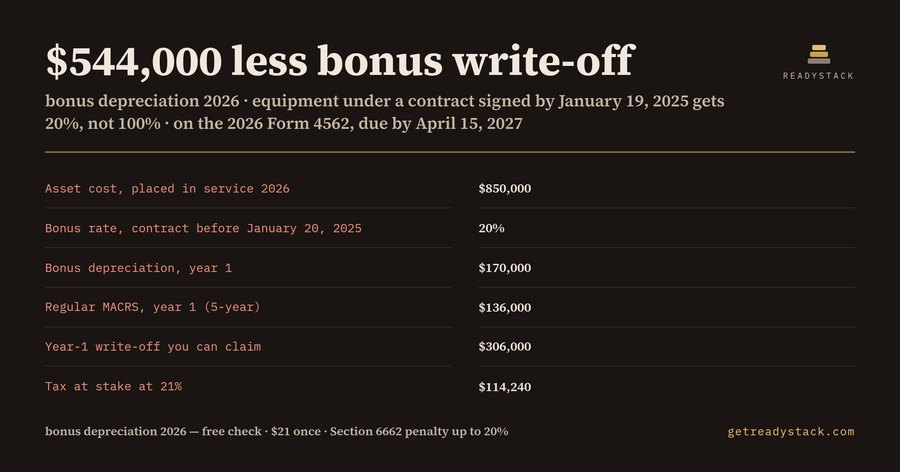
Ask a chatbot for the 2026 bonus depreciation rate and it may say 20%, the old Tax Cuts and Jobs Act phase-down. The One Big Beautiful Bill Act made it 100% for most 2026 equipment. Not all of it, though, and the dividing line is a date most fixed asset ledgers do not record.
IRS Notice 2026-11, released in January 2026, says property acquired after January 19, 2025 and placed in service after that date qualifies for the permanent 100% rate. Property acquired on or before January 19, 2025 keeps the old phase-down, even if it is delivered and placed in service in 2026. For that property the 2026 rate is 20%. If it slips into 2027, it is zero.
Acquired means the date the written binding contract was signed, not the delivery date. A contract is binding if it cannot be cancelled without a substantial penalty, usually 5% of the price. Without one, the date is when more than 10% of the cost was paid or incurred.
In money: take $850,000 of 5-year equipment, placed in service in 2026, under a contract signed before January 20, 2025, with no Section 179 election and a 21% corporate rate. Bonus depreciation is 20%, or $170,000. Regular MACRS in year one, at the 20% half-year rate from IRS Publication 946, is $136,000 on the remaining basis. The year-1 write-off is $306,000. If the return claims 100% bonus instead, the deduction is $544,000 too high, and the tax understated is $114,240. Section 6662 adds an accuracy-related penalty of up to 20% of an underpayment.
Change one answer, that the contract was signed after January 19, 2025, and the same asset gets 100% bonus: $850,000 in year one, and nothing lost. The asset is the same and so is the delivery date. Only the date on the contract changed.
For the pre-cutoff asset, Section 179 is the way back to a full first-year write-off. Revenue Procedure 2025-32 sets the 2026 limit at $2,560,000, reduced dollar for dollar once Section 179 property placed in service in the year passes $4,090,000. With $1,200,000 of business income, electing $850,000 of Section 179 expenses the whole asset in 2026 and recovers the $114,240.
Section 179 has its own trap: the deduction cannot exceed business income, the excess carries forward, and under Treasury Regulation 1.179-1(f)(1) the full elected amount still reduces basis. With $500,000 of income, electing $850,000 gives a $500,000 deduction, a $350,000 carryforward and no bonus or MACRS. Elect only $500,000 instead, and the remaining $350,000 gets 20% bonus ($70,000) and MACRS ($56,000), for a year-1 write-off of $626,000. That is $126,000 more deduction, or $26,460 of tax at 21%, from electing less.
The free calculator on this page does this for one asset. Type the cost, answer 1 or 0 for a contract before January 20, 2025, and add Section 179, business income and your rate. It returns twelve results, from the bonus rate to the tax at stake and the best Section 179 election, in your browser.
It is federal only: no state decoupling, no Section 280F auto caps, no mid-quarter convention.
The paid file is for a client with many assets: a 200-row register that sets each asset's bonus rate from its contract and in-service dates, totals the write-off and flags Section 179 above the 2026 cap, plus a sources sheet for the workpapers.
The 2026 Form 4562 goes in with the return: March 15, 2027 for calendar-year partnerships and S corporations, April 15, 2027 for calendar-year C corporations. Before then, find the signed purchase contracts for anything that arrived in 2026, check their dates and cancellation terms, and run each asset through the calculator.
15 seconds — what it actually does
Questions people ask
What does this bonus depreciation 2026 calculator work out?
It tells you whether one asset placed in service in 2026 gets 100% or 20% bonus depreciation, based on when the binding contract was signed relative to January 19, 2025. It then applies the 2026 Section 179 cap of $2,560,000, regular MACRS on the rest, and shows the year-1 write-off, the gap against a 100% assumption and the tax at stake.
Who is this calculator built for?
US accountants, CPAs, enrolled agents and in-house tax staff who prepare 2026 Form 4562 for businesses that bought equipment, vehicles or machinery. It is for anyone whose client signed a purchase contract around January 2025, because the signing date, not the delivery date, decides whether the asset gets 100% or 20% bonus depreciation.
Why not just ask a chatbot or use a free depreciation calculator?
Many free calculators and chatbot answers still apply the old TCJA phase-down and say bonus depreciation is 20% in 2026. Others say 100% for everything. Neither checks the acquisition date. This page applies the January 19, 2025 cutoff from IRS Notice 2026-11 and the 2026 Section 179 limits from Revenue Procedure 2025-32 to your own numbers.
What is free and what is in the paid file?
The full check for one asset is free in your browser with no limit: bonus rate, Section 179 cap and allowance, MACRS, year-1 write-off, gap and tax at stake. The paid .xlsx adds an asset register of 200 rows that applies the cutoff to every asset by date, plus a dated sources sheet you can keep with the workpapers.
What does getting this wrong cost compared with the file?
Claiming 100% on a pre-cutoff asset overstates the deduction. On the example $850,000 asset that is $544,000 too much, or $114,240 of tax at 21%, and the IRS can add an accuracy-related penalty of up to 20% of an underpayment under Section 6662. The register is a one-time $21 payment, not a subscription.
Ask about this tool
One question, answered by the person who built it. Your email only if you want the answer sent.