Real numbers from this tool, line by line.
Amapiano log drum bassline, 113 BPM: 14 notes over 2 bars in A minor, for beatmakers producing amapiano, the scene from South Africa. This is the finished groove, note by note, as the free page draws it:
bar  step  note  length  velocity  kick
1    1     A1    1/16    115       on the kick
1    4     A2    1/16    100       off
1    7     E2    1/16    105       off
1    9     A1    2/16    110       on the kick
1    12    A2    1/16    95        off
1    13    G2    1/16    90        on the kick
1    15    E2    2/16    105       off
2    1     F1    1/16    115       on the kick
2    4     F2    1/16    100       off
2    7     C2    1/16    105       off
2    9     F1    2/16    110       on the kick
2    12    F2    1/16    95        off
2    13    D2    1/16    90        on the kick
2    15    C2    2/16    105       off
Three of the seven hits in each bar land with the kick (steps 1, 9 and 13). Four fall between kicks, jumping up an octave and a fifth. The range runs from F1 to A2. Put a four-on-the-floor house bass under the same kick instead and every bass note starts on a kick step. Both parts fight for the same moment, and you hear the mud at the mixdown, after the arrangement is done.
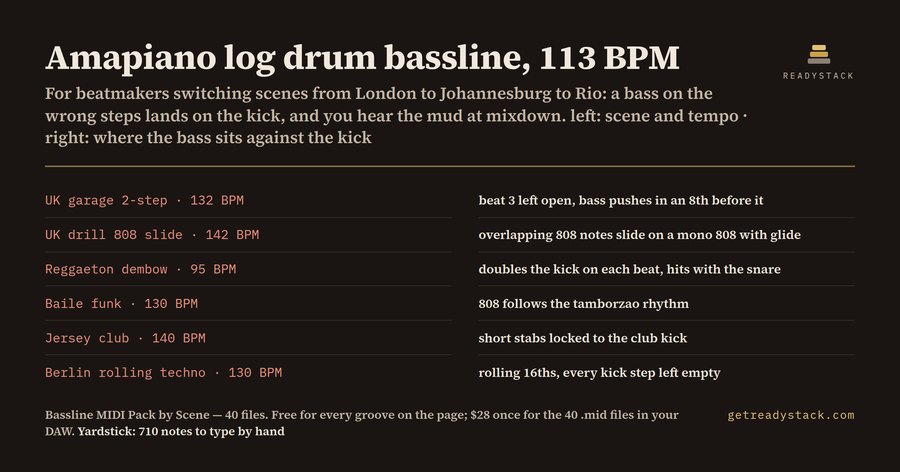
That placement is what makes a groove sound like its scene, and it changes from scene to scene. This pack is 40 bassline MIDI files, four for each of ten regional scenes: UK garage 2-step and UK drill from London, amapiano from South Africa, afrobeats from Lagos, reggaeton dembow from Puerto Rico, dancehall from Jamaica, baile funk from Rio de Janeiro, Jersey club, Berlin rolling techno and French filter house from Paris. Counted from the files:
- UK garage 2-step: F minor, 132 BPM. The groove leaves beat 3 open and pushes in an 8th note before it.
- UK drill 808 slide: G minor, 142 BPM, roots G-Eb-C-D. The 808 notes overlap the next note, so a mono 808 with glide on slides between them.
- Reggaeton dembow: D minor, 95 BPM. The bass doubles the kick on each beat and hits with the snare on steps 4 and 12.
- Baile funk: C minor, 130 BPM. An 808 on steps 1, 4, 7, 11 and 13, following the tamborzao rhythm.
- Jersey club: B minor, 140 BPM. Short stabs locked to the club kick on steps 1, 5, 9, 11, 13 and 15.
- Berlin rolling techno: F# minor, 130 BPM. Rolling 16ths that leave every kick step empty (steps 1, 5, 9, 13).
Each scene gets four files: a 2-bar groove, a 2-bar variation, a groove bar followed by a fill bar, and a 4-bar progression through the scene's root movement. Across the 40 files there are 710 notes, each with its own start, length and velocity. The README table lists the key, BPM, bar count, note count and note range of every file.
Using them takes 3 steps. Drag a file onto an instrument track in Ableton Live, Logic Pro, FL Studio, Reaper, Cubase or Bitwig. Set the project tempo to the BPM in the file name; the file carries a tempo event as well. Load your own bass: a sub, a reese, an 808 or a log drum patch. These are note data, not audio.
The free page does the listening. Pick a scene, a pattern and your song key, and it draws every note on a 16-step grid, marks a typical kick for the scene, and plays the groove at the scene tempo. Move the amapiano groove to D minor and it shifts up 5 semitones: the first notes read D2, D3, A2, D2 and the range moves to Bb1-D3. You can copy any of the 40 grooves by hand, and that stays free.
A chatbot or a tutorial can describe a dembow or log drum rhythm, but it hands you text, and you still type every note, length and velocity into the piano roll: 710 notes here. The .mid files drop onto the grid with all of that intact. It is a fixed set of 40 files with no audio. Try the groove in your own key on the free page first. The files are a single payment, not a subscription.