· ReadyStack
Worked example
Real numbers from this tool, line by line.
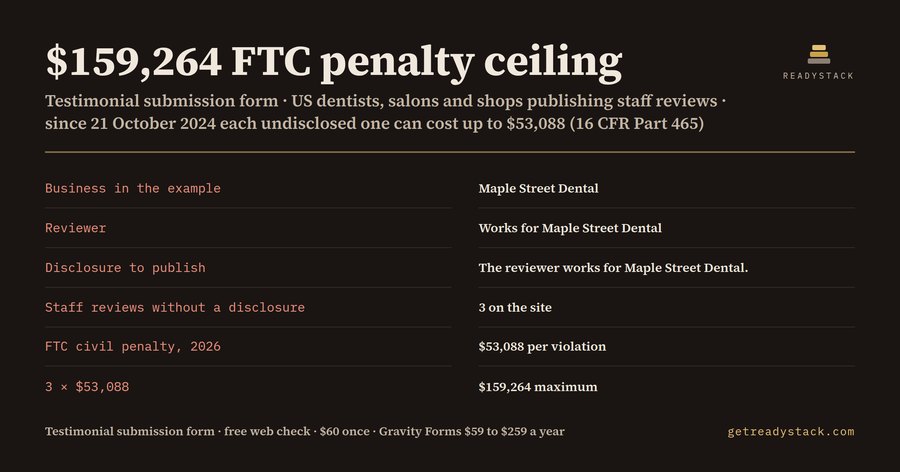
If your business publishes customer reviews or testimonials on its own website, the FTC rule on consumer reviews and testimonials, 16 CFR Part 465, has applied to you since 21 October 2024. Two tests in it matter for almost every small business.
The first is about who wrote the review. Under section 465.5, a review or testimonial written by an owner, manager, employee or agent of the business, or by one of their relatives, needs a clear and conspicuous disclosure of that connection. A glowing review from the receptionist's sister is not banned; publishing it without saying who she is, is the problem.
The second is about rewards. Under section 465.4, you may not give a discount, a gift card or anything else only to people who leave a positive review or a high rating. A thank-you that is the same whatever the customer writes is allowed, but under the FTC Endorsement Guides, 16 CFR Part 255, it is still a material connection and belongs next to the review.
What does a mistake cost? The FTC can seek civil penalties for knowing violations of a trade regulation rule. The amount is $53,088 per violation, the 2025 level, which the FTC kept for 2026 without an inflation adjustment. Each review is its own violation. Take Maple Street Dental with three staff reviews on its homepage and no disclosure: 3 × $53,088 = $159,264 as the ceiling.
The hard part is not the disclosure line. It is knowing which reviews need one. A generic contact form collects a name, an email and a message. It never asks whether the writer works for you, is related to someone who does, or got a coupon for writing. So a staff review arrives looking exactly like a customer review, and nobody remembers two years later.
The testimonial submission form plugin adds one form with one shortcode, [testimonial-submission-form-ftc]. It has 9 fields: name, email (never published), city and state, a rating from 5 choices, the review in the customer's own words, the date they used your product or service, their connection to your business (4 choices), what they received for writing (5 choices, from Nothing to Money or a commission) and permission to publish (3 choices). Seven fields are required, so no review arrives without the connection and reward answers. Above the form, two lines you set once tell reviewers your review promise and ask anyone who works for you, or is related to someone who does, to say so. Every review is listed in WordPress admin with all 9 answers, 50 per page.
The free plugin is complete for collecting reviews. The free web check on our page does the next step: enter your business name, the reviewer's connection and the reward, and it writes the disclosure line to publish, such as 'The reviewer works for Maple Street Dental.' If the reward depended on a good rating, it tells you not to use the review at all, because a disclosure does not fix a section 465.4 problem.
The paid version, $60 once, emails each review to you when it arrives, sends the reviewer a copy of what they wrote, exports every review with its answers and arrival time as CSV, filters reviews by reviewer name and lets you run a separate tagged form per location or service. Gravity Forms, a general form builder, costs $59 to $259 a year and ships no disclosure questions.
Try the free check with your own business name first.
15 seconds — what it actually does
Questions people ask
What does this testimonial submission form do?
It adds a review and testimonial form to your WordPress site with one shortcode. Nine fields ask for the name, email, city, rating, the review itself, the date of the purchase, whether the reviewer works for you or is related to someone who does, whether they got anything for the review, and how you may publish it. Every review is listed in admin, 50 per page.
Which businesses is it for?
US businesses that publish customer reviews or testimonials on their own website: dentists, clinics, contractors, salons, agencies, coaches, restaurants and online shops, plus the web agencies who build their sites. The FTC rule 16 CFR Part 465 makes reviews by staff or their relatives need a clear disclosure and bans rewards that depend on a positive review.
Why not use a free contact form?
A contact form does not ask whether the reviewer works for you, is related to your staff or got a discount for writing, so you cannot tell which testimonials need a disclosure. We found no free WordPress plugin that asks these questions. The paid version emails each review to you on arrival and exports a dated record of every answer.
What do I get for free?
The free plugin works on its own: the nine-field form, your review promise and the connection question shown above it, spam protection, a label on every field and every review listed in admin. The free web check writes the disclosure line for any review and shows your maximum FTC penalty at $53,088 per undisclosed review.
How does the price compare?
It is $60 once, not a subscription. Gravity Forms, a general form builder, costs $59 to $259 every year and ships no disclosure questions, so you would still design them yourself. The FTC can seek up to $53,088 per violation of the reviews rule, so three undisclosed staff reviews carry a ceiling of $159,264.
Ask about this tool
One question, answered by the person who built it. Your email only if you want the answer sent.