· ReadyStack
Worked example
Real numbers from this tool, line by line.
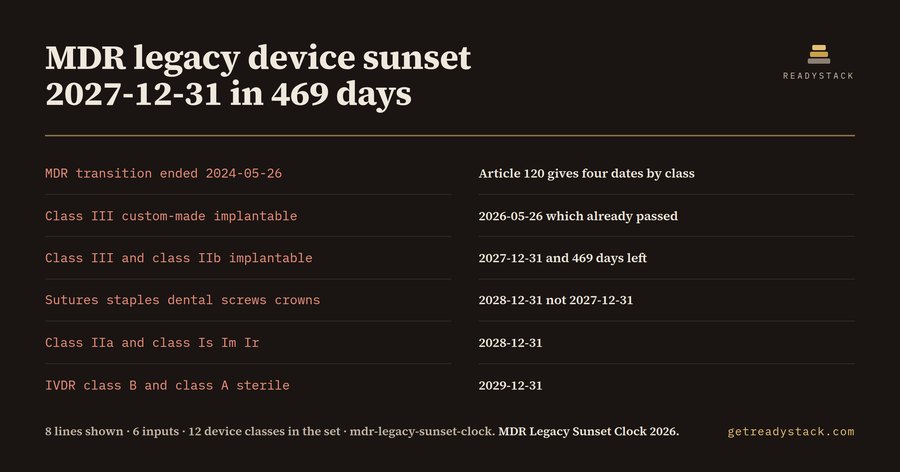
A class IIb implantable device still selling on its old MDD certificate has 469 days left on 2026-09-18, and the day its dossier had to reach the notified body was 2026-06-30, which is already 154 days gone. That is this extension's run from six inputs: device class, Article 120 conditions, today, a dossier date of 2026-12-01, an 18-month notified body review and EUR 2400000 of EU revenue on that device.
If you are the regulatory affairs or quality manager who has to say which quarter each legacy product stops being sellable in the EU, that first paragraph is the whole job. The hard part is not the arithmetic. It is that the date most sources still give you is wrong.
Ask a general chatbot when the EU medical device transition ends and it answers 2024-05-26. That was the original MDR deadline, and it is the answer sitting in most training data. Regulation (EU) 2023/607 replaced that single date with four, split by risk class, and deleted the sell-off provision, so there is no tail on the far side of the date.
The four dates the extension holds: 2026-05-26 for class III custom-made implantables, which on 2026-09-18 is 115 days past. 2027-12-31 for class III, implantable class IIb and IVDR class D. 2028-12-31 for non-implantable class IIb, class IIa, class Is, Im and Ir, class I devices needing a notified body for the first time, and IVDR class C. 2029-12-31 for IVDR class B and class A sterile.
Inside the 2027 group there is a carve-out. Implantable class IIb devices that are sutures, staples, dental fillings, braces, crowns, screws, wedges, plates, wires, pins, clips or connectors are not at 2027-12-31. They sit at 2028-12-31. That is a full extra year on one side of a list nobody memorises, so the extension carries it as its own device class in the dropdown.
The sunset date is not the deadline you work to. That is the day the dossier has to be in the notified body's hands: the sunset date minus the conformity assessment length. 2027-12-31 minus an 18-month review is 2026-06-30. A dossier planned for 2026-12-01 is 154 days late. The device then spends 153 days without a valid certificate, and at EUR 2400000 of annual EU revenue those days carry EUR 1006027 of product that cannot be placed on the market.
Change the inputs and the answer really moves. An IVDR class D assay with a 14-month review and a dossier ready 2027-01-15 has a last safe day of 2026-10-31, runs 76 days late, and loses 75 days off market, which at EUR 900000 of EU revenue is EUR 184932. A class IIa device with a 12-month review and a dossier ready 2026-10-01 has 456 days of slack and loses EUR 0, even though its revenue is the largest of the three at EUR 5000000.
Article 120 only extends anything if the quality system application was lodged by 2024-05-26, the written notified body agreement was signed by 2024-09-26, and the device has not changed significantly. If any of those is missing there is no extension, and the tool prices the gap from 2024-05-26 instead.
All of that is free, in the popup and on the free web page, with no key and nothing held back. The free layer finishes the job for one device. The paid layer sits on a different axis: it exports the whole legacy portfolio as a CSV you keep and sets a browser alarm before each device's last safe submission date, because the second time you need this it is a list, not a lookup.
Nothing you type leaves the browser; the only outward call is licence key validation. The basis for every date above is Regulation (EU) 2023/607, amending MDR Article 120 and IVDR Article 110, and the tool prints which sub-article produced your answer.
Questions people ask
What does the MDR Legacy Sunset Clock actually do?
You pick your device's old-directive class and the extension returns the Regulation (EU) 2023/607 date that binds it: 2026-05-26, 2027-12-31, 2028-12-31 or 2029-12-31. It then subtracts your notified body review length to give the last day the dossier can be handed over, and the EU revenue any overrun costs.
Who is this for?
Regulatory affairs and quality managers at EU medical device and in vitro diagnostic manufacturers who still have products on the market under MDD, AIMDD or IVDD certificates. It is built for the person who has to say, in a management review, which quarter each legacy device stops being sellable in the EU.
Why will a free chatbot not answer this?
General chatbots still reply that the MDR transition ended on 2024-05-26, because that was the original deadline. Regulation (EU) 2023/607 replaced one date with four, split by risk class, carved sutures and dental devices out of the 2027 group, and deleted the sell-off provision entirely. A wrong date here is a product off the market.
What is free and what needs the key?
Every calculation is free and unlimited: the sunset date, the days left, the last safe submission day, the slack, and the revenue at risk, for any of the twelve device classes. The 60 dollar key adds two things on a different axis: a CSV of your whole portfolio that you keep, and browser alarms before each submission date.
What does this cost if a person does it?
This is normally answered by a regulatory affairs consultant, device by device. At a EUR 150 per hour EU consulting rate, roughly half a billed day goes into confirming the Article 120 class, the carve-out and the submission gap for a single device. A legacy portfolio is quoted per device, so the bill scales with your catalogue.
Ask about this tool
One question, answered by the person who built it. Your email only if you want the answer sent.