· ReadyStack
Worked example
Real numbers from this tool, line by line.
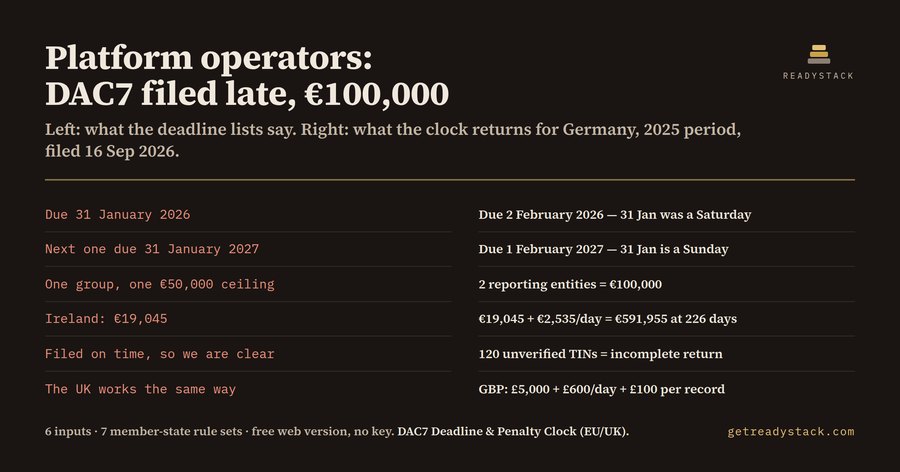
A German marketplace group filing two DAC7 reports for the 2025 period, still unfiled on 16 September 2026, is carrying EUR 100,000 of statutory exposure — and the date it missed was not the one on its calendar.
DAC7 obliges reporting platform operators to file seller data by 31 January following the reporting period. Almost every deadline list, and almost every chatbot, stops there. Three things sit behind that sentence, and each moves the number a finance lead puts in front of a board.
The date moves when 31 January is a weekend. 31 January 2026 fell on a Saturday, so the German due date for the 2025 period rolled to Monday 2 February 2026 under section 108(3) of the Fiscal Code (AO). 31 January 2027 falls on a Sunday, so the 2026-period date rolls to Monday 1 February 2027.
The penalty is national, not European. The directive only requires member states to set penalties that are effective, proportionate and dissuasive, so the ceilings scatter. Germany sets up to EUR 50,000 per report under the Plattformen-Steuertransparenzgesetz. Italy sits at EUR 31,500. Ireland charges EUR 19,045 for a late, incorrect or incomplete return plus EUR 2,535 for every further day it stays outstanding, under section 898O of the Taxes Consolidation Act 1997. The Netherlands ceiling for a platform operator reaches EUR 1,030,000. The UK runs the OECD model rules instead, in sterling: GBP 5,000, GBP 600 per day, and GBP 100 per unverified seller record.
The ceiling attaches to the report, not to the group. A group that operates two reporting platform entities files two reports and carries the ceiling twice. That is how the German example above reaches EUR 100,000 rather than EUR 50,000 — same delay, same state, twice the exposure, because a second legal entity files a second report.
Put the Irish figures through the same filing date and the shape of the problem changes. A 2025-period return that was due on 2 February 2026 is 226 days outstanding. EUR 19,045 plus EUR 2,535 multiplied by 226 days is EUR 591,955 — from one entity, one report, one missed date. A fourth trap catches teams who did file. Filing by the due date does not clear you if the seller records inside the return are incomplete. Section 898O in Ireland attaches its penalty to an incorrect or incomplete return, not only to a late one. A Dutch operator that files its 2026-period report on time, on 1 February 2027, but carries 120 seller records with unverified TIN or VAT numbers, is still looking at a EUR 1,030,000 ceiling with 138 days left on the clock to fix those records. On time is not the same as complete.
The DAC7 Deadline & Penalty Clock is a browser extension and a free web page that runs the whole calculation. Pick the reporting state, the period, the date you expect to file, your number of reporting entities, and how many seller records are still unverified. It returns the due date after the working-day roll, the reason that date moved, the days left or overdue, the ceiling multiplied by your entity count, the daily accrual to date, the total statutory exposure and what it works out to per reportable seller.
Every one of those calculations is free, in the popup and on the web page, for all seven reporting states, with no key, no cap and no watermark. The paid tier sits on a different axis: keeping the result and being reminded of the date. It exports the exposure schedule as a .csv you hand to an auditor, and sets browser reminders at 90, 30 and 7 days before each entity's due date.
The calculation costs nothing. The day you find out about it is what costs money.
15 seconds — what it actually does
Full walk-through
Questions people ask
What does the DAC7 Deadline & Penalty Clock actually do?
It turns a reporting period and a member state into the real DAC7 due date, applying the working-day roll when 31 January lands on a weekend, then prices a late or incomplete report. Germany, 2025 period, two reporting entities, still unfiled on 16 September 2026 returns EUR 100,000 (€100,000); Ireland returns EUR 591,955 after 226 days outstanding.
Who is this built for?
Finance, tax and compliance leads at EU and UK online marketplaces, gig-work platforms, short-term rental sites and app stores that must file DAC7 or UK MRDP seller reports. It is built for the person who owns the filing date for more than one reporting entity and has to explain the exposure to a board or an auditor.
Why will a free chatbot not answer this?
Because a chatbot answers 31 January for all 27 member states. It does not apply the working-day roll that moved the 2025-period deadline to 2 February 2026, it does not know DAC7 penalties are national, and it does not multiply by reporting entity. Those three misses are the whole difference between a right and a wrong number.
What is free and what needs a licence key?
Every calculation is free and unlimited: all seven reporting states, every due date, every penalty figure, in the popup and in the web version, with no key and no watermark. The 60 dollar key adds two things on a different axis — a .csv export of the exposure schedule you keep, and browser reminders at 90, 30 and 7 days before each due date.
What would this cost without the tool?
Ireland's penalty for a late, incorrect or incomplete DAC7 return is 19,045 euro plus 2,535 euro for every further day it stays outstanding under s.898O of the Taxes Consolidation Act 1997. A single day of accrual costs more than the licence. The Netherlands ceiling for a platform operator reaches 1,030,000 euro.
Ask about this tool
One question, answered by the person who built it. Your email only if you want the answer sent.