· ReadyStack
Worked example
Real numbers from this tool, line by line.
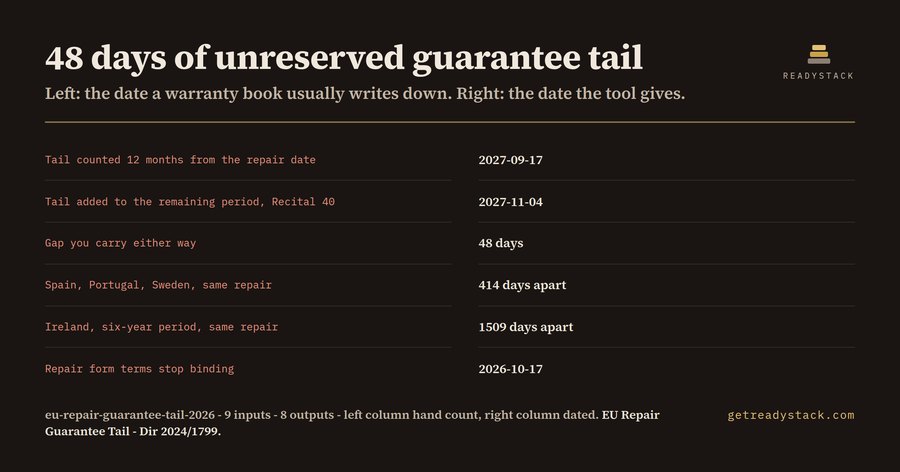
48 days. That is the distance between the two dates Directive (EU) 2024/1799 can lawfully be read to give an after-sales manager at an EU e-commerce seller, for one washing machine delivered on 4 November 2024 and repaired on 17 September 2026. In Spain, Portugal or Sweden the same repair splits the two dates by 414 days. In Ireland, where the Sale of Goods and Supply of Services Act runs six years, it splits them by 1509 days.
The directive has applied since 31 July 2026, the day Member States had to have it transposed. Its best-known sentence is short: where repair is the remedy that brings the goods into conformity, the liability period is extended once by 12 months. Everyone quotes it. Almost nobody agrees on where the 12 months start.
There are two defensible readings. Recital 40 says the extension is added to the remaining liability period of the good, which puts the tail at the end of the original period plus twelve months. A great deal of published guidance instead counts twelve months forward from the day the repair was completed. Either way the two dates are not the same date, and the one your warranty book uses is the one you will be held to.
That is the whole reason this tool exists. It does not pick a reading for you. It dates both, and it prints the gap in days, so the reserve decision is made on a number instead of on a confident paragraph.
The base period underneath the extension is not harmonised either, and this is where a generic answer goes wrong fastest. Directive (EU) 2019/771 sets a two-year floor. Spain, Portugal and Sweden run three years. Ireland runs six. The Netherlands and Finland do not use a fixed number at all; they ask what lifespan a reasonable consumer would expect, so the tool takes your own assessed figure. Article 10(6) also lets Member States allow a shorter agreed period for second-hand goods, never below one year, and one checkbox applies that floor. Switch the regime and the answer moves: with the same delivery and repair dates, an expected-lifespan assessment of eight years puts the two readings 2240 days apart.
There is a second clock in the same directive that is easier to miss. Article 4 makes the European Repair Information Form free of charge, and it holds the repairer to the terms quoted in it for 30 calendar days. A form issued on 17 September 2026 stops binding on 17 October 2026.
The last output is the one finance asks for. It multiplies your own numbers, not an industry average: the in-guarantee repairs you complete in a year, your own average repair cost, and your own repeat-failure rate for the extra year. At 1,200 repairs a year, 84 euro a repair and a 10 percent repeat rate, the extension adds 14,400 guarantee-months to the book and 10,080 euro of carried cost a year. Change any one of those three and the figure moves with it; there is no assumed constant hiding in the arithmetic.
All of that is free, uncapped, with no key, no watermark and no locked answer, in the extension popup and on the web page, which run the same compute function. The paid layer sits on a different axis entirely: keeping what you computed. Export every dated repair to .csv with both end dates and the day gap, and set a browser alarm on each tail end date, so an expiring guarantee reaches you before the consumer does.
One more date worth putting in the calendar while you are here: from 27 September 2026 every EU-facing shop has to carry the harmonised legal guarantee notice on its product pages. Different obligation, same customer, same week.
Questions people ask
What does this actually do?
It dates the 12-month guarantee extension that Directive (EU) 2024/1799 adds to a repaired good, in force since 31 July 2026. You enter the delivery date, the repair date and the guarantee regime you sell under, and it returns the base end date, both lawful readings of where the tail ends, the gap between them in days, and the 30-day window during which the European Repair Information Form binds you.
Who is it for?
After-sales and warranty managers at EU e-commerce sellers, and independent repair shops, working on the goods in Annex II of the directive: washing machines, dishwashers, refrigerators, electronic displays, vacuum cleaners, tumble dryers, servers, welding equipment, smartphones and tablets. It is the person who has to answer a consumer claim with a date, not an opinion.
Why is a free chatbot not enough here?
Because the directive does not say where the 12 months start. Recital 40 adds the extension to the remaining liability period; a large share of published guidance instead counts 12 months from repair completion. A chatbot picks one reading and states it confidently. This tool dates both, shows the gap, and leaves the reserve decision with you, where it belongs.
What is free and what needs the key?
Every calculation is free and uncapped: all four guarantee regimes, both readings, the day gap, the repair-form window and the yearly tail cost. The 60 USD key does not unlock an answer. It adds ownership and repetition: CSV export of the repairs you have dated, and a browser alarm set on each tail end date.
What would this cost without the tool?
Published European law-firm rates for company clients run 200 to 330 euro per hour excluding VAT, and a Belgian practice lists 200 euro ex VAT per hour for company clients. One billed hour to settle a single guarantee end date costs more than the key, and the date still has to be recomputed for the next repair.
Ask about this tool
One question, answered by the person who built it. Your email only if you want the answer sent.