· ReadyStack
Worked example
Real numbers from this tool, line by line.
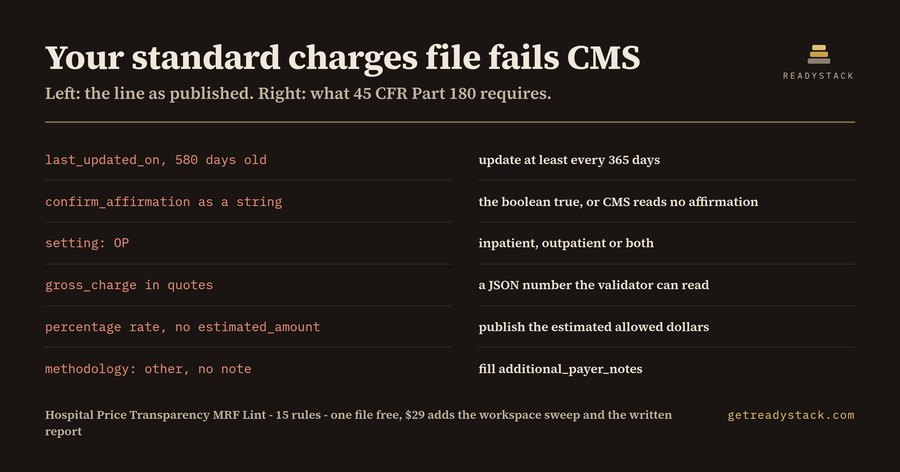
17 findings, 15 of them errors, came back on a single hospital standard charges file - the file a US revenue-cycle engineer publishes to the hospital website and then forgets until CMS writes.
The machine-readable file is the one piece of hospital compliance that is pure code. Somebody exports the chargemaster, somebody reshapes it into the CMS JSON template, somebody uploads it. Nobody reads it again - until a CMS review letter arrives naming the file.
What the clock is worth: under 45 CFR 180.90 CMS can impose a civil monetary penalty of 10 dollars per bed per day, capped at 5500 dollars a day and 2007500 dollars a year for one hospital. A 250-bed hospital sits at 2500 dollars a day while the file is non-compliant. The file that triggered it usually failed on something small.
Here is the sample file that ships with the extension, and what the 15 rules found in it.
The last_updated_on was 2025-02-14. Checked against 17 September 2026 that is 580 days old, and 45 CFR 180.50(d)(2) wants an update at least every 365 days. Staleness is the finding nobody can see by reading the file, because it does not exist inside the file - it exists between the file and today. That is also why a chat assistant cannot tell you: it does not know what day your build ran.
The affirmation block was there, but confirm_affirmation was the string "true" rather than the boolean true - human eye fine, CMS validator no affirmation. The setting was "OP". The CMS template takes inpatient, outpatient or both, spelled that way, and a chargemaster export that speaks in its own abbreviations quietly produces a file that validates as JSON and fails as a machine-readable file.
The gross_charge was "3120.00" - a number wearing quotes, which is what happens when a spreadsheet column comes through as text. A negotiated rate was published as a percentage, 42.5, with no estimated_amount beside it; the rule that requires an estimated allowed dollar amount for percentage and algorithm rates is conditional, so the field is legal to omit in most rows and fatal to omit in that one. One methodology was "other" with no additional_payer_notes. One item carried a drug_information block with a unit and no type of measurement. One item had no code_information at all.
That is what this extension is: 15 rules, offline, in the editor, on the file you already have open. Nothing is uploaded, which matters when the file is the hospital's full negotiated rate table. Each finding names the paragraph it comes from.
The reason a generic JSON validator does not cover this is that the CMS template is conditional and dated. A formatter checks that braces balance. It has no opinion about whether estimated_amount is required in this row, or whether the file is late. Only a rule that knows today's date can tell you the file is 580 days old.
Free, with no key: open one standard charges JSON file, run the check, and every one of the 15 rules reports with a line number. That is the whole check for that file - not a sample of it.
The paid axis is scale and the paper trail, not the answer: a sweep of every hospital location file in a multi-campus workspace in one pass, and one dated evidence report you export and keep, with finding counts per location and the rule text beside each finding. 29 dollars once, one licence key per person or CI seat. A hospital price-transparency review by a revenue-integrity consultancy is commonly quoted as a five-figure engagement.
Run it on the file you published last quarter. The 580-day finding surprises people.
15 seconds — what it actually does
Questions people ask
What does Hospital Price Transparency MRF Lint actually do?
It reads a hospital standard charges machine-readable file in the CMS JSON template and reports, with line numbers, every place it departs from 45 CFR Part 180 and the template data dictionary. 15 rules run offline in the editor. The dirty sample file returns 17 findings, 15 of them errors, and the clean sample returns none.
Who is it for?
US hospital revenue-cycle engineers, chargemaster analysts, and the contractors who build the standard charges export out of Epic, Cerner, Meditech or a home-grown script. If you are the person who answers when CMS emails the hospital about its posted file, this is written for you.
Why will a free JSON validator or a chatbot not do this?
A validator checks that braces balance. The CMS template carries conditional duties: estimated_amount is required only when the rate is a percentage or an algorithm, additional_payer_notes only when the methodology is other, and 45 CFR 180.50(d)(2) wants an update at least every 365 days, which only a tool that knows today's date can count. A chat assistant answers from an older template version.
What is free and what does the full version add?
Free, with no key: open one standard charges JSON file and every one of the 15 rules reports with a line number. That is the whole check for that file. The full version adds scale and the paper trail - a sweep of every hospital location file in the workspace and one dated evidence report you export and keep.
What does this cost compared with the alternatives?
A hospital price-transparency review by a revenue-integrity consultancy is commonly quoted as a five-figure engagement; this extension is 29 dollars once. Under 45 CFR 180.90 CMS can impose a civil monetary penalty of 10 dollars per bed per day, capped at 5500 dollars a day and 2007500 dollars a year for one hospital.
Why not just ask ChatGPT or another AI chat?
A general AI chat answers from training data with a cutoff date, cannot read your repository and names no rule version. Hospital Price Transparency MRF Lint checks the file you open against 15 rules, each naming its legal or official basis, from a rule set dated 2026-09-20, and points at the exact line with the fix. For a filing, an audit or a client you need that dated result on your own files.
Ask about this tool
One question, answered by the person who built it. Your email only if you want the answer sent.