· ReadyStack
Worked example
Real numbers from this tool, line by line.
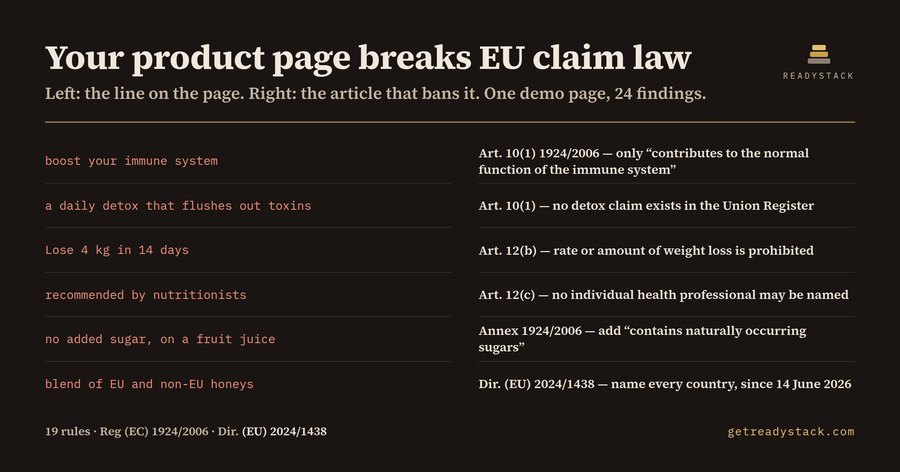
A demo product page for a Dutch food-supplement shop returned 24 findings — 13 of them outright prohibitions — when I ran it through the 19 rules of EU Health Claim Lint, a VS Code extension for people who maintain EU food and drink storefronts.
The page was not unusual. It sold a fourteen-day bundle: a cold-pressed juice, a jar of honey, a box of capsules. The copy said the bundle would boost your immune system and cleanse your body. It promised a daily detox that flushes out toxins. It said lose 4 kg in 14 days. It called the formula a superfood, recommended by nutritionists, clinically proven. That is ordinary e-commerce English, and almost every sentence of it is a finding under Regulation (EC) No 1924/2006.
Here is why it needs a linter rather than a careful read. The regulation does not work by banning a list of bad words. It works the other way round: Article 10(1) says a health claim may be made only if it appears in the Union Register of authorised claims, in the wording that was authorised. So detox is not forbidden because someone ruled against detox; it is forbidden because there is no entry for it, for any food or botanical. Boosts your immune system fails the same way, and the authorised wording sitting in its place is contributes to the normal function of the immune system — usable only where the nutrient reaches 15 % of the NRV. A phrase can be true, popular and entirely unlawful at once, and nothing in the sentence tells you which.
That is the shape of problem a generative model gets wrong. Ask a chatbot for a vitamin C product page and it writes what it has read, which is a decade of food marketing rather than the Register. It gives you immunity boosting. It does not know Article 12(b) prohibits any claim about the rate or amount of weight loss, so lose 4 kg in 14 days has to go in full, figure and timescale together, nor that Article 12(c) rules out a recommendation by an individual doctor or nutritionist.
Then the dates, which is where this got urgent. Directive (EU) 2024/1438 revised the honey, fruit juice and jam labelling rules, and they have applied in full since 14 June 2026. A honey blend can no longer be described as a blend of EU and non-EU honeys; every country of origin must be named, in descending order of weight. Extra jam needs its 45 g of fruit per 100 g stated. Stock labelled before that date may be sold until it runs out — and that grace is the trap, because a product page is not stock. Nothing on it runs out. It sits there, indexed, until somebody complains.
The rest is arithmetic the copywriter never sees. The Annex to 1924/2006 ties each nutrition claim to a figure: low fat 3 g per 100 g, fat-free 0.5 g, low sugars 5 g, sugars-free 0.5 g, high protein 20 % of energy, source of fibre 3 g, high fibre 6 g, low sodium 0.12 g. Source of a vitamin means 15 % of the NRV; high in means 30 %. The linter does not guess your recipe — it checks whether the figure appears where a reader or an inspector would look.
Supplements carry three more sentences under Article 6(3) of Directive 2002/46/EC: not a substitute for a varied diet, do not exceed the recommended daily dose, keep out of the reach of young children. The demo page had none of them.
The two fixtures are the whole measure. The clean page — a protein bar with its per-100 g table, its 37 % NRV figure and its varied-and-balanced-diet statement — returns zero findings. The dirty page returns 24, across 16 of the 19 rules. A linter that fires on a compliant page is worse than none, so that zero matters as much as the 24.
Checking the file you have open is free and finished: all 19 rules, every article, no key. The paid layer moves on a different axis — it sweeps every page in the workspace and exports a dated per-SKU dossier in Markdown and CSV that you keep and hand to a lawyer or an authority. A food-law consultant reviewing the same copy bills roughly $200 an hour.
15 seconds — what it actually does
Questions people ask
What does EU Health Claim Lint actually do?
It reads a food or supplement product page — HTML, Markdown or MDX — and flags wording that EU food law does not allow. Each finding names the line, the phrase and the article: Art. 10(1) of Regulation 1924/2006 for a claim missing from the Union Register, Art. 7(3) of Regulation 1169/2011 for a disease claim, and so on. 19 rules.
Who is it for?
Developers and agencies who build and maintain EU food, drink and supplement shops, and the e-commerce managers who write product copy for them. If you ship to a member state and your pages say boosts immunity, detox, superfood or clinically proven, this is aimed at you.
Why will a chatbot or a free grammar checker not do this?
A general model has absorbed far more food marketing than food law, so it writes boosts immunity without hesitating; the authorised wording is contributes to the normal function of the immune system and only above 15 % NRV. Grammar checkers look at sentences, not at the Union Register or the Annex thresholds.
What is free and what costs money?
Linting the page you have open is free and complete: all 19 rules, every finding, every article, no key and no cap. The $29 licence adds a different job — sweeping the whole workspace and exporting a dated per-SKU dossier in Markdown and CSV that you own and can hand to a lawyer or an authority.
What would this cost if a person did it?
A food-law consultant reviewing label and web copy bills roughly $200 an hour in the EU, and a catalogue review is measured in days, not minutes. The extension checks a page in the time it takes to save it, and the licence is $29 once.
Why not just ask ChatGPT or another AI chat?
A general AI chat answers from training data with a cutoff date, cannot read your repository and names no rule version. EU Health Claim Lint — Food & Supplement Pages checks the file you open against 19 rules, each naming its legal or official basis, from a rule set dated 2026-09-20, and points at the exact line. For a filing, an audit or a client you need that dated result on your own files.
Ask about this tool
One question, answered by the person who built it. Your email only if you want the answer sent.