· ReadyStack
Worked example
Real numbers from this tool, line by line.
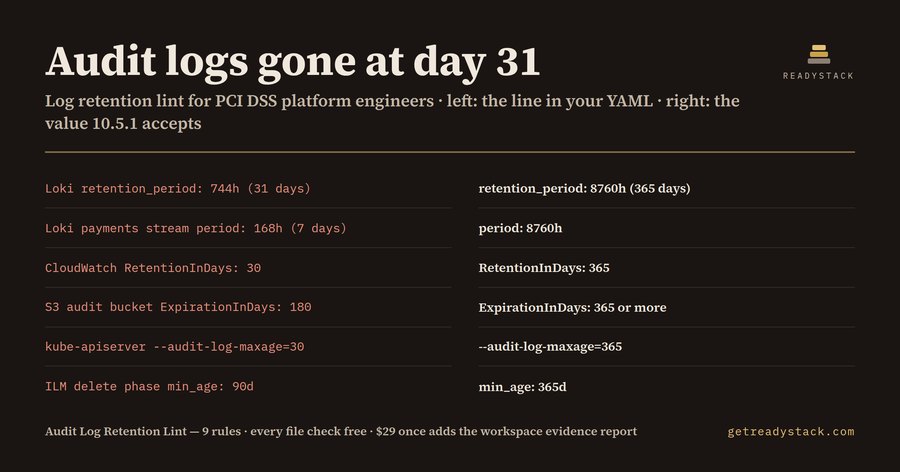
Audit logs gone at day 31: that is what a Loki retention_period of 744h means for a platform engineer whose cluster sits inside a PCI DSS scope, because Requirement 10.5.1 asks for at least 12 months of audit log history, with the most recent three months immediately available for analysis.
The number that decides this is rarely in a policy document. It is one line of YAML, often copied from an example, and it is written in a different unit in every tool. Loki counts hours (744h). Elasticsearch ILM counts days with a suffix (90d). CloudWatch RetentionInDays counts plain days. kube-apiserver takes --audit-log-maxage=30, also days. Nobody reads 744h and thinks "31 days" during a code review.
We wrote one sample file with the settings a payments team might ship: Loki, a CloudFormation log group, an S3 audit bucket, a kube-apiserver manifest and an ILM policy. Under PCI DSS the lint returns 7 findings, 6 errors and 1 warning:
- Loki retention_period: 744h is 31 days against 365.
- A Loki retention_stream override for the payments namespace, period: 168h, is 7 days.
- An AWS::Logs::LogGroup with RetentionInDays: 30.
- An S3 audit bucket with ExpirationInDays: 180.
- The same bucket moves logs to GLACIER after 30 days, before the three immediately-available months end (the warning).
- kube-apiserver --audit-log-maxage=30.
- An ILM delete phase at min_age: 90d.
The fixed file, with 8760h, 400 days and a 90-day archive transition, returns 0.
Why the rule you declare matters. The same YAML passes or fails depending on who you answer to. The lint knows three profiles. pci-dss applies PCI DSS v4.0.1 Requirement 10.5.1: 365 days total, 90 days immediately available. cert-in applies direction (iv) of the CERT-In Directions of 28 April 2022: logs of all ICT systems kept for a rolling 180 days, within Indian jurisdiction, so a log store in us-east-1 is a finding on its own. Failing to comply with a CERT-In direction can be punished under s.70B(7) of the IT Act with a fine up to ₹1,00,000 or imprisonment up to one year. m-21-31 applies OMB Memorandum M-21-31 for US federal systems: 12 months active storage plus 18 months cold storage, which the lint counts as 913 days total and 365 active. A CloudWatch group at RetentionInDays: 365 passes PCI DSS and fails M-21-31.
You declare the profile with one comment line at the top of the file, for example # log-retention: pci-dss, cert-in. When several are listed, the strictest minimum wins per check. With no line, PCI DSS applies.
Why not ask a chatbot? A chatbot can recite 10.5.1, but it does not open the YAML in your repository, and it has to convert 744h, 90d and a bare 30 correctly every time. The lint runs on every save, in the Problems panel, with the line number.
What it does not do: it reads configuration text only. A retention changed in a cloud console after deploy is not seen, and the lint does not decide whether a system is in scope.
The file check is free in VS Code and in the browser at getreadystack.com/tools/audit-log-retention-lint, with all 9 rules and no key. A licence key adds the workspace sweep, which walks every YAML file in the folder and writes one Markdown evidence table of file, line, value, minimum and clause, ready for the QSA or auditor.
15 seconds — what it actually does
Questions people ask
What does Audit Log Retention Lint do?
It reads log-retention settings in YAML files, such as Loki retention_period, CloudWatch RetentionInDays, Elasticsearch ILM delete min_age, S3 lifecycle expiration and kube-apiserver --audit-log-maxage, and flags every value shorter than PCI DSS 10.5.1 (365 days, 90 immediately available), CERT-In 2022 (180 days in India) or OMB M-21-31 (913 days). Each finding gives the line, the clause and the value that passes.
Who is Audit Log Retention Lint for?
Platform, DevOps and SRE engineers who keep logging configuration in YAML and answer to a PCI DSS assessment, the Indian CERT-In directions of April 2022, or US federal logging rules under OMB M-21-31. It suits teams preparing for a QSA visit or a CERT-In incident request who need to know which log store deletes evidence too early.
Why not just ask a chatbot or read the standard?
A chatbot does not open the YAML in your repository, and it often mixes up units: Loki writes 744h, ILM writes 90d, CloudWatch writes days. The rule is also different per regime: PCI DSS 10.5.1 wants 12 months, CERT-In wants 180 days kept within India, and M-21-31 wants 30 months. The lint converts each unit and applies the strictest declared rule.
What is free and what does the licence add?
Free: every finding in the open YAML file, in VS Code or in the browser, with clause and fix value, no key and no limit. The $29 licence, paid once, adds the workspace sweep: every YAML file in the folder checked at once and written into one Markdown evidence table of file, line, value, minimum and clause for a QSA or auditor.
What does the alternative cost?
One hour of a lawyer with 15 years' experience is $851 on the DOJ Fitzpatrick Matrix for billing year 2026. Under India's IT Act s.70B(7), failing to comply with a CERT-In direction can be punished with a fine up to ₹1,00,000 or imprisonment up to one year. The lint runs the retention check on every save at no cost.
Why not just ask ChatGPT or another AI chat?
A general AI chat answers from training data with a cutoff date, cannot read your repository and names no rule version. Audit Log Retention Lint (PCI DSS, CERT-In) checks the file you open against 9 rules from a rule set dated 2026-09-26, and points at the exact line with the fix. For a filing, an audit or a client you need that dated result on your own files.
Ask about this tool
One question, answered by the person who built it. Your email only if you want the answer sent.