SRE interview prep · troubleshooting round · NALSD · Linux and networking · study plan
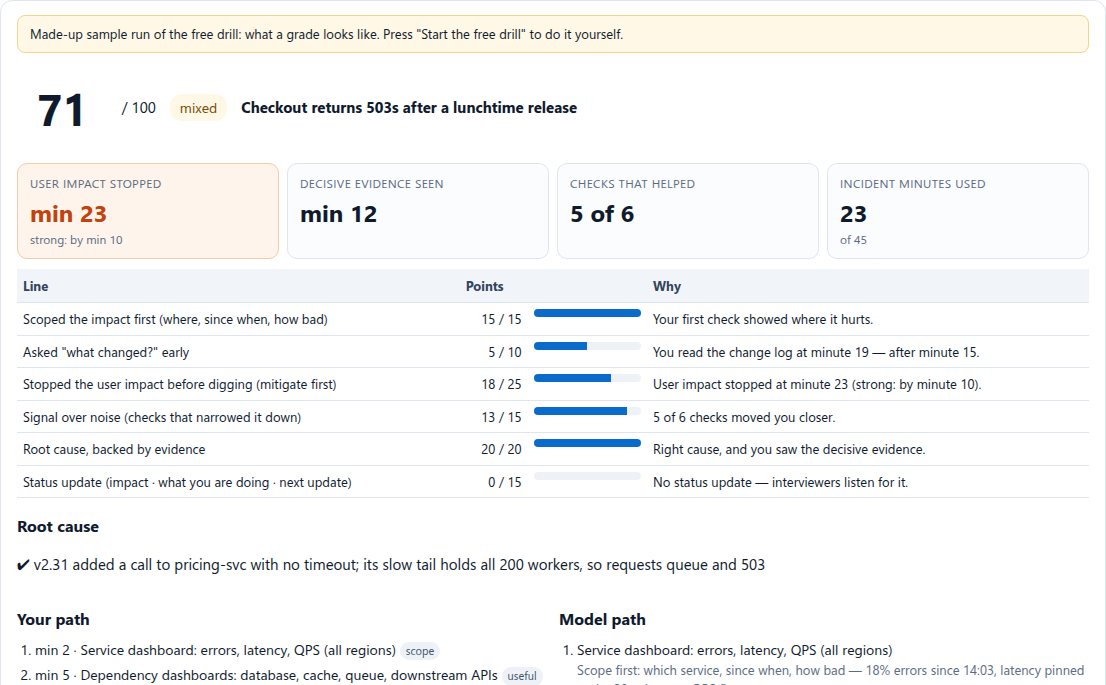
Example (made-up NALSD drill): sizing the thumbnail service for the average instead of the peak leaves 152 servers ($53,200 a month) missing. In a made-up run of the free outage drill, rolling back at minute 23 instead of the model answer's minute 9 is graded 71 of 100.
You work the outage instead of reading about it: every check costs incident minutes, and the grade shows where your 45 minutes went — scope, "what changed?", mitigate first, signal over noise, root cause with evidence, the status update.
User impact now:
1 · Investigate
2 · Mitigate
3 · Status update
4 · Root cause
Incident log
Pro: all 13 outages, all 6 NALSD drills, the Linux round and the plan on your calendar
- 12 more timed outages: Linux (deleted-but-open files, file-descriptor limits, clock drift), networking (conntrack drops, TLS chain, MTU black hole), and failure modes (cold cache, retry storm, region failover, poison message, replication lag, memory leak)
- 5 more NALSD sizing drills (URL shortener, log ingestion, chat fan-out, short video, metrics store), each graded line by line
- The 24-question Linux and networking round on a 10-minute clock
- Your study plan as a calendar file (.ics) and on paper, re-planned from your saved scores: drills under 80 come back first
- Saved attempts and readiness per round in this browser; a printable scorecard of every attempt
Free: the checkout outage drill with the full grade and model path, the thumbnail NALSD drill graded, the worksheet for your own numbers, and your study plan on screen.
How a troubleshooting drill is graded (100 points)
| Line | Points | What earns them |
|---|---|---|
| Scope first | 15 | Your first check shows where it hurts (15); within your first 3 checks (10); later (5). |
| "What changed?" | 10 | You read the deploy / config / infrastructure change log by incident minute 15 (10); later (5). |
| Mitigate first | 25 | A mitigation that stops user impact by the drill's target minute (25), falling to 5 at minute 45. Partial mitigation only: 8. Each move that makes it worse: −5. |
| Signal over noise | 15 | Share of your checks that narrowed it down (15 × useful ÷ all). |
| Root cause with evidence | 20 | Right cause after seeing the decisive evidence (20); right cause without it (10). |
| Status update | 15 | Impact, current action and next update time (5 each). |
80+ = strong · 60–79 = mixed · under 60 = not yet. These are this tool's bands for practice, not a prediction of any company's decision. Interview loops vary by company, track and level; a troubleshooting round is commonly a 45-minute simulated outage worked in a shared document.
Questions
Are these real interview questions?
No. Every outage, host and number is made up and written for this tool. They are built from failure modes SREs meet in production (bad releases, deleted-but-open files, conntrack drops, certificate chains, MTU, retries, capacity after failover) so you practise the method, not memorise answers.
How does the grading work without a person?
Each drill knows which checks show the scope, which ones narrow it, which one is the decisive evidence, and which mitigations stop, ease or worsen the impact. The grade is computed from what you did and when, on the 6 lines above, and every line says why you got those points.
Does it use AI or send my answers anywhere?
No AI. Everything runs in this browser; your attempts are saved in this browser's storage. The only request it makes is the licence key check at getreadystack.com.
Monthly or one payment?
Monthly suits a job hunt: you use it every day until the interview and cancel in your Whop account afterwards; it renews until you cancel. One payment keeps Pro with no renewal. Both open the same things.
What happens when I cancel?
The 12 Pro drills, 5 NALSD drills, the Linux round, the calendar file and the printouts lock. Your saved attempts stay in your browser, and the free drill, the free NALSD drill, the worksheet and the plan on screen stay free.
Sources for the facts used in the drills
- The Site Reliability Workbook — Alerting on SLOs (burn rate 14.4 over 1 hour = 2% of a 30-day budget; read 2026-11-03)
- Site Reliability Engineering — Addressing Cascading Failures (retries, load shedding; read 2026-11-03)
- resolv.conf(5) — ndots · proc(5) — /proc/pid/limits · systemd.exec(5) — LimitNOFILE
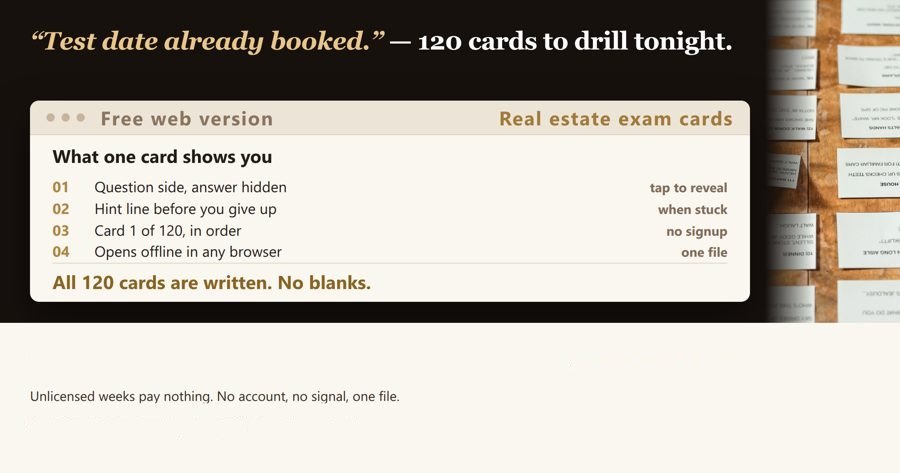 U.S. Real Estate Salesperson National Exam: 120 Flashcards for License Candidates
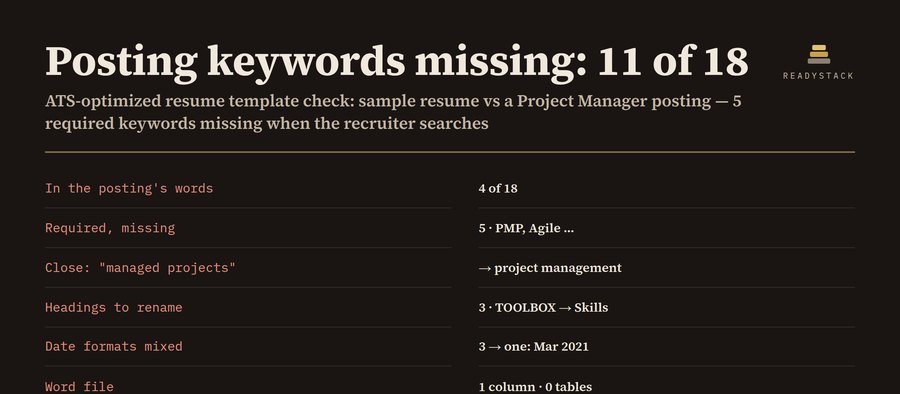 ATS-Optimized Resume Template — matched to each job posting
 CV Template UK 2026 — ATS-friendly, with cover letters
 Cover Letter Template UK