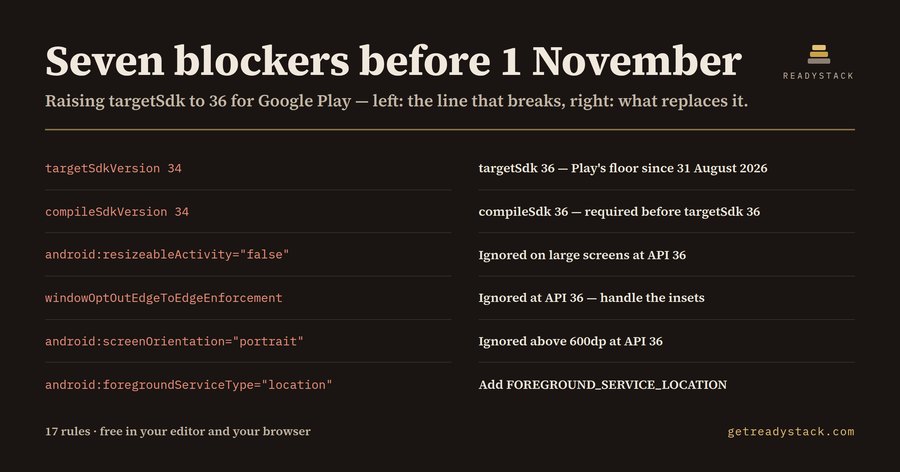
Google Play’s stated deadline for raising an app’s target SDK to 36 is 31 August 2026. This checker reads AndroidManifest.xml and app/build.gradle to identify what breaks when you raise targetSdk to 36. You can check the files in your editor or paste them into the free web page. It runs offline in your browser, and nothing is uploaded.
Reads your AndroidManifest.xml and app/build.gradle and tells you what breaks when you raise targetSdk to 36 before Google Play's 31 August 2026 deadline. Date-aware. Runs offline. Runs entirely in your browser — nothing is uploaded.
Same engine as the VS Code extension, byte for byte.
Sweep every AndroidManifest.xml and build.gradle in the workspace in one pass and write a dated targetSdk36-report.md you own and can attach to the release ticket — a different axis: scope across modules, plus a file that leaves the editor.
One payment, one licence key for this tool. The key is shown right after payment.
A contract Android developer at the common US freelance rate of $50-100/hour bills more for one afternoon of manifest review than this costs once.
Buy the full version — $29Need more than this one? ReadyStack Pass opens all 609 files and 521 full versions — $29/month or $199/year. See the Pass →
It reads an AndroidManifest.xml and an app/build.gradle and reports what breaks when targetSdk goes to 36. Seventeen rules cover the Gradle side (targetSdk, compileSdk, Android Gradle Plugin, Billing Library, NDK, jniLibs packaging) and the manifest side (edge-to-edge opt-out, orientation and resizability locks, android:exported, foreground service types, Play-declared permissions). Each finding carries the line and the fix.
React Native, Flutter and Capacitor developers, who edit the Android manifest and Gradle files in VS Code rather than Android Studio, and native Android developers maintaining a multi-module app. It is aimed at whoever has to answer why the upload was refused, or whoever is planning the API 36 bump before the Play Console extension window closes on 1 November 2026.
Target API levels move every August and models answer from training data, so a chatbot will often name API 34 or 35 as current and describe the edge-to-edge opt-out flag as a working escape hatch, which it is not at API 36. This runs the rules against your own file, offline, and counts the days from a date you set rather than from whenever the model was trained.
Checking the file that is open in your editor is free, forever, with every one of the 17 rules and no key. The same engine also runs free in your browser. The licence adds a different job: sweeping every manifest and Gradle file in the workspace in one pass and writing a dated report file you keep, which is what a multi-module React Native or Flutter repo actually needs.
A contract Android developer at the common US freelance rate of $50-100/hour bills more for one afternoon of reading manifests than the licence costs once, and that is for a single pass. The rules here are re-run on every branch. The licence is $29, paid once and one key per person or team seat.
One question, answered by the person who built it. Your email only if you want the answer sent.
Paste this code into your page. It runs in your visitor’s browser and stays up to date. Nothing your visitors type is stored.
For businesses: your name and logo instead of ours, and each visitor’s result + e-mail in your inbox (only when they tick consent) — Pro from $19/month. See Pro →