· ReadyStack
Worked example
Real numbers from this tool, line by line.
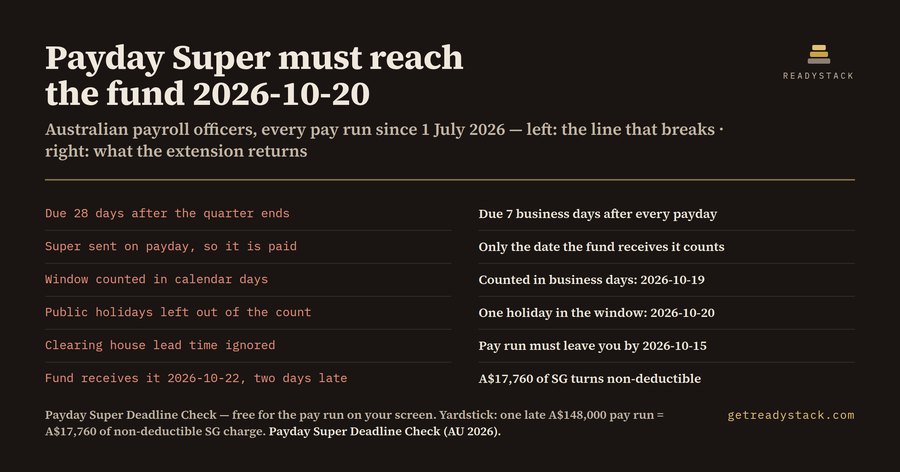
An Australian payroll officer who pays wages on 2026-10-08 has until 2026-10-20 to get the super into the fund, and until 2026-10-15 to let the pay run leave the building. Neither of those dates is the one most payroll calendars still carry.
Payday Super started on 1 July 2026. Superannuation guarantee contributions are no longer a quarterly job with a 28-day tail after the quarter closes. They now ride every single pay run, and the test is not when you send the money. It is when the fund receives it, within seven business days of the day wages are paid. Contributions are calculated at 12% of qualifying earnings, a term that lands close to the ordinary time earnings payroll already knows.
Three things quietly break in that sentence.
The first is business days. Seven business days from a Thursday payday on 2026-10-08 is not 2026-10-15. Counting forward and skipping weekends lands on Monday 2026-10-19. Put one public holiday inside the window and it moves again, to 2026-10-20. A generic date calculator counts calendar days and will hand you a date that has already passed by the time the fund posts the contribution.
The second is the clearing house. The deadline belongs to the fund, not to you. If your clearing house or gateway takes three business days to pass the money through, the real internal deadline is three business days earlier: 2026-10-15. That is the date that has to sit in the payroll calendar, and it is never the date anyone quotes.
The third is what late actually costs. A contribution the fund receives after the deadline stops being an ordinary super payment. It becomes a superannuation guarantee charge, and that charge is not tax deductible. On a pay run with A$148,000 of qualifying earnings, 12% is A$17,760. For a base rate entity paying 25% company tax, the deduction forfeited on that one run is A$4,440. Run fortnightly, and a habit of shipping super two days late across 26 pay runs puts A$115,440 of forfeited deduction on the table in a year.
Change the employer and the numbers move. A weekly employer paying A$62,500 on 2026-07-02, with a two-day clearing house, has to be received by 2026-07-13 and sent by 2026-07-09. Arriving on 2026-07-23 is ten days late: A$7,500 of SG and, at 30% company tax, A$2,250 of deduction gone on that run. Get the October run in by 2026-10-19 instead of 2026-10-22 and the forfeited deduction is zero.
The ATO published PCG 2026/1, a transitional compliance approach for the first twelve months from 1 July 2026, focused on high and medium risk employers. It is a grace in how enforcement is prioritised, not a change to the deadline, and it does not make a late contribution deductible.
This is a Chrome, Edge and Firefox extension, so the calculation sits in the toolbar next to the payroll tab already open. You type the payday, the date the fund received the money, the qualifying earnings, your SG rate, the public holidays inside the window, your clearing house lead time, your company tax rate and your pay runs per year. It returns the received-by date, the leave-by date, the days late, the SG for the run, the deduction forfeited and the figure across the pay year. Eight inputs, six answers, no key and no cap.
The full version sits on a different axis and never gates the answer. It keeps it: the dates and amounts export as .csv for the payroll file, and reminders fire 30, 14 and 1 day before a date you enter, which is the part a calculator cannot do because it forgets the moment you close the tab.
15 seconds — what it actually does
Full walk-through
Questions people ask
What does this extension actually do?
It takes a payday and counts seven business days forward, skipping weekends and the public holidays you enter, to give the date your super must have been received by the fund under Australia's Payday Super rules that started 1 July 2026. It then walks your clearing house lead time back from that date.
Who is it for?
Australian payroll officers, bookkeepers and BAS agents who run weekly or fortnightly pay for small and mid-sized employers. It suits anyone who moved off quarterly super in July 2026 and now has to hit a received-by date on every single pay run instead of four times a year.
Why not just ask a chatbot or use a date calculator?
A generic date calculator counts calendar days and does not know your state's public holidays or your clearing house lead time. A chatbot will often quote the old quarterly 28-day deadline, and it cannot tell you the day the pay run has to leave you rather than the day the fund needs it.
What is free and what needs the key?
Every calculation is free and unlimited: the received-by date, the submit-by date, the SG amount, the forfeited deduction and the yearly figure. The full version adds a different axis, keeping the result: .csv export for your payroll file and browser reminders before a date you enter.
What does getting this wrong cost?
A contribution received late stops being an ordinary super payment and becomes a superannuation guarantee charge, and that charge is not tax deductible. On a A$148,000 pay run the twelve per cent is A$17,760 of super you can no longer deduct, plus the charge and interest the ATO assesses on top.
Ask about this tool
One question, answered by the person who built it. Your email only if you want the answer sent.