· ReadyStack
Worked example
Real numbers from this tool, line by line.
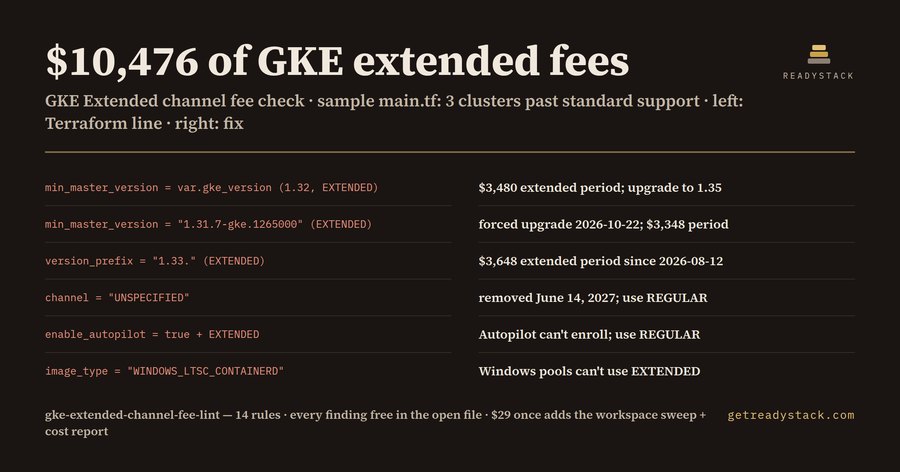
$10,476 of GKE extended fees: that is what three Extended channel clusters in one sample main.tf cost over their extended support periods, for the platform engineers, SREs and FinOps leads in the US and Europe who run Google Kubernetes Engine with Terraform.
What the Extended channel costs, and when
The Extended release channel lets a GKE cluster stay on one Kubernetes minor version for up to 24 months: 14 months of standard support, then about 10 more months of extended support. The first part is free. The second is not. From the day a minor leaves standard support, Google charges the GKE extended period cluster management fee, $0.50 per cluster per hour, on top of the $0.10 cluster management fee. That is $0.60 per cluster per hour.
The dates come from the GKE release schedule. 1.31 left standard support on 2026-01-16 and its extended support ends on 2026-10-22. 1.32 left on 2026-04-27, 1.33 on 2026-08-12, and 1.34 leaves on 2027-01-25. Around 2 months before the end of extended support GKE begins upgrading clusters to the next minor, and on the last day it upgrades every cluster still on that minor, regardless of blocking issues.
The sample file
The sample is a 117-line Terraform file with eight google_container_cluster blocks and two node pools. Checked with today set to 2026-09-28, it gives 15 findings: 10 errors, 3 warnings and 2 info.
- payments pins var.gke_version, whose default is 1.32.4-gke.1106006, on EXTENDED. Full extended period: 290 days, $3,480.
- search pins 1.31.7-gke.1265000 on EXTENDED. Full extended period: 279 days, $3,348, and GKE force-upgrades it on 2026-10-22.
- ledger reads its version from a google_container_engine_versions data source with version_prefix = "1.33.". Full extended period: 304 days, $3,648. Its maintenance exclusion ends on 2027-09-01, after the 2027-06-12 end of extended support, which GKE does not allow.
Those three add up to $10,476. None of it shows in terraform plan, because the fee is not a resource.
The rest are the quiet ones. analytics pins 1.30, which is past the end of extended support (2026-07-30), so the pin no longer describes the live cluster. batch uses channel = "UNSPECIFIED", the No channel option GKE will remove on June 14, 2027. edge sets enable_autopilot = true on EXTENDED, and Autopilot can't enroll in that channel. ml is on 1.34, so its fee starts on 2027-01-25. tools turns on enable_kubernetes_alpha and Config Connector, both on the list of things the Extended channel does not allow, and a Windows node pool points at the payments cluster.
How the check works
For each cluster block the engine resolves min_master_version (a string, a var. default or a version_prefix) and compares the minor with the schedule and today's date. The fee is days × 24 hours × $0.50, per cluster.
There are 14 rules: the active extended fee, a fee starting within 120 days, forced upgrades within 90 days, versions past extended support, pins past standard support on other channels, No channel, Autopilot, alpha, beta APIs, Config Connector, Windows pools, exclusions past extended support, node pools past standard support, and Extended clusters with no resolvable version.
A chatbot does not know which minor your file pins. The schedule page has the dates but cannot read your var. defaults. The linter joins the two.
Try it
Open a .tf file in VS Code with the extension installed, or paste it into the free web version. Every finding in the open file is free, offline.
15 seconds — what it actually does
Questions people ask
What does GKE Extended Channel Fee Lint check in my Terraform?
It reads google_container_cluster and google_container_node_pool blocks in .tf files, resolves the pinned GKE minor version, including var. defaults and google_container_engine_versions version_prefix, and checks it against the GKE release schedule with 14 rules. It flags clusters billed $0.50 per cluster per hour after end of standard support, forced-upgrade dates, the deprecated No channel option and features the Extended channel does not allow.
Who is GKE Extended Channel Fee Lint for?
It is for platform engineers, SREs and FinOps leads who run Google Kubernetes Engine with Terraform and keep clusters on the Extended release channel to delay minor upgrades. It helps teams who review infrastructure pull requests and need to see, before apply, which cluster starts paying the extended period fee and when GKE will upgrade it anyway.
Why not ask a chatbot or read the GKE docs instead?
A chatbot does not know which GKE minor your Terraform pins, and the dates move: 1.31 left standard support on 2026-01-16 and is force-upgraded on 2026-10-22. The release schedule page lists dates but does not read var. defaults or version_prefix in your files. The linter joins your pinned version to the schedule line by line.
What is free and what does the full version add?
Free: every finding in the open Terraform file, with the GKE minor, the fee start date, the forced-upgrade date and the per-cluster fee, offline in VS Code and on the web page. The full version, $29 once with one licence key per person or team seat, scans every .tf file in the workspace and exports one GKE cluster cost report for the upgrade ticket.
How much does staying on GKE extended support cost?
Google bills the extended period cluster management fee at $0.50 per cluster per hour on top of the $0.10 cluster management fee, $0.60 in total. In the sample main.tf, three Extended channel clusters on 1.31, 1.32 and 1.33 cost $10,476 over their full extended periods: $3,348, $3,480 and $3,648 per cluster.
Why not just ask ChatGPT or another AI chat?
A general AI chat answers from training data with a cutoff date, cannot read your repository and names no rule version. GKE Extended Channel Fee Lint — Terraform checks the file you open against 14 rules from a rule set dated 2026-09-28, and points at the exact line with the fix. For a filing, an audit or a client you need that dated result on your own files.
Ask about this tool
One question, answered by the person who built it. Your email only if you want the answer sent.