· ReadyStack
Worked example
Real numbers from this tool, line by line.
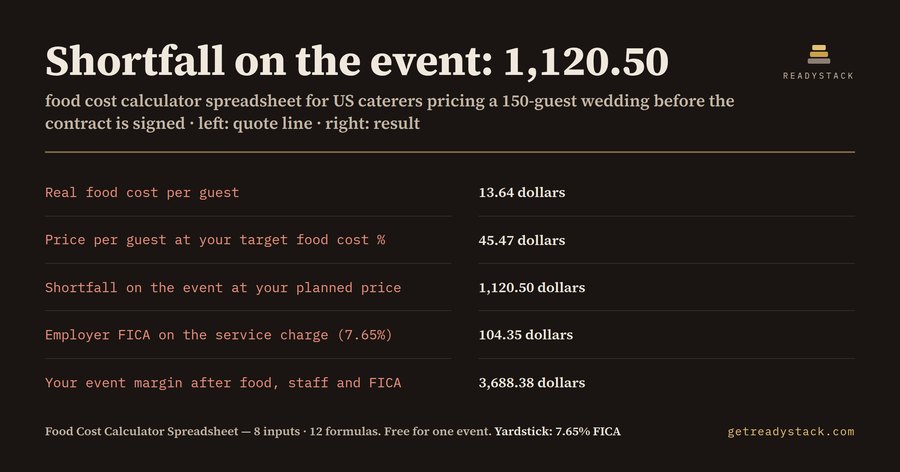
Shortfall on the event at your planned price: 1,120.50 dollars. That is what a US caterer finds when a 150-guest wedding is quoted at 38 dollars a guest while the food really costs 13.64 dollars a guest after overage and the target food cost is 30%.
| Line | Value |
|---|---|
| Food cost for the event (with overage) | 2,046.00 dollars |
| Real food cost per guest | 13.64 dollars |
| Food cost % at your planned price | 35.89% |
| Price per guest at your target food cost % | 45.47 dollars |
| Shortfall on the event at your planned price | 1,120.50 dollars |
| Employer FICA on the service charge paid to staff (7.65%) | 104.35 dollars |
| Your event margin after food, staff and FICA | 3,688.38 dollars |
Where the 13.64 comes from
Your recipe says 12.40 dollars a guest. A catered event does not serve exactly the recipe. The 10% overage you prepare is bought whether it is eaten or not. With 10% overage the event buys 150 x 12.40 x 1.10 = 2,046.00 dollars of food, which is 13.64 dollars for every guest who is actually billed.
At 38 dollars a guest the food cost is 13.64 / 38 = 35.89%, almost six points over a 30% target. The price that hits the target is 13.64 / 0.30 = 45.47 dollars. The gap, 7.47 dollars a guest, times 150 guests is the 1,120.50.
The service charge line most quotes get wrong
Many caterers add an automatic service charge to the contract, pass it to the event staff and treat it like a tip. The IRS does not.
The IRS page on tip recordkeeping says: "A payment is a tip only if the customer voluntarily decides to pay it and determines the amount." It also says: "Service charges distributed to employees must be treated as wages." Rev. Rul. 2012-18 sets out the same test, and an automatic charge in the contract fails it.
So when you pay the service charge out to your staff, it runs through payroll as wages, and you owe the employer half of FICA on it: 6.2% Social Security plus 1.45% Medicare, 7.65% in total. On the example event the service charge is 20% of 6,820.50 = 1,364.10 dollars, and the employer FICA on it is 104.35 dollars. It belongs in the quote.
There is a second effect for your staff. The no-tax-on-tips deduction covers qualified tips only. In IR-2025-92 the IRS used the example of an automatic 18% service charge with no option for the customer to change it, and said it is not a qualified tip.
If your business keeps the service charge as revenue instead of paying it out, it is not wages, and the FICA line does not apply.
Three events, three answers
A 150-guest wedding at 38 dollars a guest with a 20% charge: shortfall 1,120.50 dollars, FICA on the service charge 104.35 dollars.
An 80-guest corporate lunch at 44 dollars with an 18% charge: food cost % 31%, shortfall 117.60 dollars, FICA on the service charge 50.09 dollars.
The same wedding priced at 46 dollars with no automatic charge: the shortfall is 0 and the event margin is 3,792.73 dollars.
What the workbook adds
The paid workbook is the same calculator as a live-formula .xlsx you keep, one copy per event, plus a Quote check sheet: margin at your planned price (2,585.02 dollars in the example), margin lost by quoting it (1,103.36 dollars), break-even guests at the target price (30.8), food cost % if the final count drops 10% after you bought the food (33.33%), and the 50% deposit line for the contract (4,092.30 dollars).
Sources: IRS Tip Recordkeeping and Reporting, Rev. Rul. 2012-18, IR-2025-92 (read 2026-10-30).
15 seconds — what it actually does
Questions people ask
What does this food cost calculator spreadsheet do?
It prices one catered event per guest. You type the guest count, food cost per guest, overage, target food cost %, the price you planned, staff hours, wage and the service charge. It returns the price per guest at your target, the shortfall on the event, the service charge, the employer FICA on it and your event margin.
Who is it for?
US caterers and restaurant owners who quote weddings, corporate lunches and private parties per guest and put an automatic service charge in the contract. It fits anyone who has to name a per-guest price before buying the food and wants the food cost % and the payroll tax worked out first.
Why not use a free catering calculator?
Free calculators treat the gratuity as extra client money. The IRS says service charges you distribute to employees are wages, not tips, so you owe 7.65% employer FICA on them, and an automatic charge is not a qualified tip for the no-tax-on-tips deduction. This sheet puts that cost in the quote.
What is free?
One event, priced completely on the page: real food cost per guest after overage, food cost % at your planned price, the price at your target, the shortfall, the service charge, its employer FICA, staff wages with FICA, client total and margin. The paid workbook adds the quote check sheet and a copy you keep per event.
How does the price compare?
Catering pricing calculators on Etsy list at about $2 to $39 and add the gratuity as a plain line. This workbook is a one-time $21 and also prices the 7.65% employer FICA on a service charge paid to staff, the break-even guest count and the margin at the price you were going to quote.
Ask about this tool
One question, answered by the person who built it. Your email only if you want the answer sent.