· ReadyStack
Worked example
Real numbers from this tool, line by line.
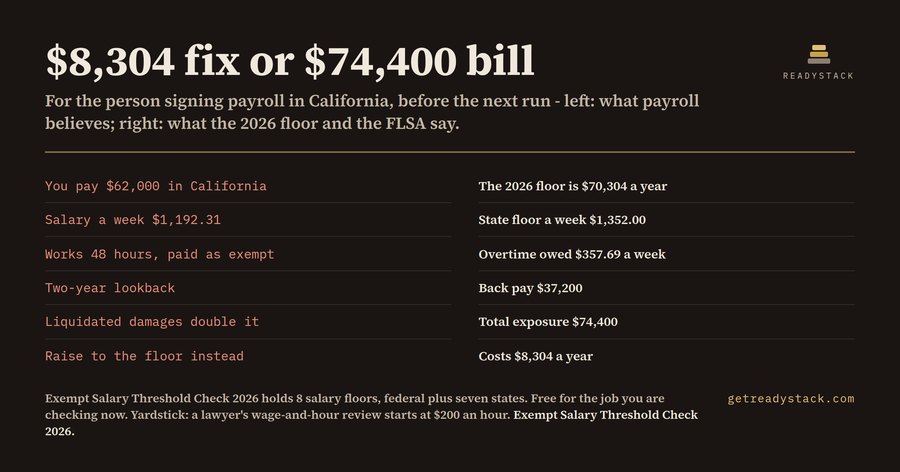
A California assistant manager paid $62,000 a year and working 48 hours a week is $8,304 short of legal, and $74,400 deep in back-pay exposure the day someone files a claim. That is arithmetic anyone can redo in thirty seconds, and most payroll offices have never run it.
Here is why it keeps being missed. In 2024 the Department of Labor raised the white-collar exempt salary floor toward $1,128 a week. A federal court vacated that rule in November 2024, and a technical amendment in May 2026 put the old 2019 number, $684 a week, back into the regulations. Ask a chatbot today and you will often get $1,128, or a confident paragraph about a rule that no longer exists. Worse, the federal number is rarely the one that binds you: seven jurisdictions sit above it in 2026.
The floors that actually apply this year, per week: federal $684; Maine $871.16; Colorado $1,111.23; Alaska $1,120.00 from July 1, 2026; New York outside the city ring $1,199.10; New York City, Nassau, Suffolk and Westchester $1,275.00; California $1,352.00; Washington $1,541.70. Miss the right one and every salaried supervisor under it has been non-exempt the whole time.
The bill is not the shortfall. Under the Fair Labor Standards Act a non-exempt employee earns time and a half for every hour past 40. Take the $62,000 California manager: $1,192.31 a week, a regular rate of $29.81 an hour, eight overtime hours never paid. That is $357.69 a week. The FLSA lookback is two years, three if the violation was willful, so two years is $37,200. Then 29 U.S.C. 216(b) adds liquidated damages equal to the unpaid overtime, which doubles it to $74,400. For one person. Wage and Hour can can also assess up to $2,515 per willful violation under 29 CFR 578.3.
Lifting the same salary to the California floor of $70,304 a year costs $8,304. The decision is $8,304 against $74,400, and it has to be made before the next payroll run, not after the claim.
Move the job to Washington and the answer moves with it: the floor is $1,541.70 a week, the shortfall becomes $18,168.40 a year, and a willful three-year lookback takes the exposure to $111,600. Same salary, same hours, a different state, an answer that is worse by $37,200.
Salary is only half the test. A job can clear every floor in the country and still be non-exempt because the duties are not executive, administrative or professional. A shift lead who spends the day on the line with a title that says manager is the classic case. Clear the duties checkbox in the tool and the answer flips to non-exempt no matter how high the pay sits, because a raise cannot fix a duties problem.
Exempt Salary Threshold Check 2026 is a Chrome, Edge and Firefox extension; the same brain runs as a free web page. You pick the state, type the salary and the hours, and it prints the floor as a week and as a year, what you pay, the shortfall, the overtime owed per week, the back pay over a two or three year lookback, the doubled exposure and the cost of the raise instead. All of it is free, with no key, no limit and no watermark, because a half answer is worth nothing to the person signing payroll.
The $60 key sits on a different axis: it exports each worked result to .csv so a whole roster ends up in one file you own, and it sets browser reminders 30, 14 and 1 days before the date you set to re-check, because the state floors step up again on January 1, 2027. One key per person or team seat.
An employment lawyer's wage-and-hour review starts at $200 an hour. Run the eight floors yourself first. This is a calculator, not legal advice.
Questions people ask
What does this extension actually do?
You type a salary, a state and the hours the job really works. Example: $62,000 in California at 48 hours a week sits under the $1,352 weekly floor, so the job owes $357.69 of overtime a week, $37,200 over two years, $74,400 once liquidated damages double it, against $8,304 to lift the salary to the $70,304 floor instead.
Who is it for?
US small-business owners, office managers and payroll staff who keep a handful of salaried supervisors, shift leads and assistant managers between $45,000 and $75,000. It is built for the person who signs payroll in California, New York, Washington, Colorado, Alaska or Maine, where the state floor is higher than the federal one.
Why not just ask a chatbot or read a blog post?
Most free answers still quote $1,128 a week from the 2024 Department of Labor rule that a federal court vacated in November 2024. The number that binds is $684 a week federally, or the higher state floor: $1,352 in California, $1,541.70 in Washington. A wrong floor turns a compliant payroll into back pay.
What is free and what costs money?
Every calculation is free, with no key, no limit and no watermark: all 8 salary floors, the exempt answer, overtime owed, back pay, doubled exposure and the cost of the raise. The $60 key adds two things on a different axis: .csv export of each result for your roster file, and browser reminders before your re-check date.
What would this cost if a person did it?
An employment lawyer's wage-and-hour review starts at $200 an hour, and a single misclassified $62,000 manager in California owes $37,200 in back overtime over two years before liquidated damages double it. The Department of Labor can also assess up to $2,515 per willful violation under 29 CFR 578.3.
Ask about this tool
One question, answered by the person who built it. Your email only if you want the answer sent.